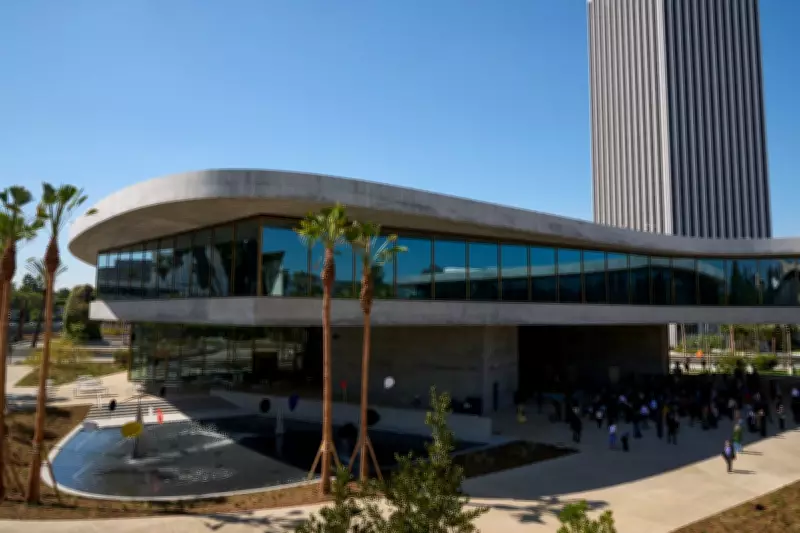
LACMA's Monumental $724 Million Transformation Opens to the Public
The Los Angeles County Museum of Art has completed a two-decade renovation journey with the grand opening of its new central building, the David Geffen Galleries, on May 4, 2026. This 347,600 square-foot structure, hovering over Wilshire Boulevard like a freeway on-ramp, represents a $724 million reinvention for the institution known globally as LACMA.
A 'Machine of Discovery' Designed for Serendipitous Encounters
LACMA's CEO and director Michael Govan, who has overseen the project from its inception, describes the new building as "a machine of discovery." The design intentionally eliminates traditional museum features like a main entrance or central atrium, instead encouraging visitors to wander freely through a single second-story floor with broad-windowed city views.
"I am a student for decades of museumgoer psychology," Govan explained in an interview. "A lot of times, that thing you don't know is what you will love if you see it. This chance of experiencing something accidentally and falling in love is part of the idea."

Aquatic-Themed Galleries and Architectural Innovation
The David Geffen Galleries feature free-flowing sections named for the Pacific, Atlantic, Indian, and Mediterranean Seas, meant to run together physically and culturally like bodies of water. Swiss architect Peter Zumthor's design strategically uses curtains—a signature element of his architecture—to control natural light for both optimal viewing and artwork preservation.
"Nothing is more beautiful to me than this play of shadow," Zumthor remarked about the interplay between time of day, curtain placement, and artwork arrangement in the space.
Art Displayed by Vibe Rather Than Formal Categories
The new galleries break from traditional museum organization, grouping sculptures, photographs, ancient pottery, and textiles as much for "vibes" as for any formal historical or stylistic categories. Modern works mix freely with centuries-old pieces, creating unexpected dialogues between different artistic periods and mediums.
Funding Challenges and Historical Context
Construction began in 2019, with Los Angeles County contributing $125 million and private donors—including 83-year-old entertainment mogul David Geffen—providing the remaining funds. The project faced delays due to the constant discovery of valuable fossils at the site, which sits next to the La Brea Tar Pits in the Miracle Mile section.
LACMA has occupied its Wilshire Boulevard location since 1961, roughly halfway between downtown Los Angeles and the Pacific Ocean. The new David Geffen Galleries represent the third phase of renovations, following earlier additions like the 1988 Pavilion for Japanese Art, the 2008 Broad Contemporary Art Museum, and the 2010 Resnick Exhibition Pavilion.
Enhancing LACMA's Cultural Footprint
The transformation comes as LACMA has strengthened its relevance through popular permanent installations like Chris Burden's Urban Light (a forest of street lamps) and Michael Heizer's Levitated Mass (a giant suspended boulder), both among Los Angeles' most Instagrammed landmarks. The adjacent Academy Museum of Motion Pictures, while a separate entity, creates a contiguous cultural district representing both the popular and fine arts that define the region.
For visitors who endured years of construction and limited access during renovations, the May 4 opening marks the culmination of a long-awaited transformation that promises to redefine how Los Angeles experiences art.