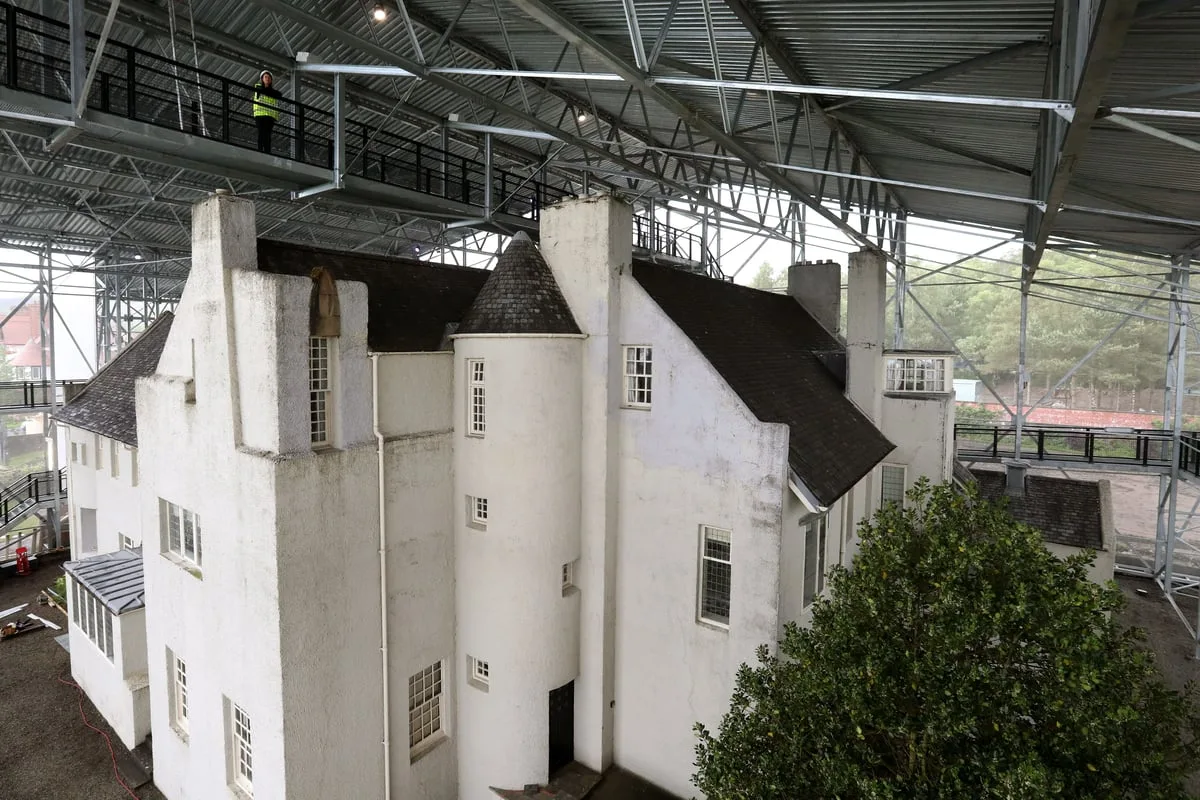
Hill House Restoration Reaches Critical Phase as Damaging Cement Render Removed
Hill House Restoration at Critical Phase as Cement Render Removed

Hill House Restoration Project Enters Critical Phase as Damaging Cement Render is Removed

The ambitious conservation project to dry out Charles Rennie Mackintosh's architectural masterpiece, the Hill House, has reached what experts describe as a critical juncture. This milestone involves the careful removal of the Portland cement render that has contributed significantly to the building's water damage problems over many decades.

A Protective Solution and Historical Challenges

Since 2019, the property in Helensburgh, Argyll and Bute has been encased within a giant steel box structure, designed to protect its saturated walls from further weather damage while allowing gradual drying as part of a long-term conservation programme. The Hill House, constructed in 1904, has suffered extensively from the relentless driving rain characteristic of Scotland's west coast since its completion.

The problematic Portland cement render was originally applied between 1902 and 1904 under Mackintosh's own instruction, when it was considered a revolutionary product that would provide superior protection against the elements. Unfortunately, this material failed to live up to expectations, and over subsequent decades, water penetration caused substantial damage to both the building's structure and its unique interior decoration.

Expert Analysis and Restoration Strategy

Phil Long, chief executive of the National Trust for Scotland, which manages the property, emphasized the project's significance: "It's difficult to overstate the international importance of Mackintosh and Macdonald and of the Hill House. Delivering this project is of vital importance in preserving Scotland's and the world's design heritage."

Long explained that after years of protection within the steel enclosure, the walls have sufficiently dried to allow the painstaking removal of the cement render. "The protective box has controlled the drying out of the building, which if done too fast may have caused further damage," he noted. "After expert analysis, it was clear that full replacement of the often-patched Portland cement render was the only tenable option for enabling the restoration work that ensures the building's long-term survival."

Architectural Significance and Future Plans

The Hill House was originally commissioned by Glasgow book publisher Walter Blackie, with its interior design representing a collaborative effort between Mackintosh and his wife, the artist and designer Margaret Macdonald. Mackintosh's designs profoundly influenced early 20th-century international architecture and design, with the Hill House standing as one of his greatest remaining masterpieces.

In the coming months, the National Trust for Scotland will collaborate with internationally-recognized specialists to develop a replacement surface render that maintains the integrity of Mackintosh's original vision while possessing the ability to "breathe" properly. This new render will prevent moisture from becoming trapped, ensuring the building can withstand future west coast weather without requiring protective enclosure.

Liz Davidson, NTS project director for the Mackintosh Illuminated initiative, revealed the project timeline: "By 2028, on the 160th anniversary of Mackintosh's birth, the Hill House should no longer need its protective box. Ahead of that, with the National Lottery Heritage Fund's support, we will be completing internal conservation work and developing new and accessible interpretative and learning materials, as well as a programme of community engagement."

The conservation and restoration work forms part of the National Trust for Scotland's broader Mackintosh Illuminated project, which has received £1.1 million in development support from the National Lottery Heritage Fund, funded by National Lottery players.