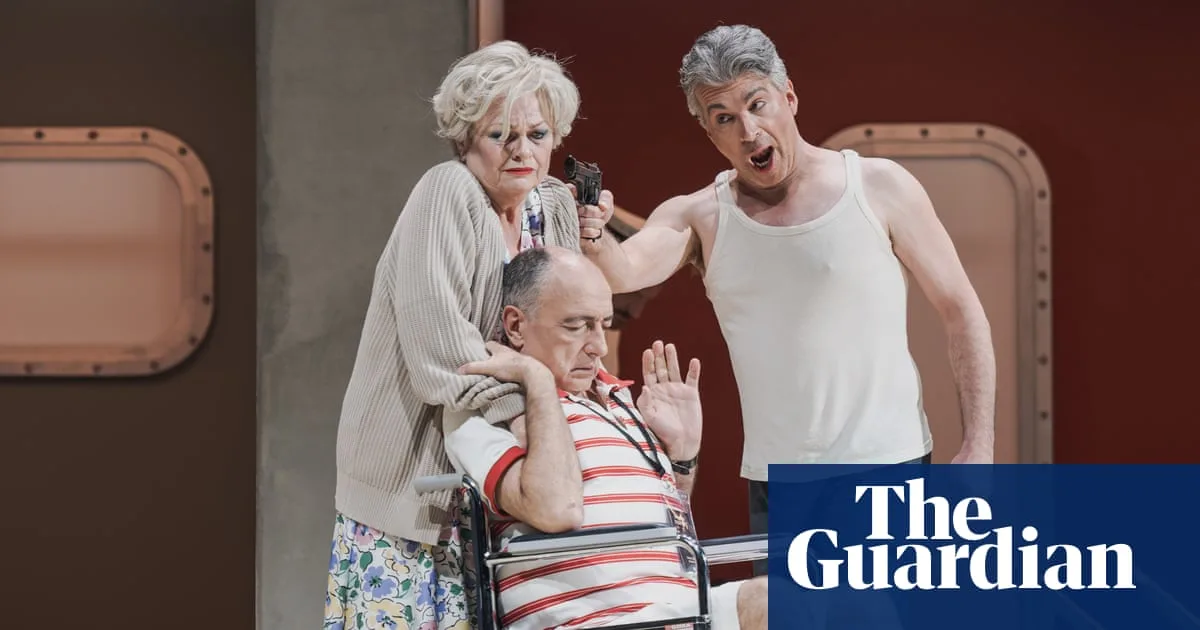
Luca Guadagnino Takes on Controversial Opera The Death of Klinghoffer in Florence
In a rehearsal room above the starkly contemporary Maggio Musicale Fiorentino theatre in Florence, Italian director Luca Guadagnino is meticulously guiding the women of the chorus through their second-act entrance. Dressed in a slouchy cardigan and slacks, he runs forward, halting at a line of tape marking the stage edge. A little out of breath, he turns to conductor Lawrence Renes, inquiring about the sound of stamping feet. "I never mind when we hear them talk, walk, breathe," Renes responds. "It's live theatre."
A Bold Foray into Opera
Better known for acclaimed films like After the Hunt, Challengers, and Call Me By Your Name, Guadagnino occasionally slips into filmic commands such as "Cut!" and "Action!" during stage rehearsals. However, today marks his second opera direction and his first in over 15 years—a highly contentious production of The Death of Klinghoffer. This 1991 opera, with music by John Adams and libretto by Alice Goodman, has sparked accusations of antisemitism and romanticising terrorism since its premiere.
The opera depicts the 1985 hijacking of the cruise ship Achille Lauro by the Palestinian Liberation Front, the murder of disabled Jewish American tourist Leon Klinghoffer, and the grief of his wife, Marilyn. Set in a historical and mythic context, this is the first new production conceived since the Hamas atrocities of 7 October 2023 and the subsequent Israeli bombardment of Gaza.
Confronting Invisibility and Duality
Guadagnino argues that the opera shatters societal mirrors that obscure suffering. "The invisibility of victims is violent, odious and definitely fascistic," he states. "One of the great qualities of Klinghoffer is that it destroys that mirror and transforms the invisible, the unspeakable, into something you have to see, be confronted by and think about."
Rejecting the label of a "CNN opera," Guadagnino describes it as a work of art that elevates beyond immediate banality. Structured like a Bach passion, it features monologues from the captain, the Klinghoffers, other hostages, and the PLF, interspersed with six chorales, including the Chorus of the Exiled Palestinians and the Chorus of the Exiled Jews. "The opera is a two-faced mirror," he explains. "There is always duality. The choruses are in the first person, and the Klinghoffers come to contain multitudes."
Artistic Challenges and Interpretations
Guadagnino's fascination with Adams' music began in the mid-2000s, leading him to incorporate it into his 2009 film I Am Love. However, performing the opera presents significant challenges due to Adams' complex rhythms and melismatic choral writing. Conductor Lawrence Renes notes it is "infinitely harder for the chorus, for the soloists, for the musicians" than other Adams works, offering broad scope for interpretation in building its architectural structure.
Central to Guadagnino's concept is choreography by Ella Rothschild, which will "bleed out" from the chorales and selected monologues. Rothschild describes the score as an accumulation of weight, with movements designed to open spaces for new understanding. In Florence, the Klinghoffers are portrayed by French bass-baritone Laurent Naouri and British soprano Susan Bullock, who brings her experience in dramatic soprano roles to this contemporary piece.
Historical Controversy and Criticism
The opera has been hotly debated since its 1991 premiere, with protests at revivals and cancellations at venues like Glyndebourne and the Metropolitan Opera. In 2014, Leon Klinghoffer's daughters criticised the work for presenting "false moral equivalencies without context" and romanticising terrorism. Musicologist Richard Taruskin accused it of romanticising terrorists in 2001, focusing on a cut prologue scene that juxtaposed Palestinians and American Jews.
Librettist Alice Goodman, who later became an Anglican minister, defends the opera as a portrayal of humanity, arguing that objections stem from depicting enemies as human. "I think Klinghoffer is the best thing I've written," she says. "It's about human beings." Guadagnino counters criticism by highlighting powerful arias like Marilyn's reminiscence and the Chorus of the Exiled Jews.
Current Production and Reception
Carlo Fuortes, general manager of the Maggio Musicale, reports no political pressure or protest plans yet, emphasising that theatre must take risks. Guadagnino views attacks on the opera as "immoral" and a testament to societal decadence. "The attacks this opera has received are a testament to the decadence of our time," he asserts. "I don't know how this opera is going to be welcomed here. But so far, so good."
The Death of Klinghoffer runs at the Maggio Musicale Fiorentino from 19 to 26 April, with streaming available on RaiPlay, continuing to provoke thought and dialogue in a divided world.