Glasgow Artist Transforms Gallery into Fully-Functioning Pub Experience
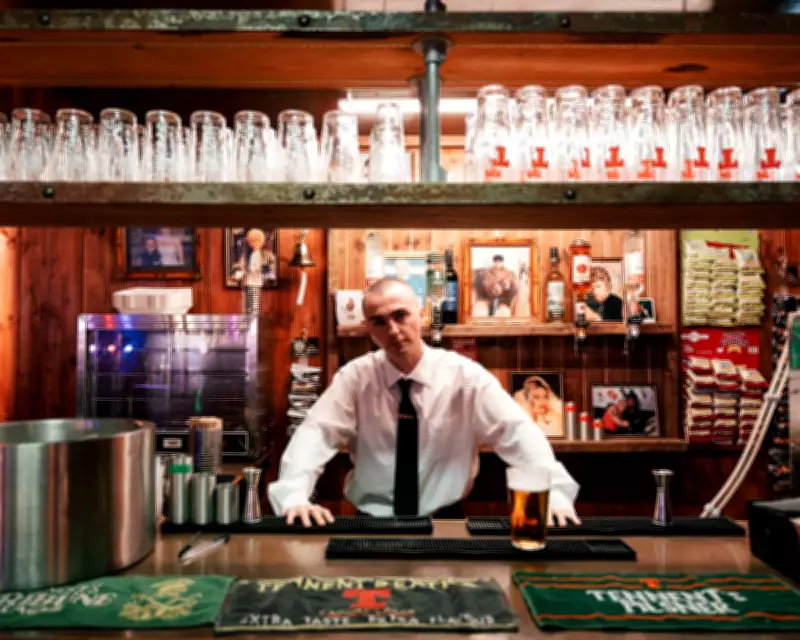
Young Glasgow artist Trackie McLeod has launched an ambitious new exhibition that directly challenges what he perceives as the art world's tendency toward excessive conceptualism and alienating jargon. For his latest show, titled Utopia, the 32-year-old has constructed a completely functional pub within Manchester's Aviva Studios, commissioned by Factory International's Young Curators team.
A Pub That Serves More Than Just Drinks
Utopia represents a custom-built, fully operational boozer where McLeod himself will serve pints to visitors throughout the exhibition's run. The installation features multiple interactive elements, including a dartboard where patrons can take aim at images of political figures like Margaret Thatcher and Donald Trump. A specially modified fruit machine dispenses chocolate coins instead of cash, serving as McLeod's commentary on how such machines traditionally exploit working-class communities.
The exhibition space also showcases McLeod's mixed-media artworks spanning print, sculpture, and sound installations. Throughout the show's duration, the pub will host various events including drag performances, DJ sets, and panel discussions, transforming the gallery into a vibrant community hub.

Rooted in Personal Experience and Social Commentary
"I grew up in places like this," McLeod explains, referencing the working-class pubs and social clubs that inspired Utopia. "All our family occasions were there – weddings, birthdays, funerals. It's where all the disputes happened. These were spaces that were cheap and cheerful but championed character and comfort. I'm trying to bring back a sense of togetherness that we're lacking at the moment."
The exhibition explores multiple themes including nostalgia, class identity, gentrification, and the erosion of traditional community spaces. McLeod's approach deliberately contrasts with what he describes as the art establishment's tendency toward "wanky jargon" that alienates ordinary people.
An Artist Finding His Voice Against the Odds
McLeod's journey to becoming an established artist has been anything but conventional. He struggled academically, particularly with art classes that focused on "dead painters" rather than contemporary practitioners. A turning point came when a former student who "looked like me and sounded like me" introduced him to artists like Andy Warhol, Jean-Michel Basquiat, and Keith Haring.
Despite being dyslexic and failing art due to essay requirements, McLeod "accidentally" found his way into design college and eventually university. His breakthrough came with exhibitions like Fruit (2024) and Fruit II (2025), which featured distinctive works including a car painted in Burberry check and an installed dovecote.
Exploring Identity and Challenging Art World Elitism
McLeod's work frequently examines toxic masculinity and his experiences growing up queer in Glasgow. One particularly powerful piece features a framed list of things that were deemed "gay" during his school years, including using gel pens, reading, and crossing one's legs. "It was only putting it out like that that you realise: fucking hell, that was ridiculous," he reflects. "The things I would do to change myself to try and fit in at the time."
The artist has consciously remained in Glasgow rather than moving to London, which he views as "oversaturated." He operates without gallery representation as part of a DIY art scene, and has previously funded exhibitions himself, sometimes sleeping on friends' sofas to make projects happen.
A Critique of Art World Inclusivity Claims
McLeod offers a pointed critique of the art establishment's claims about diversity and inclusion. "A lot of these galleries say they are championing underrepresented voices and most of the time they don't," he states bluntly. "They don't practise what they preach. It's just rich folk with limited life experience, pumping money into rich folk with limited life experience. The art world feeds on nepotism, privilege and the bank of mummy and daddy. There's definitely a glass ceiling for working-class artists."

Despite these challenges, McLeod's independent approach appears to be yielding results. His concurrent exhibition, Soft Play, runs at the Charleston in Lewes until mid-April, recreating an outdoor play park to explore "the awkward transition from childhood into teenager."
"I don't have the answers," McLeod concludes, "but I'm living proof that you can mark out your own path and it is possible. But we need more working-class voices, more queer voices, and more POC voices, because it makes for more interesting art."
Trackie McLeod: Utopia runs at Aviva Studios in Manchester from 19-21 February, while Soft Play continues at Charleston in Lewes until 12 April.