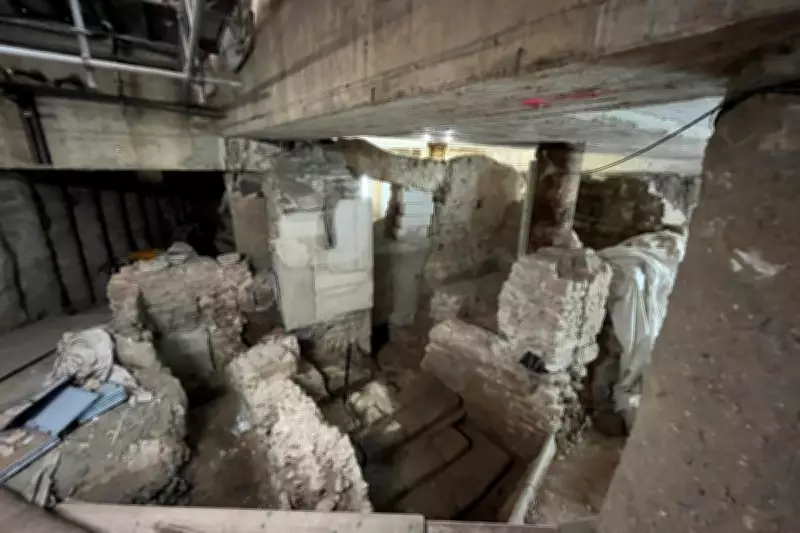
In a remarkable twist of fate, construction crews working on the new LVR-Jewish Museum in Cologne, Germany, have stumbled upon a significant archaeological treasure trove dating back almost two millennia. The accidental discovery, made during routine building operations, has unveiled a rare and well-preserved Roman site that offers a fascinating glimpse into ancient urban life.
An Unexpected Find Beneath the Museum Site
Archaeologists, who swiftly collaborated with the building teams, confirmed that the origins of the site stretch back to the first century of Roman occupation. This serendipitous unearthing has brought to light three key structures: a private household altar, the massive foundations of a late antique basilica, and a remarkably intact stone staircase.
The Rare Stone Staircase
The oldest identified structure is a stone staircase, of which only the midsection remains. This staircase once provided stepped access from the praetorium, or palace complex, towards the River Rhine. Its exact start and end points are yet to be determined, but it was likely necessary due to the natural slope of the terrain, which required such access between the palace and the riverbank.

Roman staircases are exceptionally rare finds in archaeology, making this discovery particularly noteworthy. Interestingly, a later Roman expansion of the praetorium filled in parts of the stairs to accommodate additional buildings. This unintentional act of preservation is what allowed this portion to survive through the centuries.
The Private Household Altar
Excavators also discovered a second-century private household altar, known as a lararium, within the praetorium. A lararium is typically built as a niche in a wall where offerings of food were made to the Lares, the household's patron gods. This niche was carefully constructed with molding that distinguished it from the rest of the wall and allowed it to be closed, likely housing small figurines.
Archaeologists identified nail holes where iron nails once held garlands or ribbons as decoration, and traces of paint remain visible on the surrounding stucco. These details provide intimate insights into the domestic religious practices of Roman inhabitants.
The Fourth-Century Basilica Foundations
The most recent discovery dates from the fourth century: the foundations of an apse belonging to a multi-aisled basilica. Before excavation, the structure had only been perceptible as a shallow depression in the ground. When exposed, archaeologists realised the building was not made of typical Roman cast concrete.
Instead, it consisted of 13-foot-thick layers of volcanic rock, basalt, and limestone, bonded with a strong mortar composed of crushed ceramic and gravel. Its bulk and strength had allowed it to remain intact for nearly 2,000 years, showcasing advanced Roman engineering techniques that have withstood the test of time.
Implications for Historical Understanding
This discovery not only enriches our knowledge of Roman Cologne but also highlights the importance of archaeological oversight during modern construction projects. The site's preservation, from the staircase to the altar and basilica, offers a layered historical narrative that spans centuries of Roman occupation and urban development.
As excavations continue, further analysis may reveal more about the daily lives, architectural innovations, and religious customs of the Romans who once inhabited this area. The find underscores how ancient history can lie just beneath our feet, waiting to be rediscovered in the most unexpected ways.