Alex Frayne's Photographic Exploration of America's Fractured Psyche
Presented as part of the Adelaide Festival 2026 program, South Australian artist Alex Frayne embarks on a profound photographic journey to explore the fractured psyche of modern America. Shot almost entirely on analogue film over three years and across nine states, Frayne's lens meticulously focuses on the fringes of the West, Deep South, and Bible Belt. The exhibition, titled Manifest Destiny, runs from 28 February to 15 March at ILA (Immersive Light and Art), offering viewers an immersive experience into the heart of American culture and contradictions.
Religion and Daily Life in the Sunbelt
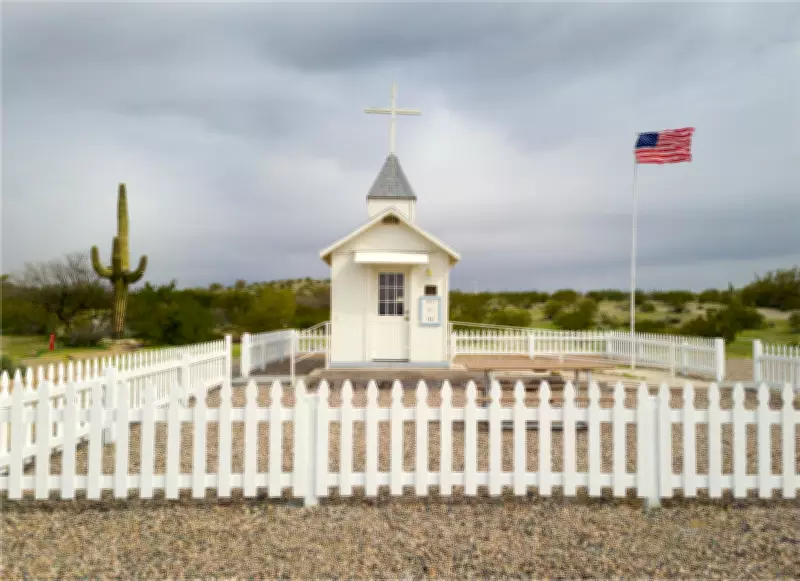
Scattered across the sunbelt are places of worship that invite passersby to pause and consider the proximity of religion to daily life in the "land of the free." Frayne recounts instances where locals approached him, offering blessings and prayers for his safety and success. This deep intertwining of faith and everyday existence highlights a cultural landscape where religion is all-encompassing, devoid of the irony often found in other parts of the world.
Eerie Encounters on the Extra-Terrestrial Highway
Driving along Highway 375 in Nevada, known as the "Extra-Terrestrial freeway," Frayne experienced an eerily quiet road. Suddenly, a UFO-like object materialised overhead with a thunderous clap, only to reveal itself as an F18 Super-Hornet on a routine sortie from the nearby Nellis airbase. This moment encapsulates the surreal and often militarised nature of American frontiers, blending myth with reality.

Contrasts in American Diners and Landscapes
Frayne's travels took him to diners and landscapes that often fell short of cinematic expectations. In New Mexico, he encountered a truck stop lacking irony, while in California, diners appeared as hollow shells compared to movie memories. His photography in Arizona, on the ancestral home of the Maricopa people, forced him to unlearn simplistic film tropes and see the landscape authentically, beyond cartoonish backdrops.
The Bible Belt and Cultural Differences
Through the Bible Belt, Frayne observed scenes reminiscent of Malick's Days of Heaven, yet noted a stark contrast with rural South Australia. In America, religion is treated with utmost seriousness, without the satire or "piss-taking" common in Australian culture. This reverence is captured in images like "Swinging in the Wind Behind a Place of Worship" in Arkansas, where Frayne laughed as he pressed the shutter, acknowledging the cultural divide.
Urban Explorations: From Venice Beach to San Francisco
In Venice Beach, California, Frayne subverted first impressions of a city filled with dreamers and grifters. Meanwhile, in San Francisco's Haight and Ashbury, he sought the spirit of '67, only to find it was part of an indie film shoot, with actors working for "points" rather than wages. This blurring of reality and performance underscores America's complex relationship with its own myths.
Ghost Towns and Industrial Echoes
Paying a taxi driver $500 to visit Nelson, Nevada, Frayne discovered a ghost town that served as a museum for Hollywood tropes. In Texas, he photographed oil pumps with a balletic grace, reflecting a culture that prays for oil as if it were family. These images speak to America's industrial past and its lingering presence in everyday life.
Social Realities: Poverty and Abandonment
Frayne's lens also captures the harsh realities of American society. In Louisiana, the quiet south, still recovering from the Civil War, is laced with jazz and gospel music. In Los Angeles, he contrasted the lucky living in old buildings with the less fortunate afflicted by disease and opioid use, forming a tragic chorus in a real-life drama. Abandoned drive-ins and schools in Texas tell stories of forgotten communities and historical injustices.
Gas Stations as Shrines to the 20th Century
Gas stations in America, as depicted in "Forever and Ever, Amen" from Oklahoma, are likened to small shrines to the 20th century. Often bereft of fuel or people, they resonate with a rusty alien elegance and honesty, symbolising the enduring yet fading echoes of a bygone era.

Through this extensive series, Alex Frayne offers a nuanced and deeply personal portrait of America, challenging viewers to look beyond stereotypes and engage with the complex tapestry of its fractured psyche.