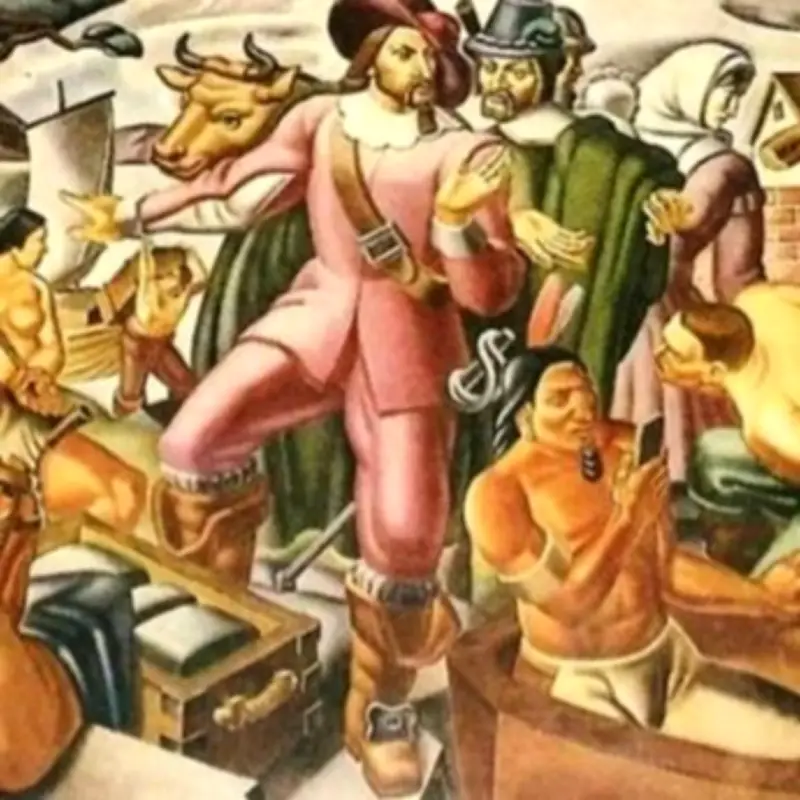
A nearly century-old painting has ignited conspiracy theories that time travel is real, after a Native American man appears to be holding an object strikingly similar to a modern iPhone. The artwork, titled Mr Pynchon and the Settling of Springfield, was painted by Italian artist Umberto Romano in 1937 and depicts the arrival of European settlers in Springfield, Massachusetts, during the 1620s.
The Mysterious Object
In the painting, a Native American man is seen holding a small, black rectangular object and gazing intently at it, as if examining his reflection or taking a selfie. This detail has puzzled viewers, given that iPhones were not invented until 2007, leading some to speculate that the painting provides evidence of time travel.
However, Brian Anderson, writing for Motherboard, offered a more grounded explanation: the object is most likely a mirror, a European trade item commonly given to Native Americans during that era. He noted that the way the man holds it up aligns with the act of looking at one's own face.

Historical Context
This is not the first time an anachronistic object has been spotted in historical art or film. In 2010, Irish filmmaker George Clarke pointed out a woman in Charlie Chaplin's 1928 film The Circus who appears to be talking on a handheld device, which some claimed was a mobile phone. The footage went viral, amassing nearly seven million views on YouTube.
Clarke described the woman as holding a thin, black device to her ear, with bent knuckles resembling the shape of a phone. He argued that no contemporary device could explain what she was holding, as ear trumpets and radios did not match the object's appearance.
Debunking the Theories
While conspiracy theorists eagerly embraced the time travel hypothesis, skeptics offered alternative explanations. Some suggested the woman in the Chaplin film was shielding her eyes from the sun or cupping her ear. The Daily News later debunked the theory, stating that she was likely using a hearing aid, a device that existed in the 1920s.
Similarly, the object in Romano's painting is widely accepted by art historians and experts as a mirror, not a smartphone. The persistent fascination with such anomalies highlights the human tendency to seek extraordinary explanations for ordinary objects, especially when viewed out of context.