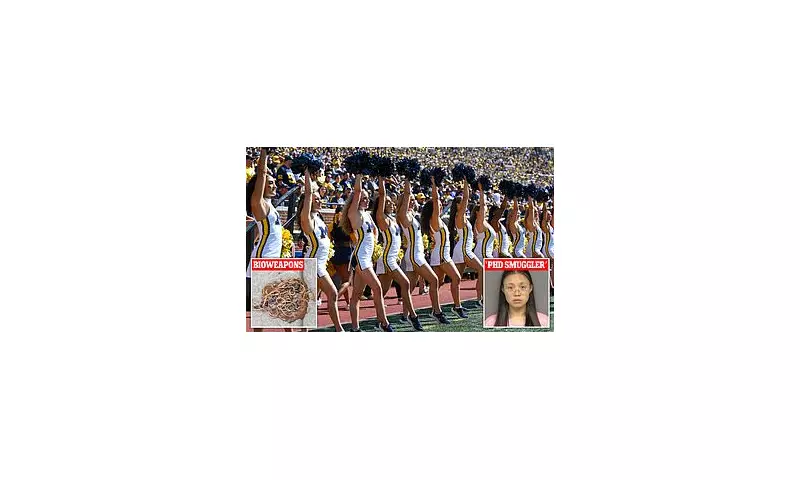
A revered American institution, the University of Michigan, finds itself embroiled in a deepening national security scandal, accused of being a soft target for Chinese operatives seeking to smuggle dangerous biological materials onto US soil.
Charges and Arrests at a Prestigious Lab
On 5 November, federal agents charged three Chinese nationals—Xu Bai, 28, Fengfan Zhang, 27, and Zhiyong Zhang, 30—with conspiring to smuggle biological materials into the United States while working at a University of Michigan (U-M) research laboratory. The trio have been terminated by the university, making them eligible for removal from the country.
According to the Department of Justice, Bai and Fengfan Zhang allegedly received multiple shipments from China between 2024 and 2025 containing concealed biological materials related to genetically modified roundworms, parasites known to infect humans and livestock. The shipments were sent to them while they worked at U-M's Shawn Xu laboratory. Zhiyong Zhang was separately charged with making false statements to federal agents about the shipments.

A Disturbing Pattern of Alleged Smuggling
These cases are not isolated. They follow the June arrest of Chengxuan Han, a PhD student from Wuhan, who pled no contest to smuggling charges before being deported and barred from re-entering the US. Han had sent modified worm samples from China before joining the Ann Arbor lab.
In a parallel case the same month, federal prosecutors charged a Chinese couple, Zunyong Liu and Yunqing Jian, with attempting to smuggle a dangerous crop fungus into the US, a pathogen described as a potential agroterrorism weapon that could devastate American fields and poison livestock. Prosecutors stated the pair intended to use the U-M lab to further their scheme. Jian pleaded guilty, served a five-month sentence, and is being deported.
US Attorney Jerome Gorgon claimed that the more than 600 research and teaching labs at U-M had repeatedly been hijacked for illicit activities. 'At some point, pattern becomes practice,' Gorgon stated.
Geopolitical Tensions Hit Campus Life
The university, a 200-year-old 'Public Ivy' with 53,000 students, hosts some 4,000 Chinese nationals, roughly half its foreign student population. The scandal has cast a long shadow over academic exchange and research collaboration.
China analyst Gordon Chang described the allegations as a 'knife at the heart for the people in the Midwest.' He argued that if proven, the charges demonstrate the thoroughness of China's penetration of iconic US institutions, part of what he terms an 'unrestricted warfare' campaign.
The US Department of Education has opened a formal investigation into U-M after finding 'inaccurate and incomplete disclosures' of foreign funding, warning that its labs were 'vulnerable to sabotage.' The university must now account for every dollar of the $375 million in foreign funding it has received since 2020, including tens of millions from Chinese entities.
In January 2025, under pressure, U-M shut down a joint institute with Shanghai Jiao Tong University, which the House Select Committee on the Chinese Communist Party had called an 'unacceptable national security risk.' Committee chairman, Michigan Republican John Moolenaar, labelled it a 'pipeline for the Chinese Communist Party's military ambitions.'
While some academics warn of a 'chill' stifling vital research on issues like climate change, security hawks demand a tougher stance. The blitz of federal arrests has thrust Ann Arbor, a city famed for football and academia, onto the front lines of a covert geopolitical contest.