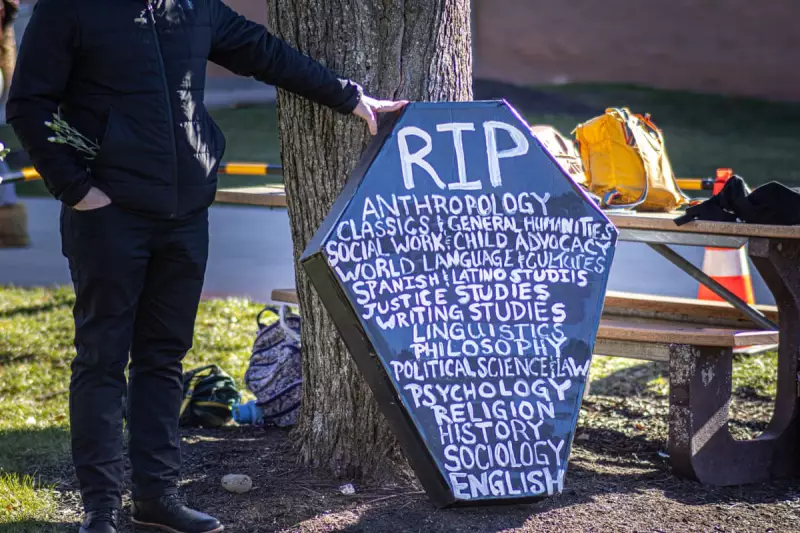
In a stark visual protest against the erosion of liberal arts education, students at Montclair State University in New Jersey recently gathered for a sombre mock funeral. They stood outside Dickson Hall, the home of the College of Humanities and Social Sciences, holding flowers beside a tombstone inscribed with the names of 15 academic departments facing consolidation.
A Eulogy for Critical Thought
Organiser Miranda Kawiecki, a junior, read a poignant eulogy mourning the "death of the social sciences and humanities at the hands of the MSU administration." She declared, "I coordinated this demonstration because I have dreams that cannot be monetized. I have a problem with our society that cannot be solved with an algorithm." The protest targeted the university's plan to merge its departments into four thematic schools, a move administration emails framed as a "strategic effort" to maximise faculty impact and ensure programme vitality.
This scene in New Jersey is not an isolated incident but a symptom of a national existential crisis for humanities and social sciences in American higher education. The fears are being realised through sweeping restructurings, programme eliminations, and layoffs at scores of public and private institutions.

A National Wave of Cuts and Consolidations
The scale of the retrenchment is vast. An analysis by Inside Higher Ed found over 9,000 higher education jobs were cut last year alone. The examples are widespread:
- In Indiana, legislation forced public universities to cut or consolidate roughly 400 degree programmes, many in the humanities.
- The University of Texas at Austin anticipates cuts targeting ethnic and regional studies.
- The University of North Carolina plans to close six area studies centres.
- The University of Chicago has paused graduate admissions for nearly all its humanities programmes.
Critics argue the crisis stems from a dual threat: years of disinvestment in public education and intensifying political pressure from the right, including the Trump administration's leveraging of federal research funds. More fundamentally, it represents a clash over the value of education itself—between market-driven metrics and the less quantifiable worth of humanistic learning.
"The humanities simply don't fit a corporate model because they are just not monetizable in the same way," said Adam Rzepka, an English professor at Montclair State. He contends the attack is also ideological: "Free thought and rigorous, free inquiry is dangerous to executive power."
Consultants, Data, and the 'Pivot' Away from Liberal Arts
Increasingly, these restructuring efforts are guided by corporate-style consulting firms. Portland State University in Oregon, facing an $18m deficit, laid off 17 non-tenure faculty, 15 from liberal arts. It has contracted with Gray Decision Intelligence, a firm used by dozens of universities including Montclair State, to launch a programme overhaul called "Pivot."
The plan uses AI-generated analyses of "student demand, job market trends, and competitor activity" to identify programmes for potential closure based on low demand and weak financial contribution. Bob Atkins, the firm's founder and a history major himself, stressed decisions should be "data-informed, not data-driven," acknowledging qualitative factors like institutional mission. However, faculty argue this consultant-led approach is fundamentally at odds with the core value of a liberal arts education.
This shift reflects a decades-long backlash against public higher education focused on developing the "whole person," says Penn State professor Eric Hayot. "The humanities are the place where education is less clearly oriented towards the market," he notes. The result, he fears, is a move towards an educational oligarchy where only the elite access humanistic learning, while others are funneled toward job training.

As confidence in higher education plummets—from 57% in 2015 to 36% in 2023—the erosion continues. Bill Knight, a professor at Portland State, warns of the lasting damage: "Nationwide, people are making really hasty decisions. And it's tragic because it's hard to get these things back when they're cut." The mock funeral in New Jersey, therefore, stands as a potent symbol for a discipline many believe is being prematurely buried.