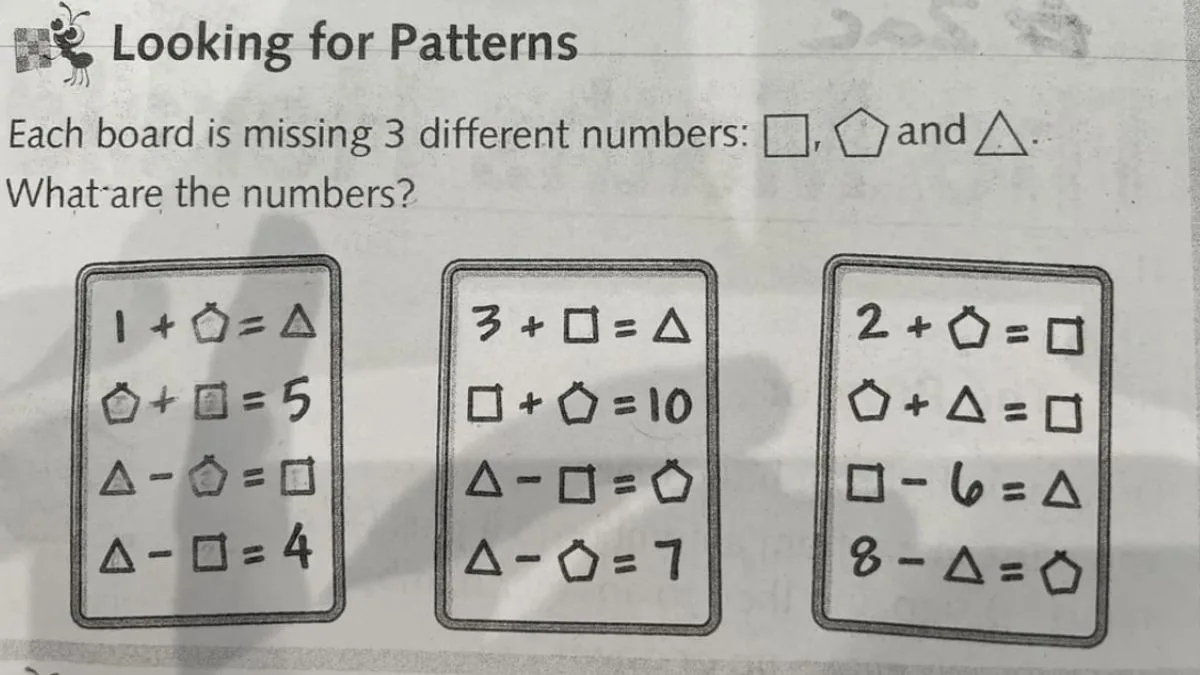
A perplexing maths homework assignment intended for seven-year-old children has left numerous parents completely baffled, unable to solve the advanced problem themselves. The confusing question has ignited a significant debate across social media platforms, with many adults criticising its overly complex wording while others question whether such material is appropriate for young pupils.
The Problem That Puzzled Parents
One frustrated parent shared the mathematical conundrum on Reddit after spending considerable time attempting to find a solution without success. The problem presents a scenario involving Brian, who possesses boxes of paper clips in two sizes: some containers hold 10 clips while others contain 100. The question states that Brian has three more boxes with 100 paper clips than boxes with 10 paper clips, and he has two fewer paper clips left over than he has boxes with 100 paper clips. The ultimate challenge asks what number of paper clips Brian could potentially have.
The parent explained their family's struggle with the assignment, noting: "Unfortunately, I had four children with this maths problem and none of them could solve it on their own - and neither could any of the adults." This admission highlights how the homework has proven challenging across multiple age groups within the same household.
Social Media Reactions and Criticisms
Responses to the shared problem varied dramatically across online platforms. Many users focused their criticism on the confusing wording of the question itself. One commenter expressed their frustration bluntly: "The real puzzle is figuring out what it's even asking. I nearly had a stroke trying to read it." Another added: "There's nothing wrong with the idea, but the wording is terrible. And for a question about counting in 10s, it doesn't even make sense - none of the answers are evenly divisible by 10."
A third user described their mental shutdown: "My brain shut down before I even finished reading it." These reactions underscore how the problem's presentation has created unnecessary barriers to comprehension for both children and adults alike.
Educational Perspectives and Potential Solutions
Some social media participants offered more analytical perspectives about the problem's educational purpose. One user suggested: "This question is about testing the limits of the student's ability to interpret word problems, and making sure the student has good number sense. The process is more important than the answer. It could absolutely be worded better, though."
Another commenter highlighted alternative learning outcomes: "It's also about learning when to ask for help. That's a valuable lesson too." This perspective reframes the challenging homework as an opportunity to develop problem-solving strategies beyond mere mathematical computation.
Regarding the problem's difficulty level, one user offered reassurance: "It's okay. Most kids won't solve these problems. They're meant to challenge students to think critically and try to problem solve on their own without copying formulas they memorised from that day's lessons. If anything, a student who answers all the questions is either a genius or (most likely) had a parent doing their homework for them."
They continued with practical advice: "This is certainly one of those 'give it your best try' problems. Your kid isn't going to flunk second grade for not being able to solve this."
Mathematical Approach and Place Value Understanding
One user attempted to demystify the problem by explaining its underlying mathematical concept: "I think it's less about algebra and more about place value - hundreds, tens, and ones. The number of hundreds is three more than the number of tens, and the ones are two less than the hundreds. So any number that fits that works. For example, if the tens column is one, then the hundreds would be four, and the ones would be two - making 412."
This interpretation suggests the problem might be designed to reinforce place value understanding rather than traditional arithmetic, though the confusing presentation has obscured this educational objective for many families.
The ongoing debate highlights broader questions about homework expectations for young children, the balance between challenge and accessibility in educational materials, and the role of parents in supporting their children's mathematical development during primary school years.