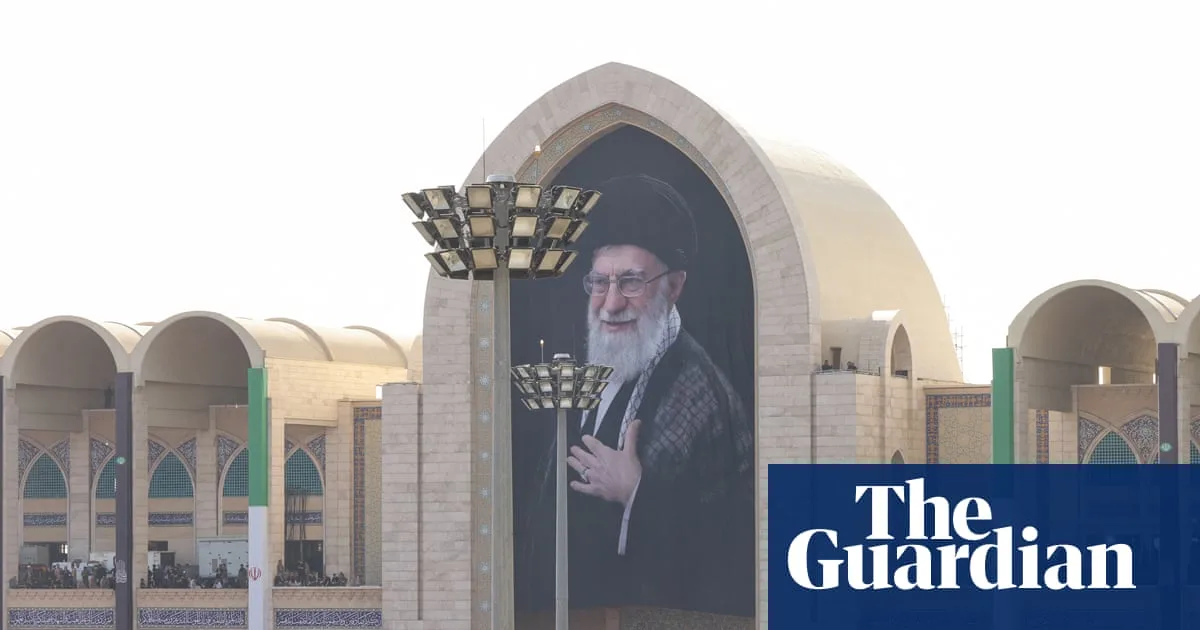
Michigan Professor Condemns Trump for Khamenei Killing, Vows to Continue His Path
A Michigan community college professor has launched a scathing public attack on former President Donald Trump, blaming him for the killing of Ayatollah Ali Khamenei and pledging to carry on the Iranian Supreme Leader's legacy. The controversial remarks have ignited a fierce debate about free speech, institutional policies, and national loyalty at publicly funded educational establishments.
Engineering Instructor's Viral Video
Ali Akbar Shdid, an engineering instructor at Henry Ford Community College in Dearborn, Michigan, shared a video on his Instagram account following Saturday's joint US-Israeli military operation that resulted in Khamenei's death. In the emotional recording, Shdid condemned the attack and honored what he called the "pure soul" of the Ayatollah.
The professor alleged that Khamenei was martyred by what he termed the "Epstein regime" and accused Trump of making a "huge mistake" by eliminating Iran's "beloved leader." This characterization comes despite documented reports that Khamenei ordered the killing of approximately 30,000 citizens during recent anti-government protests in Iran.
"He thought that by killing him he's going to make the believers submit and make them hopeless," Shdid declared in his video. "However, we're going to continue on the path of Sayid Ali Khamenei. We're going to hold his blood, his ideology. We're going to learn it and teach it to our children and the grandchildren."
Social Media Backlash and Institutional Concerns
The engineering instructor's video has been reshared across multiple social media platforms, gaining viral attention and prompting significant public backlash. Many social media users have questioned why an instructor at a taxpayer-funded college can publicly profess what they consider divisive and potentially dangerous rhetoric.
Outraged X users, noting the US government's longstanding designation of Khamenei as the leader of a terrorist network, alleged that Shdid has effectively "declared himself an enemy of the USA" through his statements.
"It is absolutely atrocious to have a person apart of a terrorist group working for one of our public school systems," one user wrote, urging Henry Ford Community College to terminate Shdid's employment immediately.
Another commenter challenged Shdid's reference to Khamenei as "our leader," emphasizing that elected American officials represent legitimate leadership in the United States. "If you're American, Donald Trump is your leader. Your elected Congressmen and Senators are your leaders," the user tweeted. "If a foreign leader, especially one classified by your government as a terrorist, is your leader, then you're not an American."
First Amendment Questions and Institutional Policies
The controversy has raised complex questions about the boundaries of free speech, particularly regarding whether Shdid's remarks could be classified as threats or hate speech, and whether such commentary enjoys protection under the First Amendment.
"Is it legal in America to say you are going to 'continue on the path' of the world's leading terror sponsor?" one social media poster questioned, highlighting the tension between free expression and national security concerns.
Henry Ford College maintains specific social media policies that require "respectful, appropriate, and professional interaction across its platforms." The institution's website states that the school monitors posts and reserves the right to delete any content deemed "offensive, defamatory, or violating policies, including hate speech, profanity, or illegal content."
However, the policy also clarifies that individuals affiliated with the school do not represent the "official voice" of Henry Ford College. "It is important that College social media representatives maintain accuracy by verifying facts with reliable, reputable sources before posting information on any College social media channel," the policy states. "Respect, professionalism, and good judgment are required for all representatives or agents of the College."
Institutional Context and Community Demographics
Henry Ford College is a publicly funded institution that receives financial support from multiple sources including tuition and fees, state and federal grants, and local tax revenue. The college serves approximately 12,000 students each semester and participates in Michigan's Reconnect program, which provides free tuition to state residents over age 25 who lack a degree.
The college is situated in Dearborn, Michigan, which holds the distinction of being recognized as America's most Muslim city in 2024. Census data reveals that more than 55 percent of Dearborn's population claims Middle Eastern ancestry, making it the first US city to achieve an Arab-American majority.
This demographic context adds layers to the ongoing debate, as community members grapple with questions of cultural identity, political allegiance, and academic freedom in an increasingly polarized national climate.