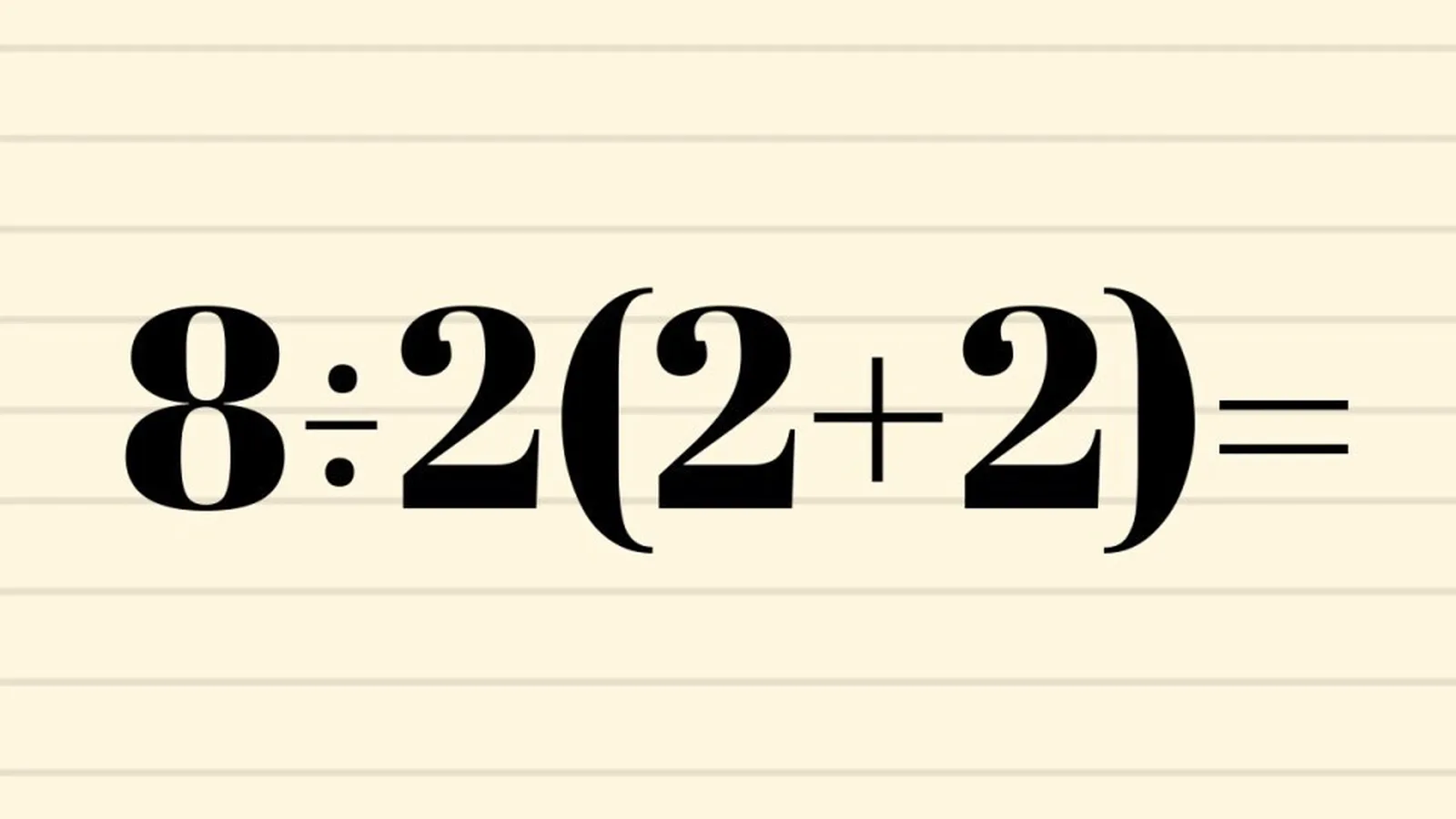
Social media users have been divided by a viral maths equation, with the expression "8÷2(2+2)" sparking debate over whether the answer is 1 or 16. The confusion highlights how the order of operations—the sequence in which addition, subtraction, multiplication, and division are performed—can lead to different results.
Mathematical conventions such as BOMDAS or BODMAS (Brackets, Orders, Multiplication/Division, Addition/Subtraction) are designed to reduce ambiguity. For example, in the expression 1+2×3, multiplication is performed before addition, yielding 7. However, these rules are not foolproof. The expression 4÷2×2 can be interpreted as 1 or 4 depending on whether multiplication or division is prioritised.
To avoid confusion, mathematicians often use fractions or brackets. The division symbol (÷) is rarely used beyond primary school, replaced by fractions that imply brackets around the numerator and denominator. Similarly, the square root symbol groups its contents. In higher mathematics, abstract algebra explores when brackets are necessary for more complex ideas.
Context also plays a role in resolving ambiguity in everyday language. For instance, the phrase "man eating tiger" could describe a tiger that eats humans or a person consuming tiger meat, depending on the situation. Similarly, in maths, clear notation is essential to avoid misinterpretation.