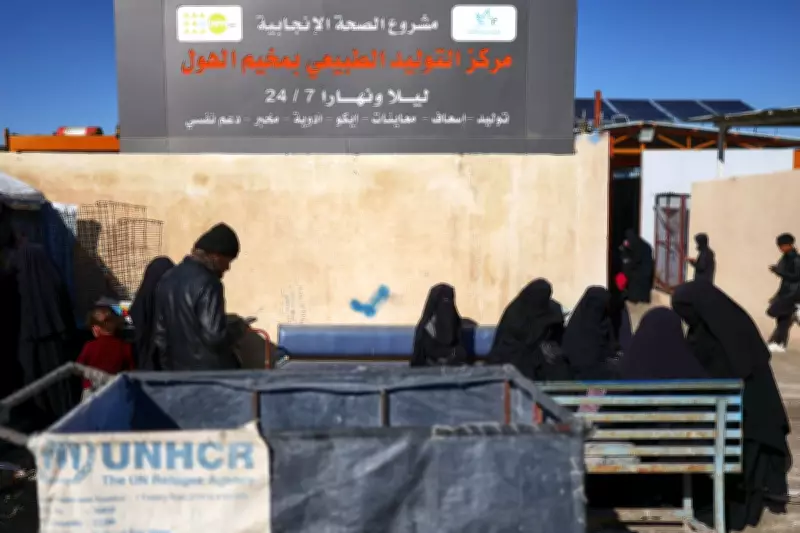
Officials have confirmed that a significant camp in northeastern Syria, which had been housing families of suspected Islamic State group members, is now largely empty following extensive repatriation and transfer operations in recent weeks. The al-Hol camp, once a sprawling facility, has seen hundreds of women and children either returned to their countries of origin or moved to other locations as part of a coordinated effort.
Major Repatriation Drive Underway
The repatriation initiative, particularly focused on Iraq, forms a key component of Syrian government efforts to return suspected IS militants and their family members to their home countries. These individuals have been held in various camps across Syria since the extremist group's defeat in the country back in 2019.
Gonzalo Vargas Llosa, the United Nations refugee agency's representative in Syria, issued a statement detailing the agency's involvement. "With this repatriation, and with today's return of several vulnerable Syrian families supported by UNHCR and partners, Al-Hol camp will now be practically empty," he declared. The UNHCR assisted in the return of 191 Iraqi citizens from the al-Hol camp to Iraq just this past Thursday.

Transfers and Operational Decisions
A Syrian government official, speaking anonymously due to lack of authorisation for public comment, revealed that approximately 600 Syrians were relocated from al-Hol to the Akhtarin camp in northwestern Aleppo province, with transfers continuing. The decision to empty al-Hol was reportedly driven by its remote desert location, which is far from essential services and close to areas where authorities do not maintain full territorial control.
Following the defeat of IS in 2019, al-Hol camp housed around 73,000 people, predominantly Syrian and Iraqi citizens, but also including thousands from other nations. The residents were mostly women, often wives or widows of IS members, along with their children. Over time, numbers have declined as some countries repatriated their citizens, leaving about 24,000 last month. Exact current figures remain unclear after many fled during recent struggles for control of the camp and the latest repatriations and transfers.
Camp Conditions and Historical Context
It is important to note that the camp's residents are not technically prisoners, and most have not been formally accused of crimes. However, they have been held in de facto detention at the heavily guarded facility for years.
A decade ago, at the peak of its power, the Islamic State captured vast territories spanning a third of Syria and Iraq, establishing its so-called caliphate. Hundreds of foreign jihadis travelled to Syria to join IS, many forming families and raising children there. Last month, Syrian government forces captured the al-Hol camp after a weeks-long offensive against the Kurdish-led Syrian Democratic Forces, which had managed the camp near the Iraqi border for ten years. A ceasefire has since ended the fighting.
Escapes and International Advocacy
During the recent conflict, many families are believed to have escaped from the camp. Save the Children stated on Thursday that around 70% of the camp's residents departed in recent weeks. The non-governmental organisation has long advocated for safe repatriation from al-Hol, describing conditions as "dire, with a lack of food, water, and widespread violence." They have urged the international community to support the repatriation process actively.
Related Developments and Broader Implications
In a related development, Syrian authorities turned back a group of 34 Australian women and children on Monday after they left the Roj camp, which is similar to al-Hol and also located in northeastern Syria. Australian authorities later confirmed they would not repatriate these families.
Separately, the U.S. military has transported thousands of IS militants, previously held for years in Syrian prisons or detention camps, to Iraq, where they will face trial. This broader context underscores the ongoing international efforts to address the legacy of the Islamic State's presence in the region, balancing security concerns with humanitarian considerations for displaced families caught in the aftermath.