Ancient Roman Sanctuary Unearthed Beneath Frankfurt May Hold Dark Secrets of Ritual Human Sacrifice
Archaeologists have made a stunning discovery beneath the modern city of Frankfurt, Germany, unearthing a Roman-era walled complex that may have a dark past involving ritual human sacrifice. The remarkably preserved sanctuary, largely undisturbed since the early 2nd century AD, represents what experts are calling an archaeological find of almost unparalleled significance in Europe.
Discovery During School Construction
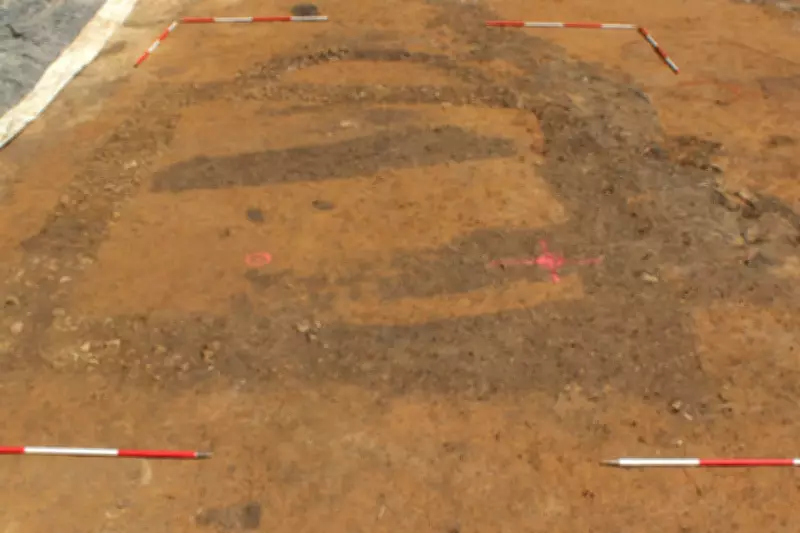
Parts of this ancient sanctuary first came to light during excavations between 2016 and 2018, with further discoveries emerging in 2022 during construction of a new primary school. The German Research Foundation (DFG) and the Swiss National Science Foundation (SNF) are currently supporting extensive efforts to study the sanctuary located in the ancient city of Nida within modern Frankfurt.
"The central cult district of Nida represents an archaeological discovery of almost unparalleled significance in Europe," emphasized Ina Hartwig, Frankfurt's city commissioner for culture and science, highlighting the importance of this remarkable find.

Complex Ritual Structures and Remains
The sanctuary features an elaborate walled complex containing eleven stone buildings constructed over several phases, along with approximately seventy shafts and ten pits specifically used for ritual depositions. These pits contained ceramic vessels and various plant and animal remains, including fish and birds, believed to represent ritual meals and offerings made to ancient deities.
Most significantly, the remains point to potential evidence of human sacrifice, a finding that would be extremely rare for this region of Roman Germany. "The evidence pointing to possible human sacrifice at the cult district of Nida is entirely exceptional," researchers noted in their findings.
Unusual Architecture and Rich Decorations
The buildings within this Roman complex appear highly unusual according to archaeologists, with no known parallels in the Roman provinces of Germania or Gaul. Researchers discovered more than 5,000 fragments of painted wall plaster as well as bronze fittings from doors and windows, indicating richly decorated structures that would have been visually impressive in their time.
Additional finds include:
- More than 250 Roman coins
- Over 70 silver and bronze garment clasps, some still intact
- A dedication from a soldier to Mercurius Alatheus dated to 246 AD
Such objects were widely used as offerings in Roman sanctuaries throughout the empire, providing valuable insight into religious practices of the period.
Cultural Diversity and Regional Significance
While researchers remain uncertain about which specific deities were worshipped at the site, evidence suggests several gods were honored, including Jupiter, Jupiter Dolichenus, Mercurius Alatheus, Diana, Apollo, and Epona. This diverse mix indicates that the sanctuary served as an important regional center that attracted worshippers from various cultural backgrounds.
The dedication from a soldier to Mercurius Alatheus, dated to 246 AD, confirms that the sanctuary remained active at least into the mid-3rd century AD. The Roman sanctuary appears to have been known for its cultural diversity and served as one of the most significant urban centers in the region until it was abandoned around 275/280 AD.
Intersection of Past and Future
"The fact that the discovery was made during construction of the new Römerstadtschule vividly demonstrates how past and future intersect in our city," said Marcus Gwechenberger, Frankfurt's City Councilor for Planning and Housing. Römerstadtschule is an inclusive elementary school located in Frankfurt-Heddernheim, Germany, where the ancient sanctuary was discovered beneath what will become modern educational facilities.
This extraordinary archaeological discovery provides unprecedented insight into Roman religious practices in Germany, potentially including the rare and controversial practice of human sacrifice, while highlighting how ancient history continues to emerge in unexpected places within modern urban environments.