War Forces Lebanese to Abandon Traditional Funeral Rites
In Lebanon, the dead are traditionally granted one final journey through their hometowns. Carried aloft by loved ones, the casket is paraded through familiar streets before being laid to rest in a prepared grave, with family members gently covering the body with earth. This sacred farewell, however, has been brutally disrupted by the escalating conflict in the south of the country.
Temporary Graves Replace Ancestral Burial Sites
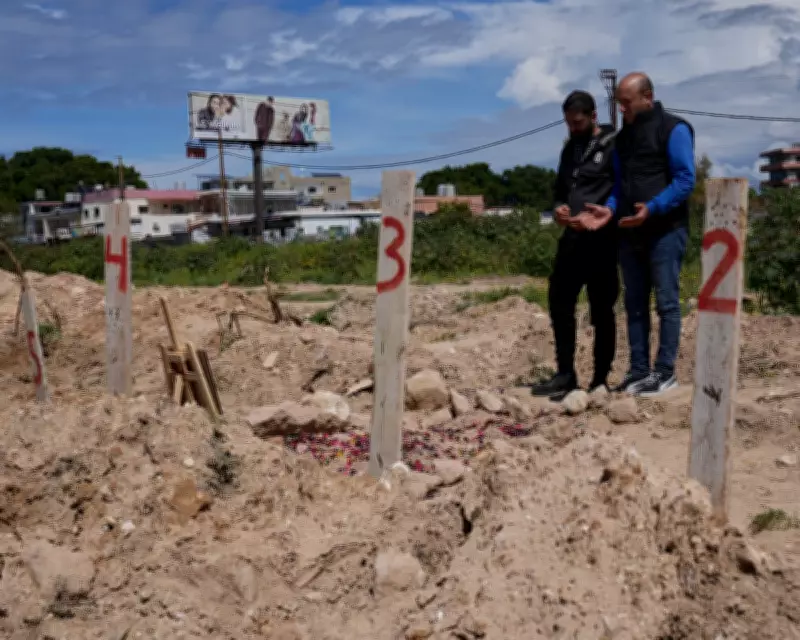
As Israel expands its ground invasion into southern Lebanon, families are being compelled to forsake these age-old rituals. Instead, they are burying their loved ones in makeshift, temporary graveyards located farther north, away from the frontline violence. In the city of Tyre, two-metre-wide ditches have been excavated to accommodate the deceased. The markers are stark and impersonal: thin wooden boards bearing only a number spray-painted in bright red.
Rabih Koubaissi has remained in Tyre to oversee these burials, defying Israeli evacuation orders and ongoing airstrikes. This conflict marks his second war in just three years. He explains the profound disruption to Islamic burial customs. Typically, in Islam, a body is washed, wrapped in a simple white shroud, and placed directly into the earth without a coffin, where it is meant to rest undisturbed.

Islamic Jurisprudence Adapts to Extreme Circumstances
The brutality of war has corrupted every step of the burial process. At times, it is impossible to properly wash the bodies. "Sometimes we just receive pieces of bodies," Koubaissi revealed. "In those cases, we just collect what we can, place them in a shroud and a body bag, and then put them in the coffin."
Under these exceptional circumstances, a specific Islamic funeral rite called wadiaa, meaning "deposit," is invoked. This technicality allows for burial in a casket. The theological reasoning is that it is the coffin being exhumed later, not the body itself, thus preserving religious tenets while acknowledging the dire reality of conflict.
Yet, these temporary solutions offer little solace. "It's very difficult. Families are being forced to bury their loved ones twice," Koubaissi stated, highlighting the deep emotional trauma inflicted upon the bereaved.
Fear of Permanent Displacement and Ruined Homelands
The anguish is compounded by a pervasive fear that there may be no return to ancestral lands for a proper reburial. Statements from Israeli officials suggesting a long-term military occupation south of the Litani River have sown dread among the Lebanese population. Many worry it could be months or even years before they can finally lay their relatives to rest in their home villages.
Even if a withdrawal occurs, the prospect of returning to devastated communities is harrowing. A grim precedent was set at the end of the 13-month war between Hezbollah and Israel in November 2024. Residents of the border village Dhayra returned to rebury two locals, only to find their village graveyard destroyed by Israeli bulldozers and the local mosque in ruins. The bodies had to be interred in an alternative cemetery.
Solitude and Sorrow at the Makeshift Graves
While the dead await their second burial, their temporary resting places see few visitors. After the initial, hurried funerals, most families have been forced to flee Tyre as the city endures intensifying attacks. The graves stand largely unattended.
A rare scene of visitation occurred last week when a young couple, who had chosen to stay in Tyre despite the dangers, tended to flowers at the graves of two young men from Al-Qlailah. These were the only two graves adorned with photographs of the departed. The couple, visibly overcome, consoled one another as they gazed at the images.

Nearby, medic Hecham Reda from the border village of Aita al-Chaab wept at the grave of his friend, Hadi. "Hadi was always with us, putting out fires, carrying the martyrs. In this war, he didn't have time. The strike that hit him was fast, brutal," Reda said, voicing a fear shared by many: that he may never get the chance to bury his friend back in their homeland.
The Unbearable Weight of Bearing Witness
As Koubaissi surveys the rows of temporary graves, the distant thud of airstrikes provides a constant soundtrack. He no longer flinches at the sound. His heaviest burden, he confesses, comes from the families' questions.
"The hardest part is when families ask you how their loved ones looked," he said. "They cannot see them, but I have seen them. You can't lie to them, but you can't tell the truth either. So you try to comfort them. It's a very heavy feeling. We hadn't even recovered from the last war before entering this one."
The conflict has not only stolen lives but also the dignity of death and the comfort of ritual, forcing a nation to endure the profound sorrow of saying goodbye not once, but twice.