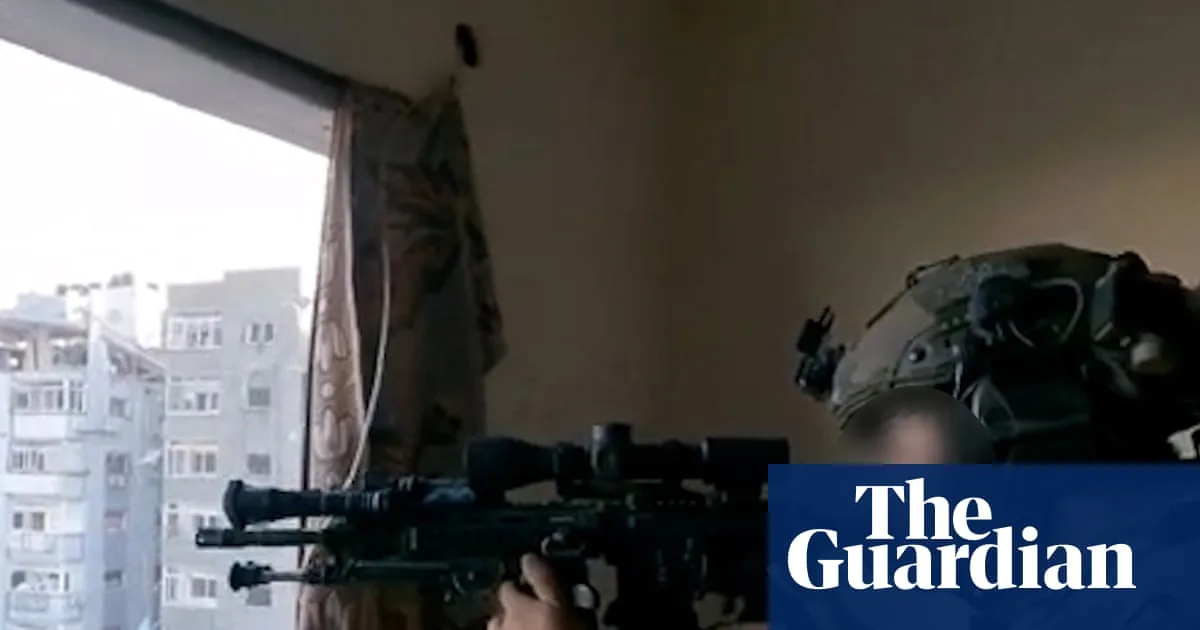
Israeli Snipers Kill Three Brothers Crawling to Gaza Hospital, Report Alleges War Crimes
Israeli Snipers Kill Brothers Seeking Hospital Help in Gaza

Israeli Snipers Kill Three Brothers Crawling to Gaza Hospital, Report Alleges War Crimes

A harrowing new investigation has uncovered potential evidence of Israeli war crimes after three brothers from the Al-Aweini family were shot dead while attempting to reach a hospital in Gaza. The report, compiled by the human rights organisation Euro-Med Monitor, details how Husam Al-Aweini, 27, and Saad Al-Aweini, 22, were killed by Israeli snipers as they carried their wounded brother Abdullah, 29, towards Nasser Hospital in Khan Yunis. Their parents, both in their 50s, were also attacked during the incident, which occurred amidst a military siege on the medical facility.

Families Demand Justice Amidst Ongoing Grief

More than two years after the tragic event, the parents of the three brothers continue to seek answers regarding why their sons were targeted. They remain devastated, unable to comprehend how a mere one-minute walk from their home to the hospital for urgent medical treatment resulted in the deaths of all three young men. The Independent contacted the Israeli Defence Forces (IDF) with detailed questions about the brothers' deaths and provided geographical coordinates of a strike on the family home, alongside a comprehensive 25-page report featuring satellite imagery and eyewitness testimony.

In response, an IDF spokesperson stated the incident was "not known to the IDF" and that further details would be required for clarity, without specifying what additional information was needed. The IDF also could not confirm whether it maintained records of each of its operations, leaving the family without official accountability.

Detailed Account of the Fatal Shooting

The sequence of events began on 11 February 2024 at approximately 11am, when a missile struck the upper level of the Al-Aweini family home as they prepared food downstairs. Abdullah, who was upstairs, sustained a severe abdominal injury. His father, Ibrahim Al-Aweini, 56, ascended to check on him and recalls being filmed by a quadcopter drone at close range before being shot multiple times in an open stairwell, resulting in shrapnel injuries to his head and back.

"The quadcopter was 30 or 40 centimetres away from my face," Ibrahim told The Independent. "When it filmed me, I felt reassured because I was a civilian and it shouldn't fire at me. But it did." With Abdullah unconscious, the family immediately planned to transport him to the nearby Nasser Hospital. Husam, Saad, and their surviving siblings Hassan, 33, and Anas, 16, rushed to carry him to safety.

Brothers Left to Bleed Out Under Sniper Fire

Euro-Med Monitor researchers utilised satellite imagery and topographic maps to establish the building's exact location, determining the distance to the hospital was no more than 100 metres. As the brothers carried Abdullah, eyewitnesses described coming under direct fire upon reaching the main road, about 15 metres from the hospital wall. "As soon as we crossed the main road, we came under direct fire," Anas recounted. "Husam and Saad fell, dropping Abdullah, while Hassan and I, closer to the side street, quickly retreated. All of this happened within a very short time."

Hassan described the agonising moment he saw his brothers pleading for help: "I saw my three brothers lying on the ground; one was still moving and asking for help, but I was powerless to help him." Witnesses reported seeing Husam and Saad attempting to crawl while bleeding profusely, only to be shot again by what are believed to be Israeli snipers. Euro-Med Monitor examined sightlines from nearby elevated structures to assess firing angles, correlating these with injury sites.

Mother's Heartbreaking Testimony and Hospital Siege

Their mother, Tahani Al-Aweini, 55, rushed outside after hearing gunfire and was instructed by Hassan to return indoors. She recounted the devastating moment she saw her son Saad gesturing for assistance as he lay dying. "He was ushering for me with his hand," she said. "He was pleading for me to come and help him. Before I got out of the house, I had shards of glass on my head and he helped me remove it. He helped me, but I couldn't help him."

Refusing to stay put, Tahani navigated an indirect route to the hospital's medical complex, during which she was shot but managed to reach the facility, where she remained for four days. Dr Atef al-Hout, director of the Nasser Medical Complex, recalled Tahani "bleeding from her foot and crying heavily," as she informed him her three sons were lying beside the eastern wall of the hospital.

"At the time, we did not know the fate of the young men, whether they were wounded or already dead," Dr al-Hout explained. "In any case, we were unable to provide any service or medical assistance because the situation was extremely dangerous. Any movement outside the hospital buildings could expose the staff to death. Israeli army snipers were deployed on top of UNRWA schools, on the Austrian Towers, and on residential buildings in the area."

Report Concludes Evidence of War Crimes

The bodies of the three brothers lay outside the hospital walls for four days as the Israeli army maintained a siege on the Nasser medical complex, one of the most controversial military operations in its history. Multiple reports at the time, including by Médecins Sans Frontières, documented Israeli snipers on surrounding buildings targeting the hospital area, resulting in further casualties before an evacuation order was issued on 14 February.

Euro-Med Monitor's investigation, which included interviews with witnesses and neighbours, confirmed the brothers were civilians with no political affiliations. The report concluded: "This shows an intent to harm civilians not involved in fighting, clearly classifying the incident as a full-fledged war crime rather than collateral damage. Additionally, the sudden attack without warning violates the precautionary principle, which requires the attacking force to take all possible steps to prevent or minimise civilian casualties."

It further added: "When considered in the context of the siege of the Nasser Medical Complex and the material facts outlined above, the targeting of the Al-Aweini family exemplifies a clear case of genocide elements in Gaza." Israel has consistently denied accusations of war crimes or genocide, despite international outrage over the high civilian death toll during its military campaign in Gaza.