Delcy Rodríguez Continues as Venezuela's Acting President Beyond Court-Imposed Limit
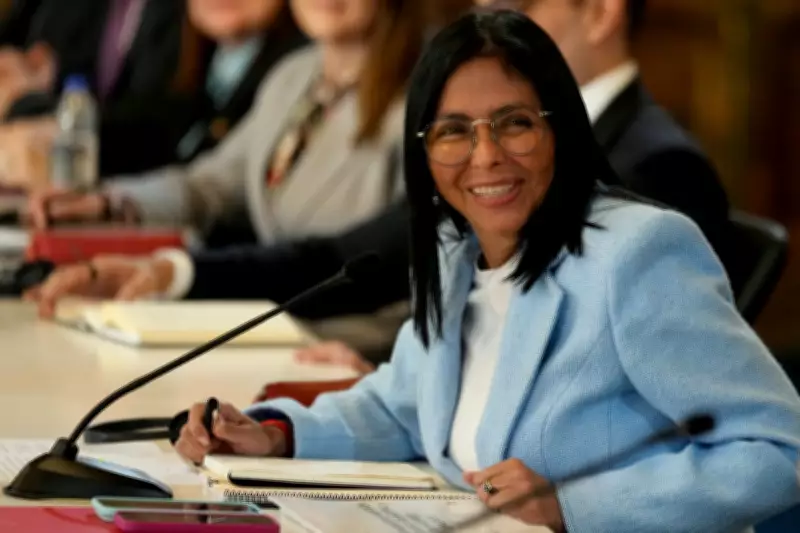
Delcy Rodríguez remains Venezuela's acting president on Monday, surpassing the 90-day restriction on her temporary role established by the country's high court following the United States' capture of Nicolás Maduro in January. However, uncertainty surrounds her tenure's duration as lawmakers have not publicly voted to extend her term beyond last Friday's deadline.
Legal Framework and Constitutional Provisions
According to the court order, Maduro is still officially Venezuela's president, with his "forced" absence due to what authorities term a "kidnapping" rendering him temporarily unable to perform duties. Venezuela's constitution, referenced by the court, stipulates that temporary absences should be filled by the vice president—Rodríguez's former position—for up to 90 days. These interim appointments can be prolonged by the national assembly for an additional 90 days.
The National Assembly, dominated by Rodríguez's party, holds the power to trigger a snap election if lawmakers declare the presidency permanently vacant. The government's press office has not responded to requests for comment on the situation.

Historical Context and Expert Analysis
Ronal Rodríguez, a researcher at the Venezuela Observatory in Colombia's Universidad del Rosario, noted that the government, particularly since Maduro assumed office in 2013, has previously employed legal interpretations to maintain power. "And it would be no surprise if they did so again now," he stated. "They will most likely try to come up with some kind of explanation, such as it being Good Friday or the way the days were counted, but in the end, everything will be validated by a ruling from the Supreme Tribunal of Justice."
Background on Maduro's Capture and Political Fallout
Maduro and his wife, Cilia Flores, were captured on January 3 in Caracas, Venezuela's capital, and transported to New York to face drug trafficking charges, to which both have pleaded not guilty. Rodríguez and other ruling-party leaders have demanded their release, labeling the detention a kidnapping, a sentiment echoed on billboards and murals across Caracas.
The Trump administration surprised many by collaborating with Rodríguez after Maduro's ouster, rather than engaging with Venezuela's political opposition. She has since spearheaded cooperation with the administration's phased plan to resolve Venezuela's complex crisis, promoting the oil-rich nation to international investors and opening its energy sector to private capital and international arbitration. Rodríguez has also replaced senior officials, including Maduro's loyal defense minister and attorney general.
International Recognition and Sanctions Relief
U.S. President Donald Trump has commended Rodríguez's efforts. Last week, the U.S. Treasury Department lifted sanctions on Rodríguez, while the U.S. State Department recognized her last month as the "sole Head of State" of Venezuela. The United States ceased recognizing Maduro as Venezuela's legitimate leader in 2019, following his contested reelection victory in 2018, a contest widely deemed fraudulent after opposition parties and candidates were barred from participation.