British Nationals Stranded in UAE Amid Iran Conflict Face Airport Chaos
British citizens fleeing Dubai have endured agonising waits at the airport, with holidaymakers subjected to 22 hours of what has been described as 'carnage' before boarding one of the few available flights home. This crisis follows a large-scale attack by the US and Israel on Iran on Saturday morning, which resulted in the death of Supreme Leader Ayatollah Ali Khamenei. In retaliation, Iran launched strikes on US assets and allies across the Gulf region, including targets in the United Arab Emirates.
Tourist Hotspots and Airports Targeted
Several major tourist and expat locations in the UAE have been hit, including the iconic Fairmont The Palm hotel and the Burj Al Arab hotel. Dubai International Airport and Abu Dhabi's Zayed International Airport have also been attacked, with one fatality reported at the latter. These bombings have instilled fear among Brits living, working, or travelling in the Emirates, leaving many stranded in a warzone.
The first official government-chartered flight out of the Middle East is scheduled to depart on Wednesday night from Muscat, the capital of Oman, operated by British Airways. However, one British couple has recounted the chaos of boarding one of the handful of UK-bound flights that has managed to depart the region since Monday.

Personal Ordeals and Evacuation Efforts
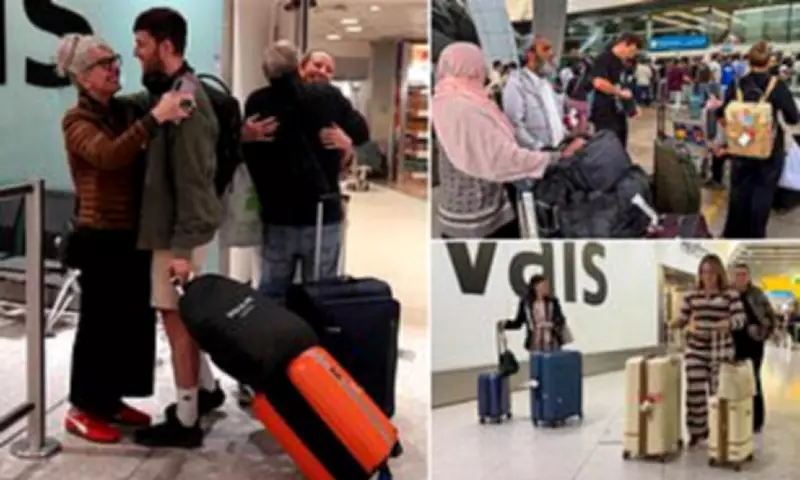
Lee Smart, 36, and his partner Nina Luminati, 35, from Thornton Heath, south London, arrived safely at London Heathrow on Wednesday afternoon after a harrowing experience. They spent a night sleeping on chairs at Dubai airport, having already delayed their return home by several days due to the conflict. The couple were returning from a wedding in India when they became stranded in the UAE while awaiting a connecting flight last Saturday.
'We were advised by our hotel to get to the airport yesterday morning and then it was just a bit of carnage,' Mr Smart said. 'I think many hotels told people the same thing. Maybe they were trying to get people out.' He noted that the UAE government handled the situation well, despite the turmoil.
Prime Minister Sir Keir Starmer announced that two official rescue flights will depart from Oman in the coming days, with the first leaving on Thursday. British Airways will operate additional flights between Muscat and Heathrow on Friday and Saturday, though all are fully booked. The airline stated it will review the situation and potentially add more services.
Flight Cancellations and Travel Disruptions
Sir Keir reported that over 1,000 British nationals returned to the UK on commercial flights from the UAE on Tuesday, with eight more flights scheduled for Wednesday. However, a widespread evacuation of the 138,000 British nationals registered in the Middle East is not expected. Most commercial flights from Dubai and Abu Dhabi have been cancelled due to airspace restrictions from the conflict.
Aviation analytics company Cirium revealed that 23 out of 33 planned flights from the UAE to the UK on Wednesday were cancelled. All flights from Qatar, Bahrain, and Kuwait to the UK were also axed. British Airways has suspended its scheduled flights from Abu Dhabi, Amman, Bahrain, Doha, Dubai, and Tel Aviv.
Muscat has emerged as a key evacuation point, as the Foreign Office does not advise against travel to that area, unlike Dubai, Abu Dhabi, and Doha. The journey from Dubai or Abu Dhabi to Muscat by road is approximately 300 miles.
Stranded Passengers and Emotional Reunions
Relieved passengers have shared their 'terrifying ordeals' upon arriving at British airports. Jessica Tennant, 30, from Lincoln, who was on holiday with her young children, described the situation as 'incredibly stressful,' with no updates from the government or airlines. Grandmother Mina Pattni, 62, from Leicester, recounted staying at the Fairmont The Palm when it was hit, calling it 'absolutely terrifying.'
Hafsa and Shamshed Ali anxiously awaited their 12-year-old son, Ahmad, who spent three nights alone in Dubai. 'It was so scary,' Ms Ali said. 'He's so young, just 12 years old, and it was his first time travelling outside the country.' Their son showed remarkable bravery during the ordeal.

Ongoing Challenges and Government Advice
Experts warn it could take weeks to clear the backlog of passengers, as about half a million people typically use airports in Dubai, Doha, or Abu Dhabi daily. The Foreign Office advises against travel to all countries under attack, including the UAE, Bahrain, Kuwait, and Qatar, and urges Brits in these areas to 'immediately shelter in place.' Travel to Iran and Israel is also advised against, with precautions recommended for Cyprus and parts of Egypt and Turkey.
Cirium reported that 1,555 out of 5,340 flights scheduled to the Middle East on Monday were cancelled, including 735 to the UAE and 255 to Qatar. Flights between the UK and Cyprus have been affected, with easyJet cancelling several routes. As the conflict continues, British nationals remain caught in a precarious situation, relying on limited evacuation options and hoping for a swift resolution.