As the United States prepares to commemorate its 250th anniversary, the stories of Black and Indigenous patriots who fought during the American Revolution are finally coming into sharper focus. These narratives, long overshadowed by traditional accounts focusing on white leaders, are now being celebrated through nationwide programs that aim to present a more complete and accurate history of the nation's birth.
The Overlooked Soldiers
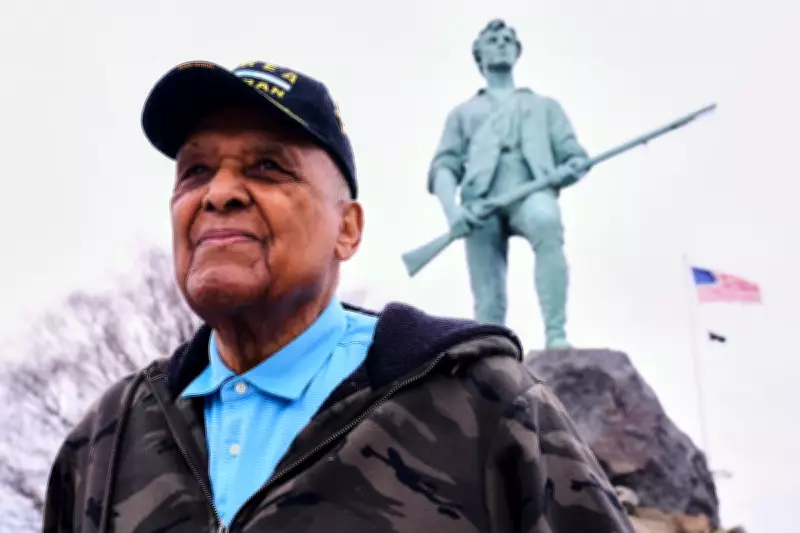
Charlie Price, a 95-year-old Black Korean War veteran, represents a common experience among Americans regarding Revolutionary War education. "I knew about George Washington, the Battle of Bunker Hill and that the patriots won," Price recalls of his school days. "It wasn't until I joined the Lexington Minutemen that I realized there's so much more to the story."
For five decades, Price portrayed Prince Estabrook, an enslaved man who joined his white neighbors on Lexington Green on April 19, 1775, as British troops approached. Estabrook was wounded that day but continued to serve through multiple deployments during the war. "I wasn't surprised that we didn't know about it," Price said. "I was surprised that there was one Black soldier out here."

Correcting Historical Narratives
Christopher Brown, a British Empire historian at Columbia University, explains that the Revolution has traditionally been portrayed as "a simple story and a moral story that celebrates American origins." However, recent decades have seen "a more accurate view of the past" emerge, showcasing the diverse collection of men and women who played critical roles in the fight for independence.
"There were Black men in the ranks who were fighting in Concord and Lexington and fought on Bunker Hill," Brown emphasizes. "They knew all of the work that women were doing to support the revolutionary effort. The fact that we didn't know that is more of a sign of our lack of curiosity and the need for greater research."
The Numbers Tell a Story
The National Park Service estimates that by the end of the Revolution, more than 5,500 patriots of color—including Black and Indigenous people—served on the colonial side. Meanwhile, many runaway slaves fought for the British, creating complex allegiances during this turbulent period.
These stories cannot be told without acknowledging the context of slavery, which was legal in all thirteen colonies at the time. Some Black soldiers fought while enslaved, while others hoped military service would lead to freedom. Indigenous soldiers made similar calculations, even as their tribes fought for survival against colonial expansion.
Contemporary Challenges to Historical Recognition
Despite growing awareness, efforts to promote these diverse stories face political pressure. Recent administrations have ordered the removal or censorship of exhibits highlighting slavery, the Civil Rights Movement, and mistreatment of Indigenous peoples.
Roger Davidson, Jr., an associate professor of history at Bowie State University, warns that failing to recognize these contributions impacts communities of color today. "If you're not seen as having contributed to society, to the military, to any of it, then people can sort of overlook you," Davidson explains. "It plays into some people's biases. Why should we pay any attention to you in the present day, politically, socially, economically, if you have not contributed?"
Commemoration Efforts Gain Momentum
MA250 has distributed millions of dollars in grants to commemorate battles across Massachusetts that led to American independence. Among the beneficiaries is the Black Heritage Trail in Concord, which highlights Black residents' lives during the Revolution.
Museum exhibitions celebrating Black patriots have also received funding. These include recognition of Crispus Attucks, a sailor of African and Indigenous ancestry who died in the Boston Massacre, and Salem Poor, who purchased his freedom before fighting at Bunker Hill.
American Ancestors, a nonprofit history center in Boston, opens its "Patriots of Color" exhibit next week with MA250 funding. The exhibition spotlights twenty-six Black and Indigenous men and women who contributed to the Revolution, including Prince Ames, forced to join the Continental Army in place of his enslaver, and Paul Cuffe, who petitioned against taxation without representation.

"By telling these lesser known stories, we want to highlight that ordinary people made a tremendous difference in the arc of the country's history," says Ryan Woods, president and CEO of American Ancestors.
The Life of Prince Estabrook
Records about Prince Estabrook's life remain limited, but the National Park Service indicates he was likely born around 1740 in the Lexington area. Born into slavery under landowner Benjamin Estabrook, his early life remains largely undocumented.
What is known is that he served under Colonel John Parker on April 19, 1775, when a musket ball struck his left shoulder. After recovering, Estabrook served eight years with the militia and Continental Army. Following the Revolution, he gained freedom and returned to Lexington, where 1790 tax records list him on Benjamin Estabrook's payroll as "a non-white freeman."
Family records indicate he died around 1830 at approximately ninety years old, buried in Ashby, Massachusetts. Price, who has passed reenactment duties to a younger colleague but still attends annual commemorations, emphasizes the importance of keeping Estabrook's story alive.
"Keep the story alive to make sure that everybody knows that Prince Estabrook was here," Price urges. "He was a viable person. He did his role, he did his part in fighting for the country."
As America approaches its semiquincentennial, these efforts to recognize diverse patriots represent not just historical correction but a crucial step toward understanding the complex foundations upon which the nation was built.