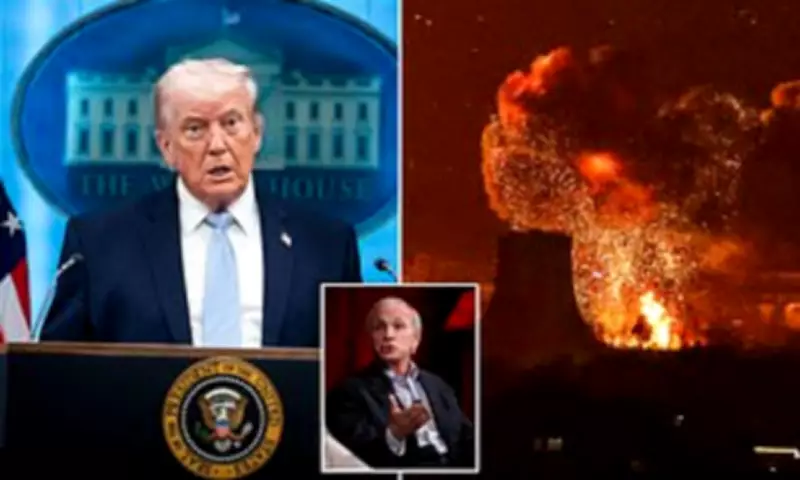
Billionaire investor and author Ray Dalio has issued a stark and urgent warning that the globe is already sliding into a world war, arguing that we are perilously close to a full-blown conflict between major superpowers. The founder of Bridgewater Associates, one of the world's largest hedge funds, contends that current international crises are not isolated events but instead paint a larger, more alarming picture of an escalating struggle between dominant global powers.
A Web of Overlapping Conflicts
Dalio, author of The Changing World Order, which examines the rise and fall of empires over five centuries, argues that the modern geopolitical landscape resembles previous world wars not through a single defining moment but through a complex web of overlapping wars and rivalries. He asserts that most of the public remains distracted by immediate events, such as heightened tensions with Iran, and fails to grasp the broader, more dangerous implications.
'For today, that is most importantly that the US-Israel-Iran war is just part of a world war that we are in and that isn't going to end anytime soon,' Dalio stated emphatically. Alongside active military engagements, he described what he terms 'non-shooting wars' involving intense competition in trade, technology, capital flows, and geopolitical influence. Together, these elements form what he calls a 'very classic world war' dynamic.

The Formation of Global Alliances
The core of Dalio's warning lies in how global alliances are rapidly forming, with a clear and stark alignment now emerging. He identifies a bloc comprising China, Russia, Iran, North Korea, and Cuba broadly opposed to a coalition led by the United States and its allies, including European nations, Israel, Japan, and Australia. Dalio points to United Nations voting patterns, strategic treaties, and deepening economic ties as concrete evidence of this deepening division, suggesting these alignments are already actively influencing global outcomes.
The billionaire investor argued that China and Russia appear to be 'the relative economic and geopolitical winners from this war,' while the United States retains a significant advantage in energy due to its position as a major exporter. This analysis forms part of what Dalio terms the 'big cycle' of global order—a recurring historical pattern that leads from periods of stability directly into intense conflict, as observed in the lead-up to past global wars.
The 'Big Cycle' and Its Alarming Progression
According to Dalio's detailed framework, the world has already progressed to step nine in this ominous cycle, bringing it just two steps away from direct military confrontation between major powers. The steps he meticulously outlined in his analysis are as follows:
- The decline of dominant powers relative to rising ones.
- Escalating economic wars, such as sanctions and trade blockages.
- The formation of economic, military, and ideological alliances.
- An increase in proxy wars.
- Financial stress, deficits, and debts increase, especially for leading powers that are most overextended.
- Government control increases over critical industries and supply chains.
- The weaponisation of key trade chokepoints.
- Powerful new technologies for warfare are built rapidly.
- Multi-theatre conflicts increasingly happen simultaneously.
- Suppression of internal dissent, as loyal support for leadership is demanded and opposition is squashed.
- Direct military combat between major powers takes place.
- Major increases in taxes, debt issuance, money creation, and financial controls to finance wars.
- One side eventually defeats the other and gains indisputable control, designing the new world order.
Recent global escalations provide tangible examples of these stages. Iran's closure of the Strait of Hormuz and subsequent US threats can be classified as stage seven—the weaponisation of trade chokepoints. Driven by fears of long-term supply shortages, oil prices experienced their fastest surge in any recent conflict, with Brent crude breaching $100 a barrel in early March for the first time in four years. The strait's closure is being hailed as the most significant energy supply disruption since the 1970s.

Meanwhile, stage eight has been quietly observed over several years as Russia and Iran exchange drone technology and production tips to expand military capacity. Stage ten is already visible in Iran, where the regime’s brutal crackdown on dissent—threatening and killing those who speak out—makes a popular uprising virtually impossible, illustrating the suppression of internal opposition.
Historical Parallels and Modern Vulnerabilities
Dalio compared the current geopolitical moment to the periods just before the First and Second World Wars, stressing that major wars rarely begin with a single, isolated event. Instead, they are preceded by numerous warning signs such as rising military stockpiles, increasing national debt and money printing, and nations repeatedly testing each other's strengths and weaknesses. The First World War, for example, was sparked by the assassination of an Austrian crown prince, but a global conflict erupted due to a complex, pre-existing system of alliances that compelled other nations to join the fight.
One particularly worrying aspect highlighted is a major vulnerability in the United States, one of the world's largest superpowers. Dalio pointed to the country's vast global military footprint, with '750-800 military bases in 70-80 countries,' as clear evidence of strategic overextension. 'It is also obvious that overextended powers cannot successfully fight wars on two or more fronts,' he added. This raises serious doubts about America's ability to respond effectively to simultaneous crises in regions such as Asia and Europe while already engaged in the Middle East—a concern for allies who rely on Washington for support.
He suggested that while the US remains the most powerful nation militarily, it may be less capable of sustaining prolonged economic and social hardship compared to its rivals. 'As history has shown, the most reliable indicator of which country is likely to win is not which is most powerful; it is which can endure the most pain the longest,' Dalio noted.
Echoes from Other Strategic Thinkers
Writing in the Daily Mail recently, former NATO deputy supreme allied commander Sir Richard Shirreff came to a similarly grave conclusion, stating: 'I cannot remember a more perilous moment in geopolitics in my lifetime – and I am now 70.' He argued that with Western attention focused on protecting allies in the Gulf and countering Iran, Vladimir Putin might double down on his campaign to seize Ukraine, sensing opportunity. Sir Richard further predicted that Chinese President Xi Jinping could seize the moment to launch a long-planned invasion of Taiwan, perhaps as soon as 2027.
Dalio warned that other nations are watching these developments closely and adjusting their strategies accordingly, as international alliances become increasingly fragile. The outcome of the US-Iran conflict, he said, will critically influence decisions by leaders worldwide, potentially reshaping the entire global order in the process.
Sir Richard continued this analysis, stating: 'The world order has changed from a multilateral rules-based world order led by the dominant US power and its allies to a might-is-right world order with no single dominant power enforcing order.' This fundamental shift, he argued, makes further large-scale conflict more likely, as there is no longer a clear, authoritative power capable of maintaining global stability. Dalio concluded with a sobering reminder: at this advanced stage in the historical cycle, conflicts typically intensify rather than fade, driven by an 'inability to resolve irreconcilable disputes with compromises' until a violent resolution is reached.