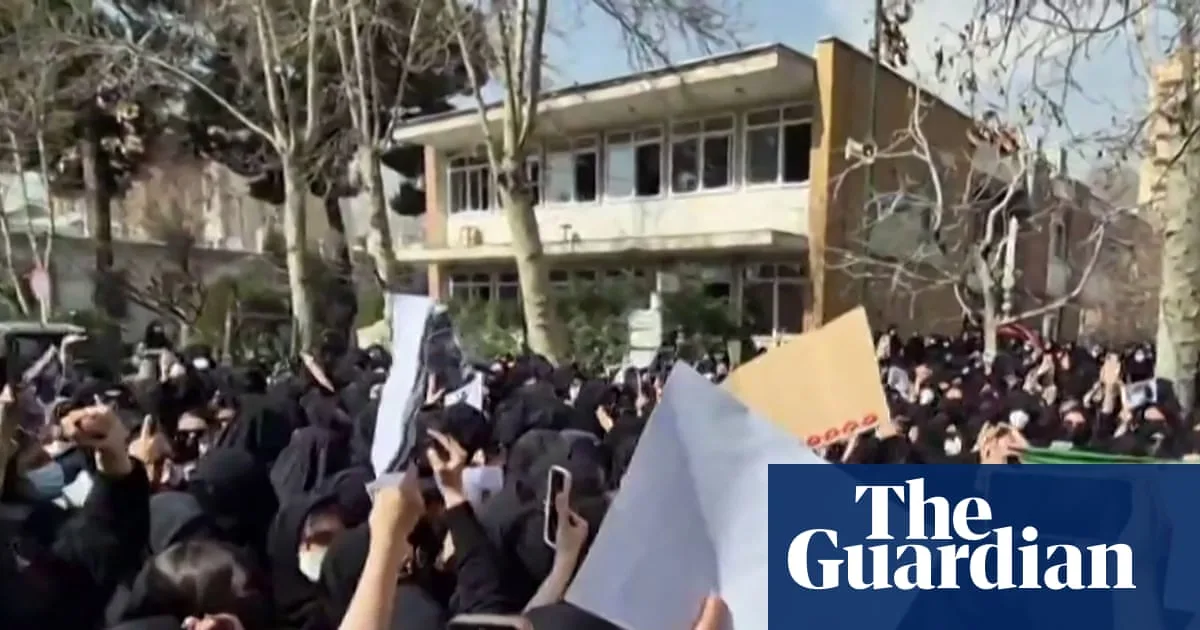
Plainclothes police and security forces, many of them armed, have flooded Iran’s remaining open universities in an attempt to crush a fourth day of student protests against the supreme leader, Ali Khamenei. Running battles were reported on some campuses, with videos showing fistfights between the Basij state-backed militia and students at the University of Science and Technology in Tehran. Pick-up trucks with machine-guns were photographed parked outside the University of Tehran, with demonstrations also in Mashhad.
Students found themselves barred from entry if they had been identified as being involved in previous protests, and university administrators announced the closure of in-person classes. Nearly 80% of Iran’s universities are already conducting virtual courses, partly to prevent students gathering to demonstrate against the government and its brutal crackdown of the January protests.
In videos from the University of Art in Tehran, chants included “We fight, we die, we take back Iran”, “Political prisoners must be freed” and “Khamenei the Zahhak [serpent king], we’ll bury you alive”. The protesters also called the Basijis the sons of sex workers and made comments about the sexual life of the supreme leader.
The protests form an uneasy backdrop to the third round of talks on Iran’s nuclear programme due to be held in Geneva on Thursday between the Iranian foreign minister, Abbas Araghchi, and the US special envoy, Steve Witkoff. Iran’s attorney general, Mohammad Mohebi Azad, demanded retribution against the protesters, stating: “The responsible agencies must quickly identify the related elements and take decisive and legal action against them.”
The indirect talks mediated by Oman are likely to be decisive and will be conducted as US President Donald Trump completes gathering his naval and air power in the region. The negotiation’s chances of success turn on whether the US is willing to give Iran a tokenistic right to enrich uranium inside Iran. Ali Hashem, associate research fellow at the Center for Islamic and West Asian Studies, Royal Holloway College, noted that Khamenei had shifted his rhetoric towards “confrontation through the lens of Karbala”, a central Shia narrative of martyrdom over submission.
The Washington-based human rights organisation HRANA published detailed identities of more than 7,000 people it says were confirmed dead in the January protests. The Iranian president’s office has published a list of 2,986 people killed and announced the total number of deaths as “3,117”.