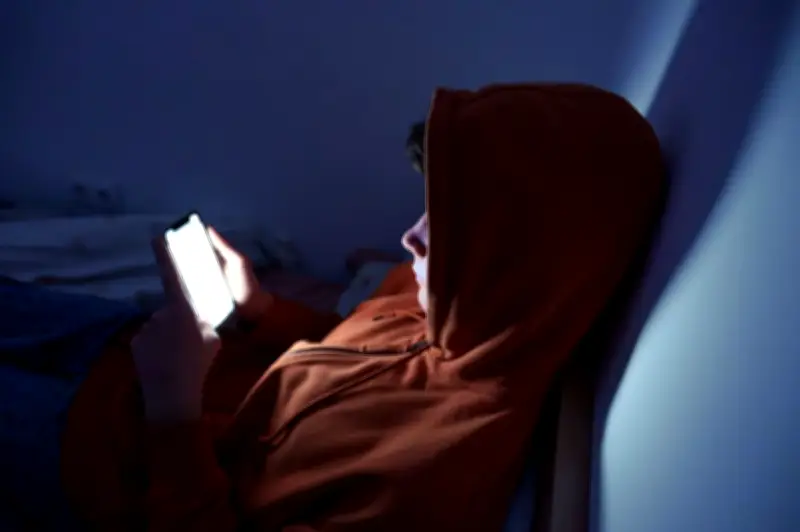
I grew up in the age of the internet — I couldn't survive social media as a teenager today. Even the way social media makes me, a woman with a fully developed frontal lobe, feel is too much to bear sometimes, writes Maddy Mussen.
Let me admit something to you. I spent the majority of my adolescence inside. While other kids played team sports or took up hobbies, I spent my evenings and weekends glued to a desktop computer. Shoulders hunched, head bent with monastic devotion, an early adopter of tech neck and blue light-induced eye strain. It taught me a lot, the 2010s internet. How to perfect a cut crease eye shadow. Quick-fix HTML coding. The astrological birth chart details of every single member of The Strokes. You name it, I learnt it.
Truthfully, I wouldn't take it back for a second — even if I do occasionally wish that I'd spent a little more time developing outdoors-related skills. Spending all day on that desktop was like a warm, informative cocoon. Which is why you might be surprised to hear that I am fully in support of the Government's decision to ban social media for under-16s. From one internet kid to another — I'm deleting the Sims pool ladder behind me and forcing them to swim.
A Different Beast Entirely
As a steadfast student of the internet, I know one thing for sure: what these kids are growing up with is nothing like the World Wide Web I once knew. It's a different beast entirely. A lot of blame can be laid at the door of the Infinite Scroll, the feature that exploits the dopamine loop in our brains by feeding us seemingly endless content. Back when I was a teenager, infinite scrolling on social media sites hadn't yet materialised. This meant you had to purposefully click between pages, the online equivalent of buying separate pints instead of having a glass of champagne constantly and imperceptibly topped up.
Even the creator of this feature, entrepreneur and interface designer Aza Raskin, has expressed immense regret over his invention. By his own calculations, Raskin once claimed that the infinite scroll wastes 200,000 human lifetimes worth of time every single day. 'One of my lessons from infinite scroll: that optimising something for ease-of-use does not mean best for the user or humanity,' he wrote on Twitter in 2019. AI users take note.
An Obsession with The Self
Then there's the internet's new-found obsession with The Self. Showcasing The Self, optimising The Self, flagellating The Self. For a large chunk of my adolescent internet life, profiles were oft-forgotten wastelands. Sure, you probably cared about your main picture, what song was playing on your site, or who your 'best friends' were on Bebo, but it didn't extend much further than that. No wonder our parents weren't as worried about our online habits back then, when putting our faces on the internet was not requisite.
Slowly but surely, pictures came to replace words. Friends could 'tag' each other in photos. Profiles prioritised galleries and 'walls' of images ahead of biography sections. Cut to 2026, and entire livelihoods are built on Instagram profiles. People pay for followers and painstakingly prune their posts, knowing that they can make millions if they manage to capture the zeitgeist just right. And even if this has created a female-dominated industry — an estimated 77 per cent of influencers are women, according to a 2023 report — it's one predicated on thinness, attractiveness and wealth.
A System Rigged Against Kids
Even the way social media makes me, a woman with a fully developed frontal lobe, feel is too much to bear sometimes. Between women's faces blending into one amorphous blob, never-ending exposure to the skeletal figures of 2020s Hollywood, and the encroaching tendrils of the manosphere, sometimes the only solution is to log off. The same can be said for my friends, who will often take month-long social media breaks — a needs-must abstinence I normally only witness during the first half of January.
I can only imagine what this kind of content does to the squishy brains of teenage girls and boys, who haven't been given the chance to develop this kind of self-restraint. Not only are teenagers naturally incapable of moderation, but the system is also now completely rigged against them. Algorithms are designed to maximise watch time and engagement, which allows toxicity to thrive. Perhaps a young boy didn't initially agree with Andrew Tate or HSTikkyTokky's views, but their content will have been inflammatory enough to keep him watching, and it's a lot easier to worm into someone's brain once you have their attention. Plus, teens aren't exactly the best when it comes to critical thinking. With social media now informing more people on current events than traditional news sites, misinformation can run rife, and they don't yet have the tools to separate the real from the fake.
For all my love of the World Wide Web, I would not have wanted my younger self on these social media sites. I'm not sure I would be the person I am today if I'd had to endure it. I completely understand why a teenager would slam a door in my face in response to me saying that — younger me certainly would have — but teenagers are famously bad at doing what's best for themselves. In time, we will look back on the era of children's unregulated social media use with horror. It might be a plaster on a bullet wound at this point, but at least someone's trying to stop the bleeding.