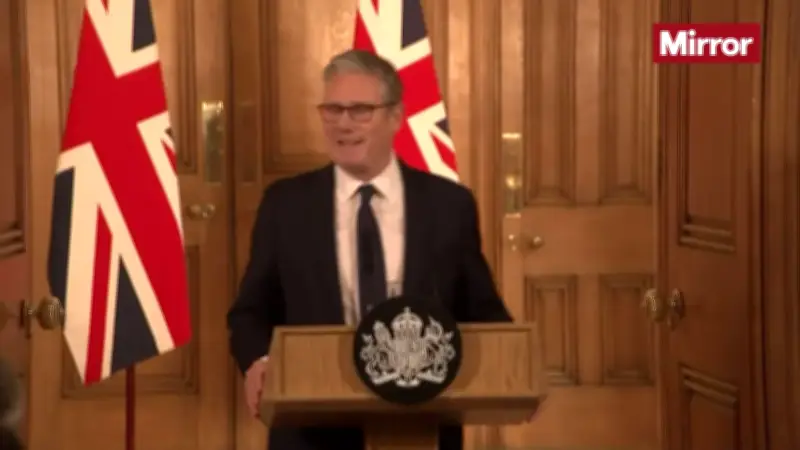
Prime Minister Keir Starmer has today announced a ban on 'high risk' social media for under-16s, with restrictions to be imposed on other platforms that are thought to be safer. Under-16s will be banned from using a string of major social media apps and heavily restricted on others, as Starmer vows he will not 'compromise the safety and happiness of our children.'
What Platforms Are Affected?
Sir Keir outlined the landmark crackdown today, Monday, June 15, confirming that under-16s will be restricted from using sites including TikTok, Instagram, Threads, Facebook, X, YouTube, Snapchat and Reddit. Messaging services like WhatsApp and Signal will not be included in the blanket ban.
Whilst 'high risk' platforms face an outright blackout, apps deemed 'safer' will hit a wall of strict restrictions, including the total removal of disappearing messages and live-streaming features. The government is also targeting AI chatbots and gaming platforms, as the government asserts that the British ban will go 'further than any other country' before.
Government's Stance
Pledging to 'give kids their childhood back', Sir Keir stated: 'This is a line in the sand. Tech giants had their chance and failed, but we're stepping in to protect children, back parents and set a new normal for future generations.' The Prime Minister has confirmed that the government is moving at speed, with legislation set to be brought before Parliament before Christmas Day, with the ban operational by early 2027.
Speaking at a press conference today, Sir Keir asserted that a full ban is the only right choice. He remarked: 'I come to it as a parent myself. I know exactly the fears that we all feel when we're thinking about this issue. All I've ever wanted for my own children, hand on heart, is for them to be happy and for them to be safe.'
While acknowledging the inevitable enforcement challenges ahead for parents of headstrong teens, Sir Keir compared the digital block to age restrictions on alcohol - arguing that just because some tech-savvy youngsters might find a loophole to access a platform, it doesn't mean the age limit should be lowered.
Background and Context
The crackdown follows a previous announcement that Britain will become the first nation to make it impossible for adolescents to take, share, or view nude photos on their smartphones. Tech bosses have been handed an ultimatum to clean up their devices or face penalties, which could include prison time.
The emergency intervention comes after a shocking Internet Watch Foundation (IWF) investigation exposed a dark web manual advising predators to use AI 'nudifying' tools to strip clothing from innocent underwear photos sent by kids, weaponising the manipulated images to blackmail victims in targeted 'sextortion' scams.
How Will the Ban Be Enforced?
A parallel social media ban for teenagers is already in effect in Australia, having launched last December. Under the regulations, 10 major social media giants must actively block under-16-year-olds from using their platform or face massive fines up to £26.5m (A$49.5m). The crackdown has successfully blocked more than one million underage accounts.
According to Ofcom data, an estimated 95 per cent of teens aged between 13 and 15 hold at least one social media account. To replicate Australia's success, the UK is expected to deploy digital ID checks and advanced face-scanning technology to stop kids from slipping through the net.
What Will Be Included in the Social Media Ban?
While the exact details will be ironed out in the coming months, the framework to minimise online harm for under-16s is expected to include:
- An addictive features ban: Stopping continuous 'doom scrolling' and autoplay videos specifically designed to keep children hooked on screens for hours.
- Account creation blocks: Preventing underage users from registering new accounts on high-risk platforms entirely.
- Late-night curfews: Muting notifications after a designated evening hour to prevent sleep deprivation and mental distraction.
- Data processing blocks: Raising the legal age of personalised algorithm data collection from 13 to 16. This targets corporate algorithms accused of serving inappropriate material anxiety-inducing content to children to keep them glued to the screen.
- Age verification checks: Utilising facial-age estimation scanning or verified digital ID systems, building on the Online Safety Act's existing framework for online pornography.
- Explicit age-blocking software: Forcing tech giants to embed software directly into devices to block receiving or sending explicit images.
- VPN crackdown: Virtual Private Networks (VPNs) are used to browse the internet privately; they reroute the user's IP address and identity, and signal that the connection is coming from elsewhere. Whilst adults are unlikely to be banned from using them, targeted restrictions could stop resourceful teens trying to bypass social media filters.
Will the Social Media Ban for Teens Work?
While polling shows an overwhelming majority of British parents support the intervention, safety campaigners remain deeply sceptical. Research published in March 2026 by the Molly Rose Foundation - a charity established in memory of 14-year-old Molly Russell, who died by suicide after viewing thousands of posts about self-harm on social media - showed that 60 per cent of Australian teens managed to keep their social media accounts despite the ban. The study found 70% of children found it 'easy' to circumvent the ban, noting that platforms routinely failed to detect or seek to remove under 16s accounts.
Furthermore, 51% of children who accessed restricted platforms prior to the ban coming into force said it has made no change to their online safety. Andy Burrows, Chief Executive of Molly Rose Foundation, warned: 'These results raise major questions about the effectiveness of Australia's social media ban and show it would be a high-stakes gamble for the UK to follow suit now. Parents and children deserve better than a flawed ban that delivers a false sense of safety that quickly unravels.' Molly's father, Ian Russell, added: 'The cost is too high to get this wrong by rushing into an Australia-style ban that offers the perception of security but is letting children down in practice.'