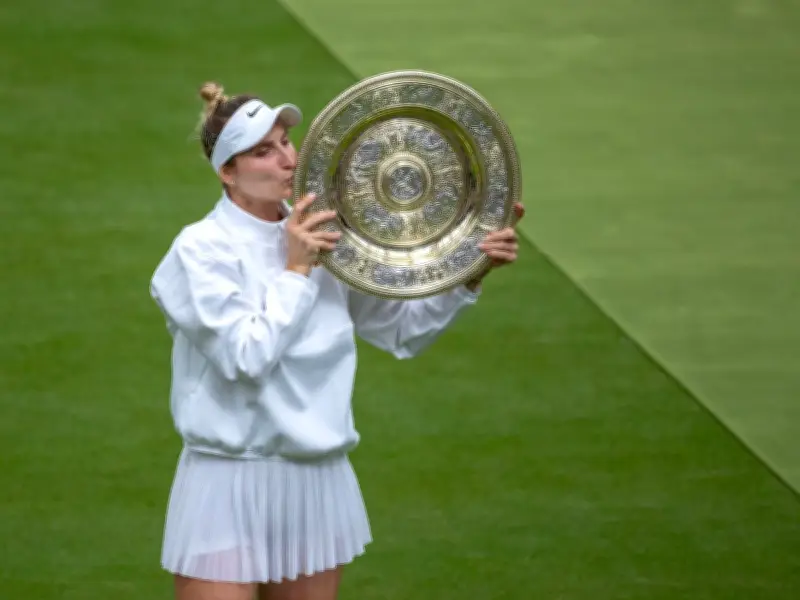
Marketa Vondrousova, the 2023 Wimbledon women's singles champion, has been banned from professional tennis for four years after refusing to submit to a doping test in December 2025. The International Tennis Integrity Agency (ITIA) announced the suspension on Monday, stating that an independent tribunal found no compelling justification for her refusal.
Background of the Incident
In late 2025, the former world No. 6 took to Instagram to express her displeasure when a doping control officer arrived at her home one evening to conduct an out-of-competition test. Vondrousova described the visit as a 'serious intrusion into my privacy.'
In April 2026, the Olympic silver medallist released a further statement, revealing she had reached 'breaking point' and felt 'scared' when someone rang her doorbell 'late at night without properly identifying themselves or following protocol.' She stressed that she had no intention of avoiding a test and was simply concerned for her safety. Vondrousova also disclosed that specialists had confirmed she was suffering from Acute Stress Reaction and Generalised Anxiety Disorder.
ITIA's Decision and Rationale
The ITIA charged Vondrousova with refusing to submit to a sample collection. The independent tribunal ruled that the starting point for a sanction when a player refuses a test must be the same as if they had tested positive, to prevent athletes from serving shorter bans by refusing tests. The ITIA stated: 'An independent tribunal has suspended Czech tennis player Marketa Vondrousova for four years for refusing an anti-doping test in December 2025.'
ITIA chief executive Karen Moorhouse commented: 'We understand that the testing process is uncomfortable, and acknowledge that it is an additional burden for players whose jobs already come with a high level of pressure and scrutiny, but it is essential to protect fair competition. Safety and welfare of players and our testers is really important to us. Our testers are well-trained, professional, and the gender of our testing witness always matches the player. They carry ID at all times, and players are able to verify their identity in other ways if they are ever unsure. Unpredictable testing is an essential tool to protect clean sport. The independent tribunal ultimately supported that principle. This case is an important reminder that players can be tested at any time, in any place, and that refusal comes with significant risk.'
Vondrousova's Defence and Tribunal Findings
During the hearing, Vondrousova argued that stress, poor mental health, and concerns for her personal safety influenced her decision. The doping control officer who attempted the test also gave evidence. The tribunal concluded that the evidence offered 'no compelling justification' for refusing the test.
Vondrousova's ban will run until 21 June 2030. A full written ruling is to be published 'in due course.' The player, the ITIA, and the Czech national anti-doping organisation each retain the right to appeal to the Court of Arbitration for Sport. The ITIA confirmed that 'independent and confidential wellbeing support' would be made available to the former Wimbledon champion.
Express Sport has approached Vondrousova's legal representative for comment.