
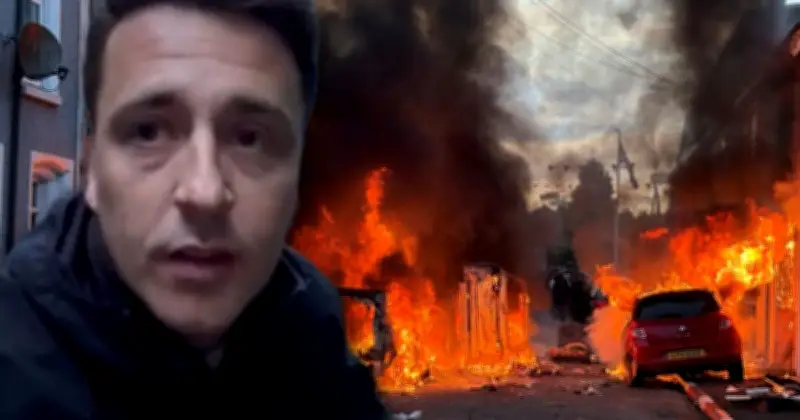
I was a British Army captain, but the Belfast riots were as bad as anything I've ever seen. As the only journalist in one of the hotspots of violence last night, the attacks on the community were as horrifying as the worst things I dealt with, writes Conor Wilson.
A City on Edge
“We’ll never have normality in this country,” the taxi driver tells me as he drives me towards Belfast’s infamous Shankill Road. It is 6.30pm in the evening after a horrific knife attack in the city that has sparked the ignition of a tinderbox with a short fuse that underpins the Northern Irish capital. There is a feeling of grim expectation in the air after shops, restaurants and offices across the city closed early in anticipation of disorder, in a normality unique to this corner of the UK.
As he speaks, I feel as though I understand his point, but hours later, after witnessing violence and criminality sweep across the city, I realise that I hadn’t fully grasped the true meaning of his words. Because normality in Northern Ireland is not normality in any other part of the country.
Witnessing the Chaos
In the hours that follow, I witness homes being broken into by masked men, although more often they are boys, simply because somebody on social media said immigrants lived in them. I see cars torched, windows smashed, and homes set alight with families inside before a cheering crowd devoid of fear of an imminent arrival of police officers. A masked rioter later tells me that this is just what happens in this country and that for many of those in attendance, this is the only means of protest they know.
Through this lens, I can see why Northern Ireland will never achieve “normality”. Children look on through adjacent houses, as their young minds try to comprehend the barbarity outside the place they call home, as they wonder whether it will be their property that is set upon by thugs capitalising on a gruesome attack to satisfy their inner urges. On the other side, I see children in the crowd, brought by parents, as if witnessing the indiscriminate attack of defenceless men, women, and children is a twisted right of passage in these parts.
The Cycle of Violence
Normality in the minds of those targeted and those within the crowds is violence and destruction. Normality is an ingrained hatred of authorities and outsiders. It is a self-destructive cycle of normalising this anger and outbursts of civil destruction. With this grounding, is it any wonder that the chances of Northern Ireland achieving “normality” are slim? Yet it is not lost on me that the disorder seen on the Shankill Road and across Belfast is not unique to this part of the world and is being seen more and more across the UK.
Generated by social media, public figures who should know better and foreign actors who benefit from division in Britain, it has been seen all too often in places such as Southampton, Epping and Southport. As Northern Ireland grasps the potential to one day achieve “normality”, the rest of the UK must ensure we do not lose ours. Normality shouldn’t become an acceptance that violence and destruction are a natural consequence of unspeakable atrocities before justice has been allowed to run its course.
Defending British Values?
Those with much to gain will justify the lawlessness and criminality that was seen last night as a response to the immigration policy of successive governments that has, as one community leader claimed in Belfast last night, allowed “people into our communities who don’t have our values.” Yet I didn’t see British values on display last night. I saw people claim to be defenders of our way of life immediately before launching indiscriminate attacks on defenceless members of their own community, including young children.
Last week, we celebrated a true defence of British values on the anniversary of D-Day. We remembered men who fought and died to rid Europe of a regime that targeted the homes and businesses of communities of those they deemed different. Remember that when, in the coming days, snake oil salesmen attempt to defend the mindless thuggery seen last night as a defence of our way of life. Because what I saw from the epicentre of the violence was the complete opposite.




