Indian National Admits Guilt in Sikh Separatist Leader Assassination Conspiracy in New York
An Indian national has entered a guilty plea to federal conspiracy charges, confessing to sending $15,000 to an individual he believed was a hitman to assassinate a prominent Sikh separatist leader residing in New York City. The plea was entered in Manhattan federal court on Friday, February 13, 2026, with U.S. Attorney Jay Clayton issuing a stern warning to foreign actors against plotting violence on American soil.
Prosecutor Issues Strong Warning Against Foreign Plots
U.S. Attorney Jay Clayton emphasized in a statement following the plea that the case sends a clear message: "Our message to nefarious foreign actors should be clear: steer clear of the United States and our people." This underscores the Justice Department's commitment to protecting American citizens from international threats.
James C. Barnacle Jr., the head of the FBI's New York office, revealed that Nikhil Gupta, the defendant, coordinated with an Indian government employee who directed him to carry out the killing. Barnacle described this as "facilitating a foreign adversary's unlawful effort to silence a vocal critic of the Indian government," highlighting the alleged state involvement in the plot.

Details of the Conspiracy and Guilty Plea
Nikhil Gupta, 54, admitted to Magistrate Judge Sarah Netburn that he was in India when he made the $15,000 payment online in 2023 to someone he thought could assassinate Gurpatwant Singh Pannun, an American citizen and Sikh separatist advocate. Unbeknownst to Gupta, he was communicating with an undercover law enforcement officer posing as a hitman, leading to his arrest and extradition.
Gupta has been held without bail since his extradition to the United States in June 2023 from the Czech Republic, where he was apprehended in Prague. A plea agreement stipulates that he will serve at least two decades in prison, with sentencing scheduled for May 29.
Courtroom Scene and Sikh Community Reaction
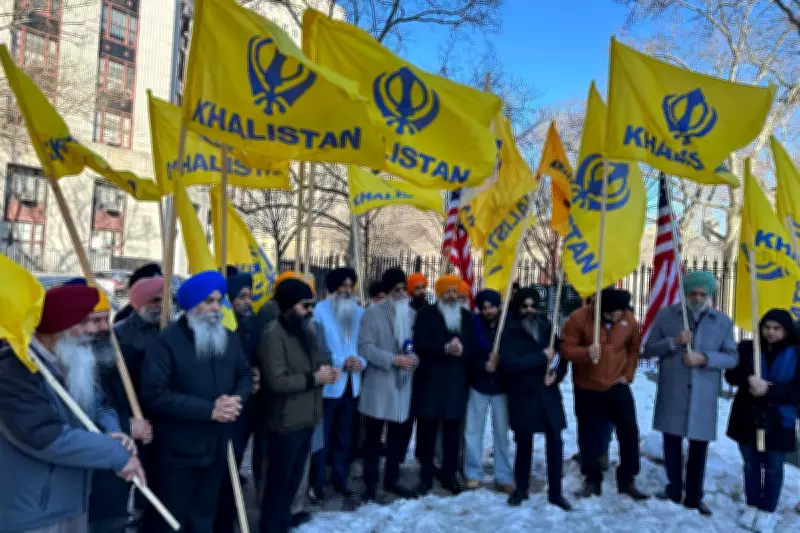
The guilty plea occurred in a courtroom filled with approximately two dozen Sikhs from the United States and Canada who support Pannun's goal of establishing an independent Sikh state called Khalistan in Punjab, northwest India. After the proceeding, the group briefly chanted a victory slogan and held a prayer service outside the courthouse, waving yellow flags emblazoned with "Khalistan" in blue ink alongside American flags.
Target's Response and Allegations Against Indian Government
Gurpatwant Singh Pannun, who advocates for Khalistan and is labeled a terrorist by the Indian government, stated in a phone interview that he plans to continue his activism "even if I have to face a bullet." He asserted, "I'm not a terrorist," describing himself as a human rights lawyer campaigning for equal rights for all religions in Punjab.
Pannun urged the U.S. to pursue Indian officials who directed Gupta, calling Gupta "just a foot soldier." He argued, "The Indian government cannot shield itself behind this operational foot soldier because the command, the direction and the funds are authorized by the Indian government." Pannun added, "I am ready to take India's bullet rather than take a step back and live like a slave. Working toward the independence of the Sikh state of Khalistan is my life's mission, until either I am killed or Punjab becomes an independent country."
Connection to Other Sikh Activist Killings
According to court documents, Gupta suggested to the undercover officer that the June 2023 killing of Hardeep Singh Nijjar outside a Sikh temple in British Columbia, Canada, was orchestrated by the same individuals planning Pannun's assassination. Gupta told the officer that Nijjar "was also the target" and "we have so many targets," instructing the officer to proceed with Pannun's killing now that Nijjar was dead.
This revelation points to a broader pattern of targeting Sikh separatist figures, raising concerns about transnational repression and the safety of activists abroad.