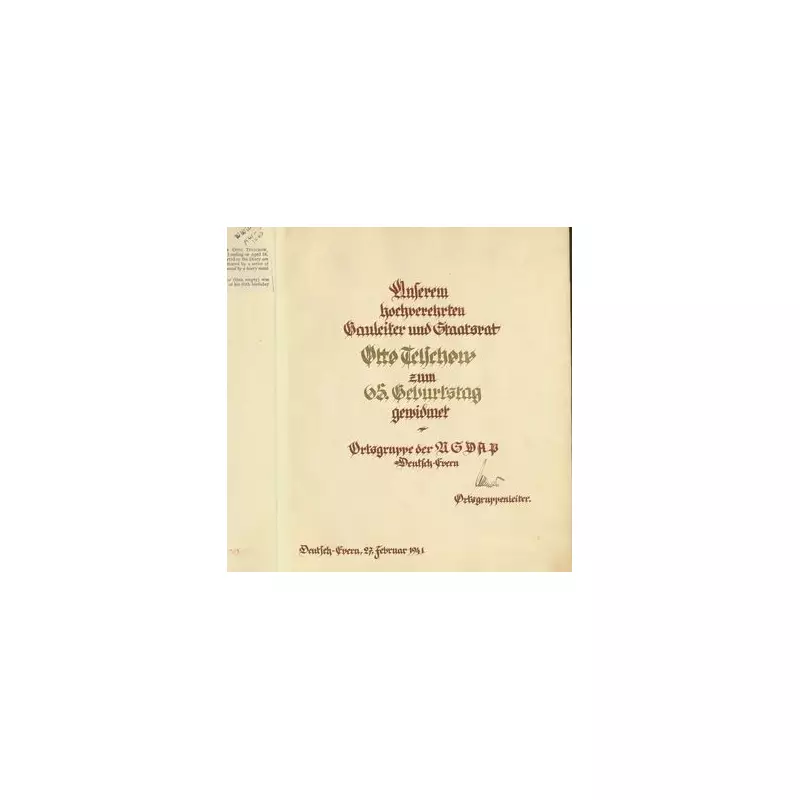
A secret diary belonging to a high-ranking Nazi official and close associate of Adolf Hitler has been authenticated, revealing chilling first-hand accounts of life inside the Third Reich and containing personal Christmas cards sent by the dictator himself.
Inside the Mind of a Nazi Gauleiter
The 75-page, leather-bound journal was kept by Otto Telschow, the Gauleiter of Ost-Hannover, a position that made him one of the most powerful Nazi officials in what is now Lower Saxony. Telschow began his diary in March 1941 at the age of 65, documenting his daily life with meticulous, often banal, detail alongside horrifying admissions of state-sanctioned terror.
Experts have confirmed the diary's authenticity after examining the paper, binding, ink, and handwriting. The volume was discovered at an auction in the United States before being purchased by the Lüneburg City Archive for £6,000. Its journey to America remains a mystery.

A Disturbing Proximity to Power
Among the most startling finds within the pages are personal Christmas cards from Adolf Hitler, carefully stuck inside the diary by Telschow. The entries provide an unfiltered glimpse into their relationship, including notes on their meetings.
In one passage, Telschow describes a meeting where Hitler had a hand injury, writing: "The Führer greeted us with his left hand, as his right is still swollen. But when he speaks, he is the same as always." This casual observation underscores the chilling normality with which Telschow documented his proximity to the architect of the Holocaust.
The diary shows a man utterly committed to Nazi ideology and comfortable with exercising brutal authority. In his own handwriting, Telschow describes using his power to remove supposed opponents, writing about clearing people "out of the way." Historians state he was actively involved in decisions that led directly to countless death sentences.
Banality and Evil Intertwined
Telschow's journal is a jarring mix of the ordinary and the monstrous. He recorded mundane details like the weather in Lüneburg and daily routines alongside passages filled with vile antisemitic rants and notes on internal Nazi rivalries. He also meticulously listed gifts he received.
The diary is an extremely rare historical source, offering the raw, unvarnished thoughts of a Nazi leader. Previously, historians relied largely on official documents. This personal account forces a confrontation with the human reality behind the bureaucratic terror.
It also raises new, disturbing questions. One unresolved case noted in the diary involves a Ukrainian forced labourer assigned to work for Telschow. Her ultimate fate remains unclear, highlighting the diary's potential to uncover further dark chapters.
The Lüneburg City Archive plans to publish the diary, aiming to expose, in plain words, exactly how Nazi power was exercised from the inside. Otto Telschow died in 1945, just days after a failed suicide attempt, but his secret record now speaks volumes about the era's pervasive evil.