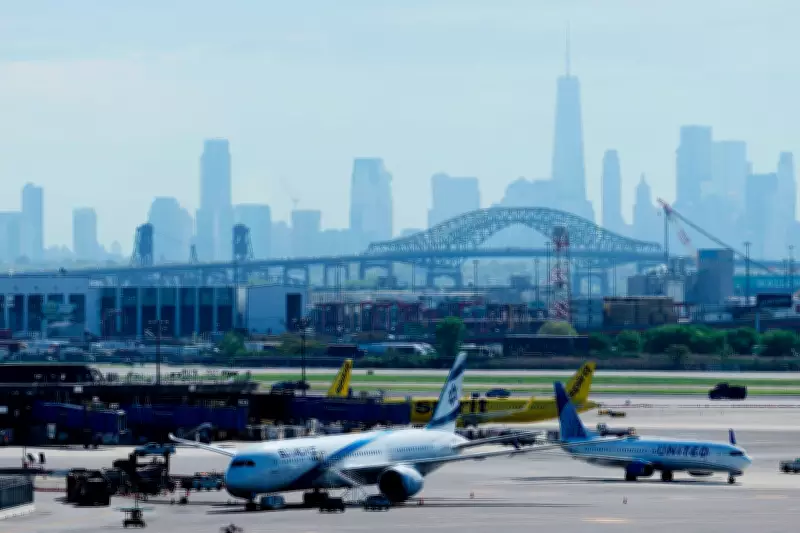
A United Airlines jet narrowly avoided a catastrophic disaster on Sunday when it struck a semitrailer truck and a light pole on the New Jersey Turnpike while landing at Newark Liberty International Airport. The Boeing 767, arriving from Venice, Italy, with 231 people aboard, made contact with the delivery truck during its approach to Runway 29.
Narrow Avoidance of Major Catastrophe
Safety expert Steve Arroyo, a former United pilot with extensive experience landing on the same short runway, remarked that a major catastrophe was avoided by mere feet. He estimated that if the aircraft had been five to ten feet lower, it could have crashed onto the highway, endangering many lives. The driver of the bakery delivery truck sustained minor injuries and was treated at a hospital, while no injuries were reported among passengers or crew.
Incident Details and Initial Reports
Air traffic control audio suggests the collision may have created a hole in the side of the aircraft, though United Airlines and the National Transportation Safety Board (NTSB) have not confirmed this. The NTSB reclassified the incident as an accident due to the extent of damage to the plane, but further details have not been released. Dash camera footage from inside the truck captured the moment of impact, showing the vehicle toppling onto its side. Semitrailers typically stand 13.5 feet tall, indicating the plane was flying exceptionally low.

Investigation Underway
The pilots did not broadcast damage details over the radio; instead, they called the tower by phone after landing. However, audio from ATC.com revealed a controller mentioning a hole in the side of the airplane more than half an hour later. NTSB investigators arrived on Monday to interview the flight crew and examine evidence. A preliminary report is expected in roughly one month, with no press conferences planned.
Challenging Approach and Runway Conditions
Runway 29, at 6,726 feet, is the shortest runway at Newark, used primarily during strong winds. Sunday afternoon saw gusts up to 31 mph, as reported by air traffic control. Arroyo noted that investigators will scrutinize the crew's planning for this contingency, including data entered into flight control systems and navigational aids. He described the approach as one of the most challenging globally, with a very low margin for error.
Historical Context and Further Inquiry
Jeff Guzzetti, a former NTSB and FAA crash investigator, stated he cannot recall a similar incident involving an airliner striking a vehicle. While small planes have hit vehicles, this is unprecedented for commercial jets. Investigators will also consider whether pilot fatigue played a role after the long transatlantic flight. The NTSB has directed United to preserve cockpit voice and flight data recorders, and the airline has placed the pilots on leave pending the investigation.