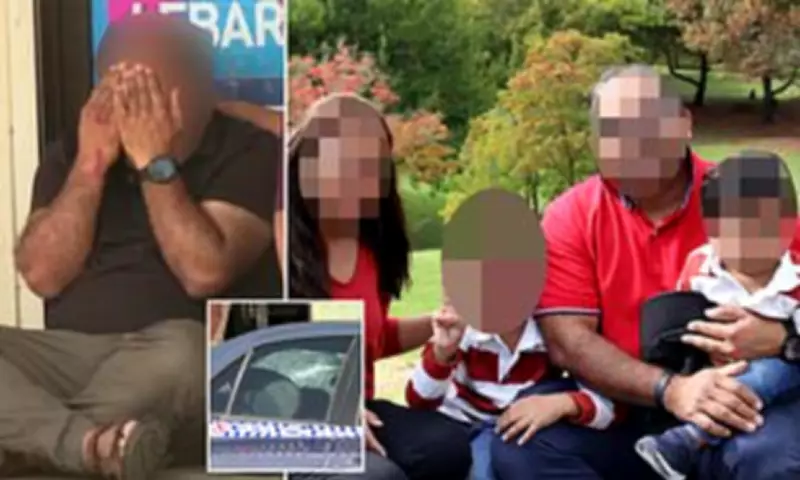
A father has delivered a gut-wrenching apology in court after his three-year-old son died when accidentally left for hours in the family car on a sweltering 34-degree day. The emotional testimony came during a coronial inquest investigating the deaths of two young children in New South Wales.
Father's Heartbreaking Testimony
The father, identified only as 'N' under court suppression orders, wept openly as he addressed the inquest into his son's death. "I wish I could see my son one more time," he said, his voice breaking with emotion. He described how his family's life had been shattered since that hot February day in 2023 in southwestern Sydney.
N offered a profound apology to his wife, calling her "amazing mum, my amazing wife." He continued: "I'm sorry I couldn't keep our family together. My guilt haunts me. It doesn't make sense. What happened to my brain?"

A Life Cut Short
The father painted a vivid picture of his son, known as 'A' in court proceedings. "He was the heart of our home and the light of our family," N said. "He wasn't just a child, he was cute, smart and adventurous."
N described precious family moments visiting his son's headstone, where they would "look up to try and see him jumping from one cloud to another and waving his hands." He remembered how A would pull their chins and say "mummy's happy, daddy's happy," and spoke of a smile that "touched everyone's heart even if you only met him once."
The Tragic Sequence of Events
The tragedy unfolded on February 2, 2023, during sweltering conditions in Glenfield. N had gone to bed late after seeing off a visitor who had been playing with his sons. In the morning, A had fallen asleep and was carried to the car, strapped into his child seat.
After dropping his seven-year-old son at primary school, N became distracted by the petrol light in his car and drove to a service station. Instead of continuing to A's daycare centre, which the boy attended five days a week, N returned home to work as a finance officer.
The Cognitive Science Behind the Tragedy
Cognitive neuroscientist Professor Muireann Irish explained to the inquest how "context dependent memory" and habitual behaviour could lead to such tragedies. "Brains constantly want to turn things into routine," she said, noting that disruptions can occur without people realizing anything is amiss.
Professor Irish emphasized this was especially likely when someone was tired, overworked, and bombarded by modern media and technology. N had returned to pick up his older son from school at 2:38pm, and it was only when they went to buy dinner ingredients that he made "the terrible observation" that A was still in the car.
Despite attempts at CPR and the arrival of police and paramedics, A could not be revived. N described living in "a parallel universe" since that day. "We live that day a thousand times a day and it never gets lighter," he said. "There is no moment when he is not with us, it is an absolute numbness."
Brotherly Bond Remembered
N spoke movingly about the relationship between his sons. "A's big brother was his superhero," he said. "They were partners in crime. They were absolutely glued together in brotherhood, friendship, love."
The father showed the court video footage of his son at 18 months old, laughing as he ascended a climbing wall at Blaxland Riverside Park. He also presented photos of the boy at the beach, on a boat, and in playgrounds. "He was high energy," N recalled. "He could sleep anywhere. I remember in Covid lockdown he fell asleep standing up against my back."
A Second Tragedy Examined
The inquest into A's death was held concurrently with that into the death of 'O', a 14-month-old girl who died in similar circumstances on February 4, 2025 in Earlwood. O had been left in the family car for around eight hours after her father failed to drop her off at an early childhood centre while distracted by heavy traffic, a huge workload, and the family running late.
In a touching moment during proceedings, photos of both children were placed on either side of the courtroom. The mother of O had a statement read by counsel assisting the inquest, William de Mars, saying: "We will never stop thinking of you. Our hearts will never be whole without you."

In a letter to her daughter, the mother wrote: "Dear [girl's name], you were our first born. Everything was fuller with you here. How desperately we reach back to that day... the what if, the frustration, the anger, the pain." She described missing "the spark in your eyes" and "the smile that broke across your face when something delighted you."
Safety Recommendations Considered
Expert witness Mark Terrell, chief technical officer of the Australasian New Car Assessment Program (ANCAP), told the inquest that child presence detection systems were gradually being introduced into new cars in Australia. Older systems used devices like weight sensors, while preferred systems now use radar sensors capable of detecting living beings through movement or even an infant's breathing.
Terrell explained that radar systems use escalating warnings including horn beeps, light flashes, or text message alerts after a car is locked. However, he cautioned: "It's not the complete answer. It's a back-up," emphasizing that public awareness and education remained crucial.
Judge Hosking, who became emotional during the father's testimony, expressed her condolences "for the loss of your beautiful baby." The inquest continued with the judge due to deliver findings and recommendations aimed at preventing future tragedies.
N concluded his testimony with a warning that resonated throughout the courtroom: "If Forgotten Baby Syndrome could capture me, it can capture anyone. It can turn your life upside down." His words served as a poignant reminder of how routine and distraction can combine with devastating consequences.