California Officials Charge 21 in Massive $267 Million Hospice Fraud Scheme
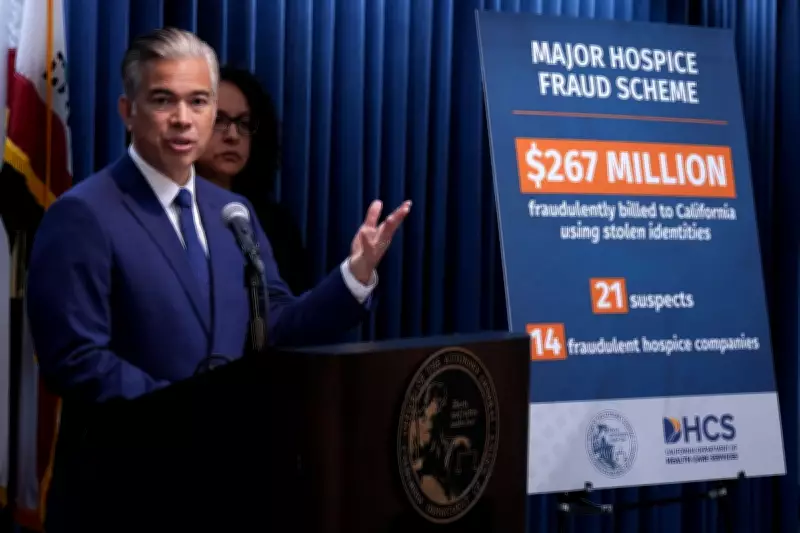
California officials announced on Thursday that they have uncovered a sophisticated multimillion-dollar scheme designed to defraud the state's government insurance program for hospice services. State Attorney General Rob Bonta revealed that authorities have charged 21 individuals, with five arrests made so far, in connection with the elaborate fraud.
Stolen Identities and Fraudulent Billing
According to Bonta's office, investigators discovered that individuals purchased personal information for non-California residents from the dark web. They then enrolled these stolen identities in Medi-Cal, California's version of the Medicaid program, which provides free or low-cost health insurance to low-income individuals and families.
The scheme escalated when the perpetrators acquired 14 hospice companies and began submitting bills for hospice services for the fraudulently enrolled individuals. The total fraudulent billing amounted to approximately $267 million, making this one of the largest hospice fraud cases in recent state history.

Charges and Political Context
The 21 individuals face multiple serious charges, including conspiracy to commit health care fraud, health care fraud, money laundering, and identity theft. These charges come with enhancements for aggravated white-collar crime and money laundering, reflecting the severity of the offenses.
This case emerges amid heightened political tensions, as the Trump administration has accused California of insufficient efforts in cracking down on fraud. Federal officials have launched a nationwide initiative targeting improper spending in federal benefit programs, recently arresting eight people in various health care fraud schemes around Los Angeles.
"This isn't a political game for us," Bonta emphasized in a news release. "This is about protecting taxpayer dollars, protecting the programs that sick and vulnerable Californians rely on, and protecting our state."
State and Federal Anti-Fraud Efforts
California Governor Gavin Newsom stated, "For years, California has led the charge to protect public programs from fraud and abuse. We hold accountable to the fullest extent of the law anyone who tries to rip off taxpayers and take advantage of public programs, particularly those as sensitive as hospice care."
Under Bonta's leadership, the state has filed 119 hospice-related criminal cases and secured 51 convictions, demonstrating ongoing efforts to combat such fraud.
The Trump administration has specifically focused on California in its national anti-fraud campaign, with particular attention to Medicare hospice fraud in the Los Angeles area. In March, President Donald Trump signed an executive order establishing an anti-fraud task force led by Vice President JD Vance.
While most federal efforts have concentrated on Democratic-led states, Republican-led Florida has also been requested to share information on Medicaid fraud identification and prevention strategies.
Broader Implications
This case highlights significant vulnerabilities in government health insurance programs and the increasing sophistication of fraud schemes involving stolen identities and corporate acquisitions. The use of the dark web to obtain personal information represents a growing threat to public programs designed to assist vulnerable populations.
The substantial financial scale of this fraud—exceeding a quarter billion dollars—underscores the critical need for enhanced security measures and interagency cooperation in protecting taxpayer-funded health care programs.