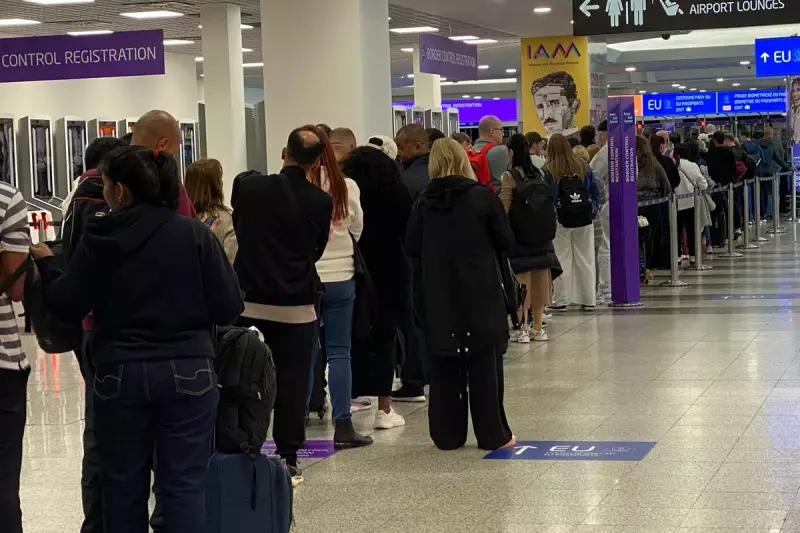
A major European airports body has issued a stark warning that the European Union's new digital border scheme is creating queues of up to three hours at passport control, with the potential for "serious safety hazards" if the current rollout continues.
Operational Chaos and Extended Waits
Airports Council International (ACI) Europe, based in Brussels, reports that the Entry-Exit System (EES) has led to a 70 per cent increase in the time taken for border checks for non-EU travellers. The system, which began its phased introduction in October 2025, requires third-country nationals like British tourists to not only have their passports examined but also to register their fingerprints and have a facial biometric captured.
Olivier Jankovec, the Director General of ACI Europe, stated that significant disruption is already being inflicted on passengers and airport operations, despite only one in ten travellers currently being required to undergo the full digital registration. "Significant discomfort is already being inflicted upon travellers, and airport operations impacted," he warned.

An Impending Crisis in January
The situation is set to deteriorate sharply in early 2026. According to the official EES implementation calendar, the percentage of travellers subjected to registration is due to jump from 10 per cent to 35 per cent on 9 January 2026.
Jankovec cautioned that unless critical operational problems are resolved within weeks, this increase "will inevitably result in much more severe congestion and systemic disruption for airports and airlines. This will possibly involve serious safety hazards." He emphasised that "The EES cannot be about mayhem for travellers and chaos at our airports."
The worst impacts are reportedly being felt at airports in France, Germany, Greece, Iceland, Italy, Portugal, and Spain.
Key Flaws in the System's Rollout
ACI Europe is calling for a moderated rollout schedule—the system is meant to be fully operational by 9 April 2026—and has highlighted several critical failures:
- Regular system outages that undermine border operations.
- Persistent configuration problems, including the partial deployment or failure of the self-service kiosks used for biometric registration.
- The continued unavailability of an effective pre-registration mobile application.
- Insufficient numbers of border guards at airports, reflecting acute staff shortages.
In contrast, data scientist Dr Nick Brown, who has studied the EES, pointed out that airports had an extra year to prepare with the kiosks already in place and could have run extensive simulations and tests with volunteers.
The European Commission has been approached for comment on the escalating crisis surrounding its flagship border management project.