

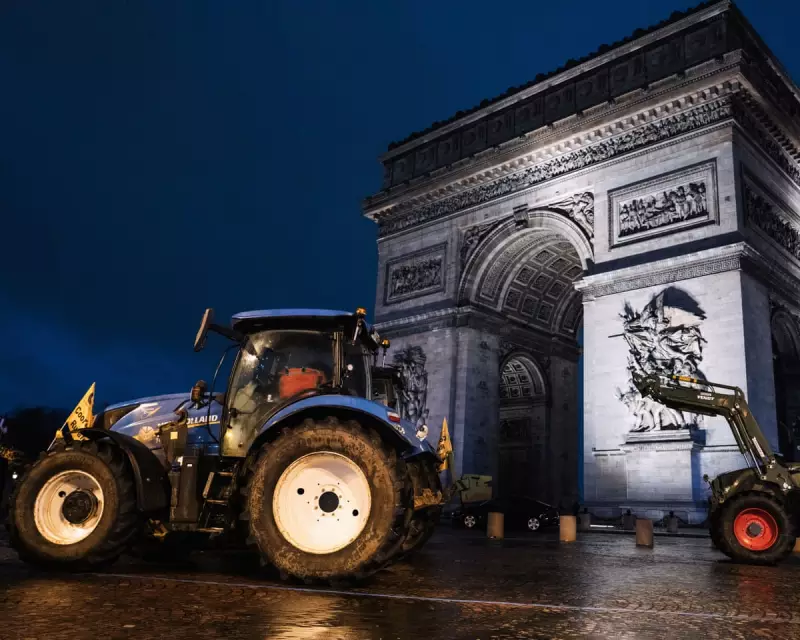
French farmers have brought their tractors to the heart of Paris, blockading iconic landmarks including the Eiffel Tower and the Arc de Triomphe. The dramatic pre-dawn protest, organised by the Coordination Rurale union, is a direct challenge to an impending European Union trade agreement with South America's Mercosur bloc, which farmers argue will devastate their livelihoods through unfair competition.
Pre-Dawn Convoy and Political Confrontation
After blockading motorways on the outskirts of the capital, dozens of agricultural vehicles breached police checkpoints to enter the city centre in the early hours. The protest culminated in a tense demonstration outside France's National Assembly, where farmers heckled the assembly president, Yaël Braun-Pivet, as she attempted to engage with them. A significant police presence surrounded the gathering, underscoring the high-stakes nature of the dispute.
Stéphane Pelletier, a senior figure within Coordination Rurale, encapsulated the mood, telling Reuters at the Eiffel Tower site that farmers felt a profound sense of "abandonment" and were caught between "resentment and despair," with the Mercosur pact symbolising their grievances. The French government, represented by spokesperson Maud Bregeon, condemned the illegal nature of the roadblocks and attempts to gather at parliament, warning authorities would "not stand by".

The Crucial EU Vote and Last-Minute Concessions
The protest strategically precedes a critical vote by EU member states scheduled for Friday. The deal, negotiated over 26 years and finally signed by European Commission President Ursula von der Leyen in late 2024, would create a vast common market of nearly 800 million people with Argentina, Brazil, Uruguay, and Paraguay. While it promises to boost EU exports like cars, machinery, and wines, it has sparked fierce opposition from agricultural sectors fearing a flood of cheaper imports.
In a bid to secure support, the European Commission this week proposed making an extra €45 billion available for farmers in the EU's next budget. This move appears to have swayed Italy, with Prime Minister Giorgia Meloni praising a "commonsense approach." Italy's support is now seen as pivotal, potentially providing the qualified majority needed for approval.
France's Isolated Opposition and Future Battles
Despite winning last-minute concessions, the French government, mindful of a powerful farming lobby and upcoming municipal elections, remains publicly opposed. France, alongside Ireland, Austria, and Poland, seeks tougher safeguards, including a trigger to reimpose tariffs if import prices fall by 5% rather than 8%, and the right to ban crops treated with pesticides illegal in the EU.
France's farming minister, Annie Genevard, has stated that even if the deal is approved by member states, France will continue to fight it in the European Parliament. However, with Germany and Spain backing the accord and Italy's likely support, analysts suggest France may lack the necessary votes to form a blocking minority under the EU's qualified majority system. The outcome of Friday's vote will determine whether this quarter-century of trade negotiations finally reaches ratification, setting the stage for the next phase of the political battle in Strasbourg.






