

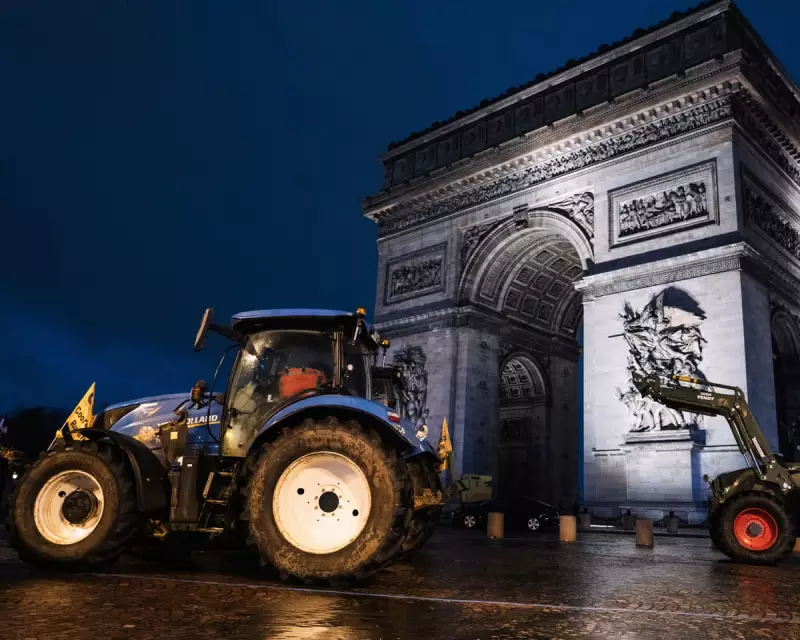
French farmers have brought central Paris to a standstill, using tractors to blockade iconic landmarks including the Eiffel Tower and the Arc de Triomphe. The dramatic pre-dawn protest was a direct action against an imminent European Union trade deal with South American nations, which agricultural workers claim will devastate their livelihoods through unfair competition.
Dawn Raid on the Capital
The protest, organised by the Coordination Rurale union, saw dozens of tractors overrun police checkpoints to reach the city centre after farmers first blockaded motorways on the outskirts. The action was strategically timed ahead of a crucial EU vote scheduled for Friday on the agreement with the Mercosur bloc—comprising Argentina, Brazil, Uruguay, and Paraguay.
Stéphane Pelletier, a senior figure in Coordination Rurale, encapsulated the mood, telling Reuters at the scene, "We are between resentment and despair. We have a feeling of abandonment – with Mercosur being an example." The protest mirrored similar action in Belgium last month, where over 1,000 tractors rolled into Brussels.

A Deal Decades in the Making
The proposed EU-Mercosur pact, negotiations for which have spanned 26 years, aims to create a colossal common market of nearly 800 million people. It promises to boost EU exports of industrial goods like vehicles and machinery, as well as wines and spirits. In return, the EU would open its markets to South American agricultural products, albeit with import limits on sensitive items like beef, pork, ethanol, honey, and sugar.
European Commission President Ursula von der Leyen signed the accord in late 2024, but it still requires ratification by EU member states and parliament. The core fear for European farmers is being undercut by an influx of cheaper produce from Mercosur, where different environmental and production standards often apply.
Political Standoff and Last-Minute Concessions
The deal has exposed deep divisions within the EU. While it is backed by Germany and Spain, France has long been a fierce opponent, mindful of its powerful farming lobby. Despite winning significant last-minute concessions, the French government remains wary with municipal elections looming in March.
Government spokesperson Maud Bregeon stated authorities would "not stand by" illegal blockades, but also declared the treaty "still not acceptable." France is pushing for tougher safeguards, including the right to reimpose tariffs if import prices fall by 5% rather than the agreed 8%, and to ban crops grown with pesticides prohibited in the EU.
In a bid to secure support, the European Commission this week proposed making an extra €45 billion of EU funding available to farmers in the bloc's next seven-year budget. This move appears to have won over Italy, whose Prime Minister Giorgia Meloni praised a "commonsense approach."
Analysts suggest Italy's pivotal support, representing 13% of the EU's population, likely provides the qualified majority needed for approval on Friday. Under this system, the accord requires backing from 15 of the 27 member states representing 65% of the population. France, whose opposition is shared by Ireland, Austria, and Poland, now seems unlikely to muster the numbers to block it alone.






