

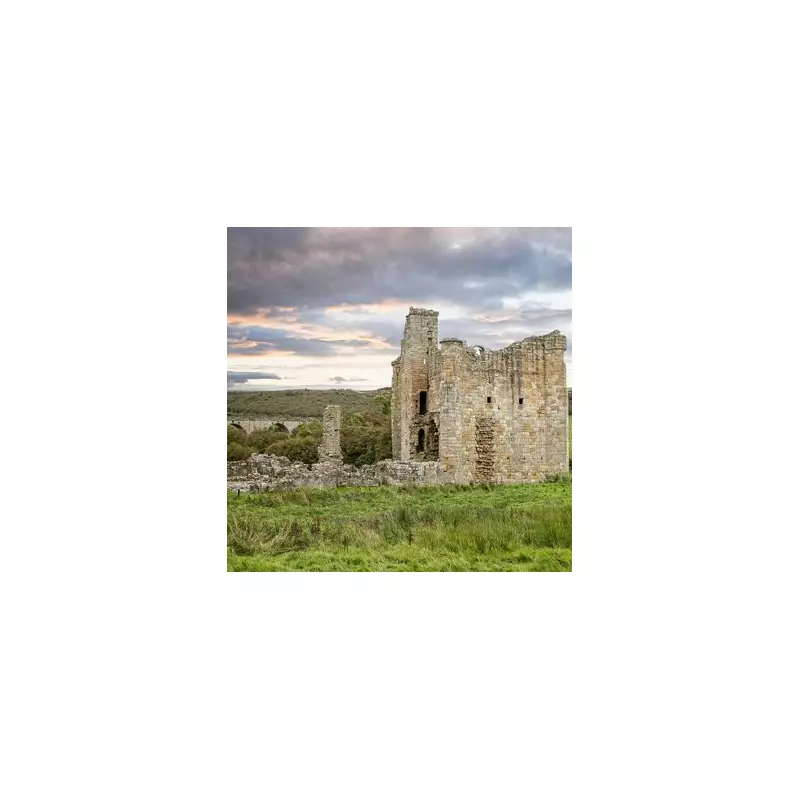
Tucked away in a serene Northumberland valley, a remarkable medieval fortress has been officially recognised as one of the region's top three castles. Edlingham Castle, a Grade I listed monument, captivates visitors with its picturesque riverside ruins and a distinctive leaning solar tower, often whimsically compared to the Leaning Tower of Pisa.
A Fortified Manor House Steeped in History
More a fortified manor house than a traditional castle, this hidden treasure lies west of Alnwick near the tiny hamlet of Edlingham. The site's origins likely trace back to a 13th-century manor house, with the oldest surviving sections being the hall house constructed around 1300 by Sir William Felton. This was a period of relative peace in Northumberland.
Sir William Felton built his fortune through royal favour, military service, and his marriage to Northumberland heiress Constance de Pontrop. His son, also named William, later enhanced the property by adding the now-famous solar tower to improve family living quarters. Despite a prominent crack, this tower remains the castle's best-preserved element today.

Architectural Intrigue and Later Decline
During the turbulent Anglo-Scottish wars, the Feltons further fortified Edlingham Castle with a gate tower and a stone curtain wall. A later heir expanded the gatehouse and completed the enclosure walls. However, by the mid-17th century, the castle was abandoned as a residence. Its stones were being quarried for other buildings by the 1660s.
By the close of the 19th century, the solar tower was the only structure visible above the grassy mounds. The state took ownership in 1975, with significant excavations conducted between 1978 and 1982. The site is now under the careful stewardship of English Heritage.
Visitor Acclaim and Atmospheric Setting
Esteemed architectural historian Nikolaus Pevsner once described Edlingham Castle as 'one of the most interesting in the county', a sentiment echoed by modern visitors. Reviews on platforms like Tripadvisor praise its unique charm and peaceful setting.
One visitor noted its spectacular and engrossing views, while another highlighted the joy of discovering it spontaneously from the B6341 road, appreciating its precarious beauty alongside a defunct railway viaduct and a nearby Norman church. The castle's location on low ground by the Burn, a tributary of the River Aln, adds to its secluded, atmospheric appeal.
This plucky historical underdog proves that you don't need the fame of Alnwick or the dramatic scale of Dunstanburgh to capture the hearts of those exploring Northumberland's rich past. Its recent accolade as a top-three castle confirms its status as an unmissable, off-the-beaten-track heritage site.






