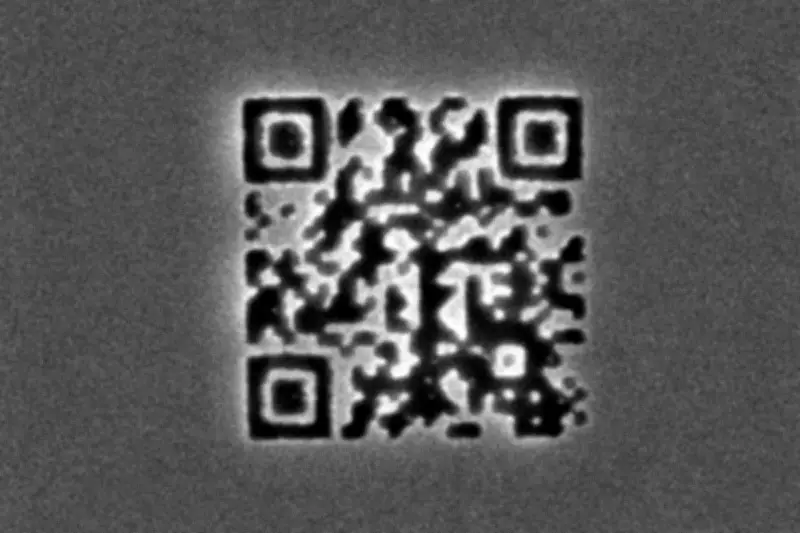
Breakthrough in Nanoscale Data Storage: World's Smallest QR Code Created
In a remarkable scientific achievement that could revolutionise how we preserve information, researchers have developed the world's smallest functional QR code, measuring smaller than most bacteria. This microscopic innovation represents a significant leap forward in long-term data storage technology.
Microscopic Engineering with Macroscopic Implications
The groundbreaking QR code, which measures a mere 1.98 square micrometres, has been officially recognised by Guinness World Records as the smallest ever created. Developed by a team from Vienna University of Technology in Austria, this microscopic code leads directly to the university's website when properly scanned.
The structure is so minuscule that it cannot be viewed using conventional optical microscopes, requiring instead the powerful magnification of an electron microscope for visualisation. Professor Paul Mayrhofer from the Institute of Materials Science and Technology explained the technical achievement: "We have created a tiny, but stable and repeatedly readable QR code."

Ceramic: The Ancient Solution to Modern Data Preservation
The research team employed an innovative approach using beams of charged particles to engrave the QR pattern onto specialised ceramic films. These materials, typically used for coating high-performance cutting tools, provide exceptional durability that allows the stored information to remain intact for centuries.
Senior scientist Alexander Kirnbauer highlighted the historical parallel: "With ceramic storage media, we are pursuing a similar approach to that of ancient cultures, whose inscriptions we can still read today. We write information into stable, inert materials that can withstand the passage of time and remain fully accessible to future generations."
Advantages Over Conventional Storage Methods
This ceramic-based storage solution offers several significant advantages over current electronic and magnetic storage technologies. Most notably, the engraved data can potentially last hundreds of years longer than conventional storage media while requiring absolutely no power or maintenance to preserve the information.
Kirnbauer emphasised the contemporary relevance: "We live in the information age, yet we store our knowledge in media that are astonishingly short-lived." The ceramic approach addresses this fundamental limitation of modern data preservation.
Future Applications and Scaling Potential
The implications of this technology extend far beyond microscopic QR codes. According to researchers, if scaled up appropriately, more than two terabytes of data could theoretically fit within the area of a single A4 sheet of paper using this engraving technique.
The research team now plans to explore broader applications of their discovery. Dr Kirnbauer outlined their ambitious roadmap: "We now aim to use other materials, increase writing speeds, and develop scalable manufacturing processes so that ceramic data storage can be used not only in laboratories but also in industrial applications."
Furthermore, scientists are investigating how more complex data structures—extending well beyond simple QR codes—can be efficiently written into ceramic thin films and reliably retrieved. This research direction could potentially lead to entirely new paradigms for archival data storage that combine exceptional longevity with remarkable data density.