Time machines may seem better suited to science fiction than the physics lab, but experts say this futuristic technology could become a reality. Researchers have revealed how time travel could really work by using the laws of quantum physics.
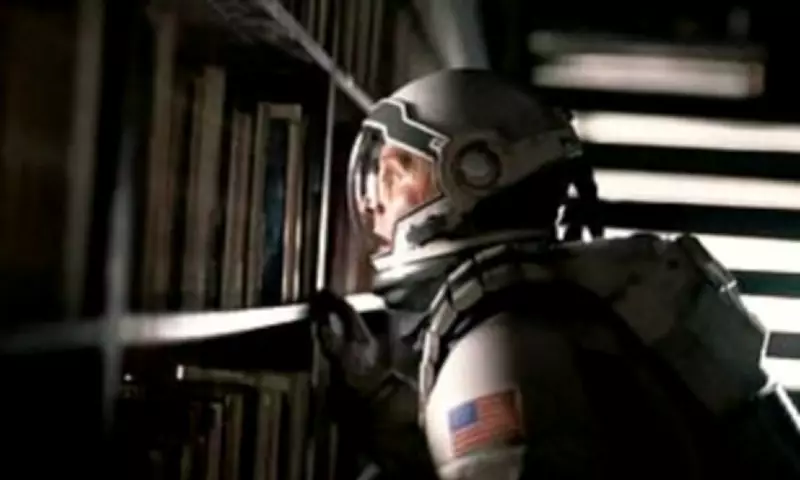
While their method will not let you hop back to the time of the dinosaurs, scientists say it could be possible to send messages into the past. The researchers even say this mind-bending technique would work just like in Christopher Nolan's sci-fi epic, Interstellar.
In the movie, an astronaut played by Matthew McConaughey sends a message to his daughter in the past by moving the hands on her watch. Although the reality would not be so cinematic, the researchers argue that this 'causal loop' resembles the way real time travel would work.

Co-author Dr. Kaiyuan Ji, a researcher at Cornell University, told New Scientist: 'The father remembers how the daughter decodes his future message. So he can instruct himself on what is the best way to encode the message.'
The Physics of Time Travel
It might seem surprising, but there is actually nothing in the laws of physics as we understand them that makes time travel impossible. According to the laws of general relativity, which are the best description of the universe we have, everything moves through the fabric of space and time on a set path.
One possible path that something can follow is known as a closed time-like curve (CTC). Something travelling on a CTC moves into the future before looping back on itself via the past to end up exactly where it started. The laws of physics allow for these loops to form, but actually making one on a large scale requires twisting spacetime with a literally infinite amount of energy.
However, on the very, very small scale, structures like CTCs might form naturally through the laws of quantum physics.
Quantum Entanglement and Time Travel
On the quantum level, two particles can become 'entangled', which means that what happens to one particle affects the other even if they are light-years apart. One possible way to explain this effect, which Einstein called 'spooky action at a distance', is to say that one particle is actually sending messages backwards in time to the other.
Rather than assuming that they are part of one massive system or that they are sending information faster than light speed, the particles' 'sensitivity' is explained by their receiving messages in the past that tell them how to react later.
That might sound absolutely mad, but in 2010, scientists actually came up with a way of mimicking closed time-like curves using entangled particles. Professor Seth Lloyd, a quantum physicist from the Massachusetts Institute of Technology, says: 'It was the equivalent of sending a photon a few nanoseconds backwards in time, and having it try to kill its former self.'
How to Send a Message Back in Time
Create a quantum system with two entangled particles. These particles form a closed time-like curve. Altering one particle creates a change in the other, sending information backwards through time. If you remember how the message was decoded in the past, you can use this to change how you encode the message in the future. That allows you to send legible messages, no matter how noisy the connection is.
What this creates is a bit like a telephone with a direct connection to another device a few moments earlier. In theory, you could use something like this to pass messages back to yourself in the past.
Just like a real phone line, the connection on a CTC is not always going to be perfect, and noise or disruption will make it hard to pass information with 100 per cent accuracy. Professor Lloyd says: 'Nobody's built an actual physical, closed time-like curve, and there are reasons to think it's very hard to make one. But all channels are noisy.'

The Interstellar Insight
This is where an insight from Matthew McConaughey in Interstellar comes in handy. In their new paper, accepted for publication in Physical Review Letters, Professor Lloyd and his co-authors write: 'The father, who is in the future, may retrieve his memory of past events he has witnessed, even including the daughter's decoding of the message which he is about to send! It would thus not be surprising that he will consult his memory of the daughter's decoding when encoding his message, so as to maximize the efficiency of the communication.'
Essentially, if you have already watched someone struggle to piece together your garbled message, you should know how to send it so that it is easier for them to decode. Even if the connection is very noisy, a backwards time-travelling message would still be legible. The slightly weird conclusion of this is that sending messages backwards in time is likely to be clearer than sending a message in normal time.
Although no one has built a real closed time-like curve, Professor Lloyd says it should be fairly easy to turn this new idea into an experiment on the quantum level. That could let scientists investigate how information is transmitted through 'noisy channels' and even improve real-life communication methods.
What Is Quantum Entanglement?
In quantum physics, entangled particles remain connected so that actions performed by one affect the behaviour of the other, even if they are separated by huge distances. This means if you measure 'up' for the spin of one photon from an entangled pair, the spin of the other, measured an instant later, will be 'down' - even if the two are on opposite sides of the world.
Entanglement takes place when a pair of particles interact physically. For instance, a laser beam fired through a certain type of crystal can cause individual light particles to be split into pairs of entangled photons. The theory that so riled Einstein is also referred to as 'spooky action at a distance'. Einstein was not happy with theory, because it suggested that information could travel faster than light.