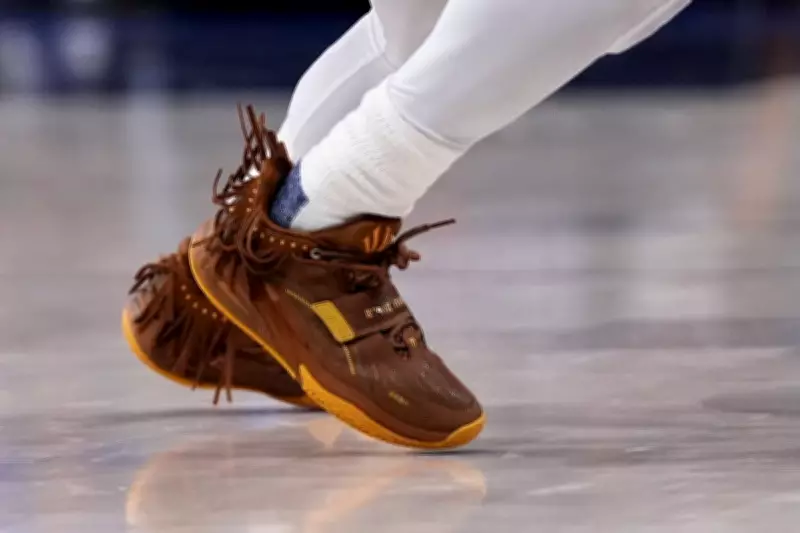
The Surprising Complexity Behind the Squeak of Basketball Shoes
As he watched the Boston Celtics play from the stands of TD Garden, one noise kept catching the ear of materials scientist Adel Djellouli. "This squeaking sound when players are sliding on the floor is omnipresent," he said. "It's always there, right?" Squeaky shoes are a familiar part of the symphony of a basketball game, where rubber soles rasp against hardwood as players jab step, cut, and pivot.
Unraveling the Mystery with Science
Returning home from the game, Djellouli, based at Harvard University, wondered how that distinctive sound was produced. He and his colleagues conducted experiments by sliding a sneaker against a smooth glass plate repeatedly. They recorded the squeaks with a microphone and filmed the action with a high-speed camera to observe what was happening beneath the shoe.
In a study published in the journal Nature, they described their findings. As the shoe works to maintain grip, tiny sections of the sole change shape, momentarily losing and regaining contact with the floor thousands of times per second. This rapid movement occurs at a frequency that matches the pitch of the loud squeak we hear. "That squeaking is basically your shoe rippling, or creating wrinkles that travel super fast," Djellouli explained. "They repeat at a high frequency, and this is why you get that squeaky noise."

The Role of Grip Patterns and Friction
The grip patterns on shoe soles may also play a crucial role. When researchers slid blocks of flat, featureless rubber against the glass, they observed chaotic, disorganized ripples but did not hear squeaks. The ridge-like designs on the bottom of shoes appear to organize these bursts, producing a clear, high-pitched sound.
Other researchers have studied similar friction bursts before, but this sneaker study examines friction at much faster speeds. For the first time, it directly links these speedy pulses with the squeaking sound they generate.
Practical Implications Beyond the Court
These insights extend beyond satisfying the curiosity of basketball fans. They could help answer important practical questions in physics and engineering. Physicist Bart Weber, in an editorial accompanying the research, noted that friction is one of the oldest and most intricate problems in physics, yet it remains difficult to predict and control. Understanding friction better could aid scientists in studying how Earth's tectonic plates slide and grind during earthquakes or in developing ways to save energy by reducing friction and wear.
Additionally, it could help eliminate awkward moments off the court, such as squeaky shoes in quiet office hallways. While this research does not offer a quick fix—though the internet abounds with risky advice like rubbing soap or dryer sheets on soles—insights from the study could inform the design of squeak-free shoes in the future.
Future Possibilities for Shoe Design
One additional experiment found that changing the thickness of the rubber could alter the squeak's pitch, making it higher or lower. This raises the possibility of fine-tuning shoes to squeak at pitches beyond human hearing. "We can now start designing for it," said Weber, who is affiliated with the Advanced Research Center for Nanolithography and the University of Amsterdam. "We can start making interfaces that either do it if we want to hear this sound, or don't do it if we don't want to hear it."
The Associated Press Health and Science Department receives support from the Howard Hughes Medical Institute's Department of Science Education and the Robert Wood Johnson Foundation. The AP is solely responsible for all content.