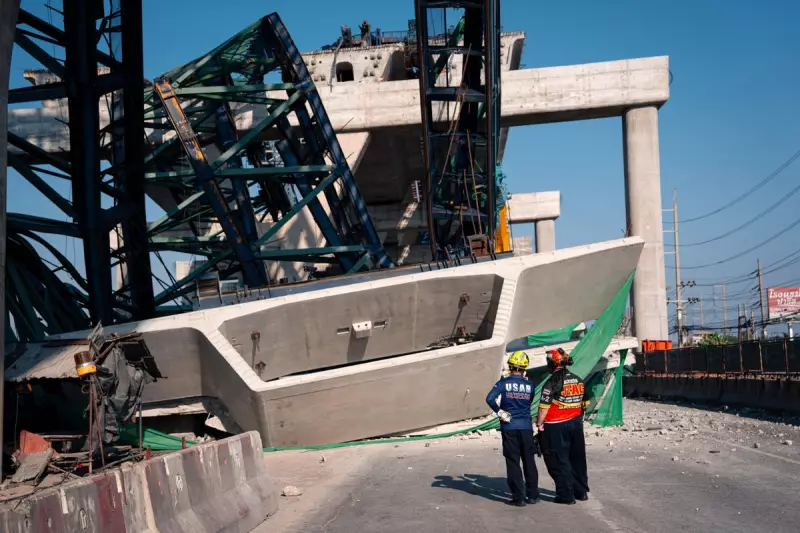
A wave of public outrage and official scrutiny has engulfed Thailand's construction industry following a devastating series of fatal accidents. The crisis has exposed deep-seated systemic failures, from lax regulation to alleged corruption, putting the safety of major infrastructure projects under the microscope.
A Week of Tragedy and a History of Failure
The immediate spark for the current furore was a catastrophic double disaster in mid-January 2026. First, a construction crane collapsed onto a moving passenger train, claiming 32 lives. Merely a day later, another crane accident killed two more people. These incidents came less than a year after the nation's worst modern construction disaster: the collapse of the 33-story State Audit Office building in March, which killed nearly 100 workers.
Public anger has zeroed in on the contractor involved in both recent sites and the prior tower collapse: Italian-Thai Development (Italthai). This major firm, a frequent winner of government contracts, was the joint lead contractor on the doomed office tower. Investigators concluded that while an earthquake triggered the collapse, the fundamental causes were flawed structural design and attempts to evade regulations.

In the wake of the 2025 disaster, twenty-three individuals and companies were indicted, including Italthai's President Premchai Karnasuta, on charges of professional negligence causing death and document forgery. The company has denied all wrongdoing in every case.
Systemic Flaws and a Government Crackdown
Experts argue that while technical causes like human error are often identified, the root problems are far broader. Lax regulation, poor enforcement, and corruption are cited as endemic issues undermining safety standards across the sector.
Panudech Chumyen, a civil engineering lecturer at Bangkok's Thammasat University, stated the core problem is not a lack of engineering knowledge but a failure of the system itself. "There are so many gaps that I don't know where we should begin to close them," he said, highlighting issues from lax law enforcement and red tape to a critical shortage of independent, conflict-free assessors.
In response to the latest tragedies, Prime Minister Anutin Charnvirakul has ordered a severe crackdown. The Transport Ministry must terminate contracts with, blacklist, and prosecute the companies involved. Unfinished projects will be funded by seizing performance bonds, and a contractor "scorecard" system to track performance records is to be enforced by early February.
The Chinese Connection and Public Backlash
The involvement of Chinese companies in Thailand's troubled construction sector has also drawn significant attention. The recent train accident occurred on a line that is part of a Thai-Chinese high-speed railway project, linked to China's Belt and Road Initiative.
Furthermore, the Chinese firm China Railway No. 10 was co-lead contractor with Italthai on the collapsed State Audit Office. Its Bangkok representative, Zhang Chuanling, was charged with violating Thailand's Foreign Business Act for using Thai nominees to hide Chinese control.
The disasters have stunned the Thai public, with social media flooded with outrage and images of so-called "tofu buildings" – a term popularised after China's 2008 Sichuan earthquake to describe flimsy structures built with substandard materials. China's ambassador to Thailand, Zhang Jianwei, stated that Beijing requires its companies to follow local rules and is willing to guide them to cooperate with Thai investigations.
The series of events presents a profound challenge for Thailand's authorities, demanding not just accountability for specific failures but a comprehensive overhaul of an entire industry's safety culture and regulatory framework.