

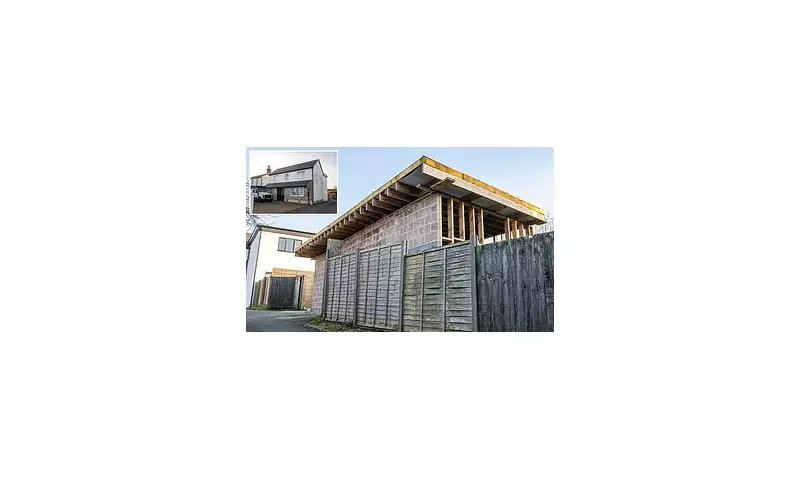
A property owner in Poole, Dorset, has sparked a bitter dispute with his neighbours after demolishing old outbuildings and constructing a two-bedroom cottage in his garden without the required planning consent.
The Disputed Development
Daniel Rayan purchased a three-bedroom detached house on Uppleby Road in Poole for £465,000 in 2022. He successfully obtained permission to extend and enlarge the main house. However, he then proceeded to knock down a dilapidated workshop and garage at the rear of the property and began building a new cottage in its place, an action not covered by his original application.
After a neighbour reported him to the BCP Council, Mr Rayan was forced to submit a retrospective planning application. His documents state the new building is intended as accommodation for elderly family members, describing it as a 'granny annexe'.

Neighbourhood Backlash and Accusations
Local residents have strongly objected, accusing Mr Rayan of dishonesty and manipulating the system. They claim he is a London-based developer with a clear understanding of planning rules, citing his role as director of Fervid Homes and his qualification as a RICS chartered surveyor.
Neighbour Rich Dymott stated: 'He knows exactly what he's doing, he made a conscious decision to bypass the system... Saying it's a family home and the cottage is for elderly relatives is a bare-faced lie.' Locals allege the main house is being used as an unregistered House of Multiple Occupancy (HMO), a claim which fuels concerns about overdevelopment.
In objection letters, residents argued the scale of the new building is excessive and that approving it would set a dangerous precedent of 'build first, apply later'. Alistair Maher, who lives next door, wrote that the applicant had 'deliberately sought to bypass planning controls'.
The Homeowner's Defence
Mr Rayan defends his actions, stating he sought formal planning advice in 2022 and was informed the outbuildings could potentially be converted. 'Based on this guidance, we proceeded with plans to convert the existing workshop and garage,' he said.
He contends that during early work, the structures were found to be structurally unsound, with unstable walls, a collapsed ceiling, and a damaged roof. 'As a result, it was necessary to demolish the original structures and replace them with new construction,' he explained, asserting the new build complies with building regulations.
The council is now considering the retrospective application, with a decision expected shortly. The outcome will determine the fate of the cottage and has become a flashpoint for wider local tensions over housing density and planning integrity.






