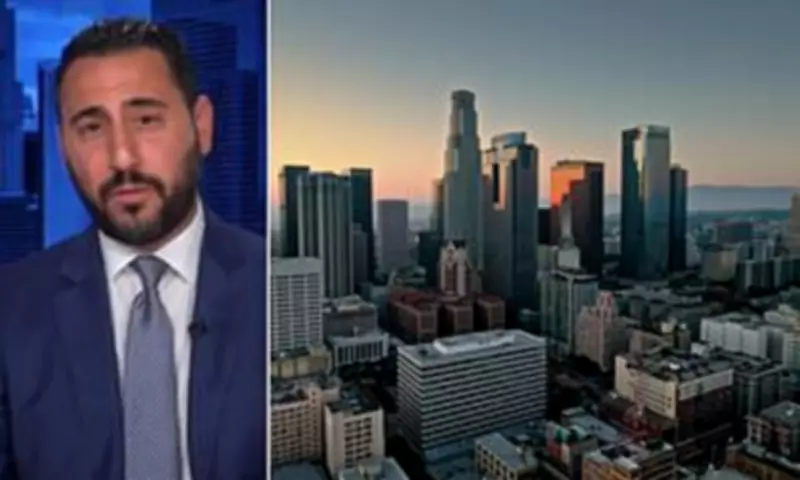
Celebrity real estate broker Josh Altman, star of Million Dollar Listing, has issued a stark warning about California's proposed billionaire wealth tax, arguing it will ultimately burden the state's working class rather than its ultra-wealthy residents.
Fox Business Interview Sparks Debate
Speaking on Fox Business's Varney & Co programme, Altman expressed profound skepticism about the California Billionaire Tax Act. The proposal would require the state's wealthiest individuals to pay a one-time levy equivalent to five percent of their assets.
'That's the dumbest idea I've heard since the ULA Measure, which I thought then was the dumbest idea I've heard,' Altman told veteran journalist Stuart Varney during the Saturday segment.

Previous Tax Measure Sets Precedent
The Measure United to House LA (ULA), referenced by Altman, is a so-called 'mansion tax' approved by voters in November 2022. Implemented in April 2023, it imposes a four percent tax on property sales between $5 million and $10 million, and a 5.5 percent tax on sales exceeding $10 million. Revenue funds affordable housing and homelessness programmes in Los Angeles.
Demographic Reality and Voting Power
'There's about 200 to 250 billionaires in California, more than any other state,' noted the 46-year-old realtor, who once appeared on Keeping Up with the Kardashians. 'However, there are also 40 million people in California, 23 million of whom are eligible to vote. If this hits the ballot, there is no way that the billionaires come out on top here, and that's an issue.'
Altman emphasised that previous tax measures haven't primarily affected billionaires. 'It was the same thing with the ULA Measure - it's not the billionaires you're hurting,' he asserted, though acknowledging that seven billionaires he knows have already relocated to more tax-friendly states like Florida and Nevada.
The Trickle-Down Concern
The real estate star highlighted broader economic consequences. 'It's the trickle-down effect. It's people, the hundreds of thousands of people that work for these billionaires. It's the trillion dollars that we're going to lose.'
Tech Billionaires Voice Opposition
Several prominent California billionaires have publicly criticised the proposed tax. LinkedIn co-founder Reid Hoffman and Google co-founder Larry Page have both spoken against the California Billionaire Tax Act.
Venture capitalist Vinod Khosla launched a particularly pointed critique on social media platform X in December, directly addressing the measure's champion, Representative Ro Khanna. 'You are so wrong Ro,' Khosla wrote. 'Top prospects for generating wealth in the state will almost certainly leave the state.'
Khosla warned that California would lose its 'most important taxpayers and net off much worse,' suggesting long-term damage unless the legislature bans wealth taxes entirely.
Notable Exceptions and Political Opposition
However, Nvidia founder and CEO Jensen Huang has indicated he hasn't paid significant attention to the act and isn't concerned about potentially paying the substantial levy.
Even Democratic Governor Gavin Newsom has expressed reservations. At a Bloomberg News event, Newsom stated he had been 'burdened by the facts' and couldn't support the effort. He argued the tax would reduce investments in education, teachers, librarians, childcare, firefighting, and police services.
Union Support Creates Political Divide
Despite high-profile opposition, the legislation has garnered support from one of America's largest unions. Teamsters California, representing professionals across private and public sectors, issued a formal endorsement last week.
'The fight to pass the California Billionaire Tax is a fight to protect workers’ ability to afford living in California; it's a fight Teamsters California will continue to lead,' stated co-chairs Peter Finn and Victor Mineros in a joint declaration.

The union emphasised concerns about technological displacement, stating: 'Our members refuse to stand idle while Big Tech replaces family-supporting jobs with unaccountable and unsafe AI. We will hold tech CEOs accountable to prevent hospitals from closing and prevent more families from being priced out of health care coverage.'
Legislative Process Underway
Signature collection to place the act on November's ballot commenced this month. Under current proposals, the ultra-wealthy would owe the one-time tax in 2027, with options to spread payments over five years with additional charges.
Representative Ro Khanna, the measure's primary advocate, has attempted to balance competing interests. 'We must balance making sure we keep the Silicon Valley miracle and dynamism with ensuring that the working class benefits from the prosperity with healthcare, education, and childcare,' Khanna previously told the Daily Mail.
Altman's Final Warning
Concluding his interview, Altman shared an anecdote highlighting billionaire perspectives. 'You know what a billionaire said to me once?' he asked Varney. 'He said, "You know what the difference is between 100 million and a billion? Nothing."'
Altman's final assessment was stark: '[The Billionaires will] be fine. It's people that need them that are not, and we're running them out of California.'
The debate continues as California considers this unprecedented wealth tax, with profound implications for its economy, workforce, and resident billionaires.