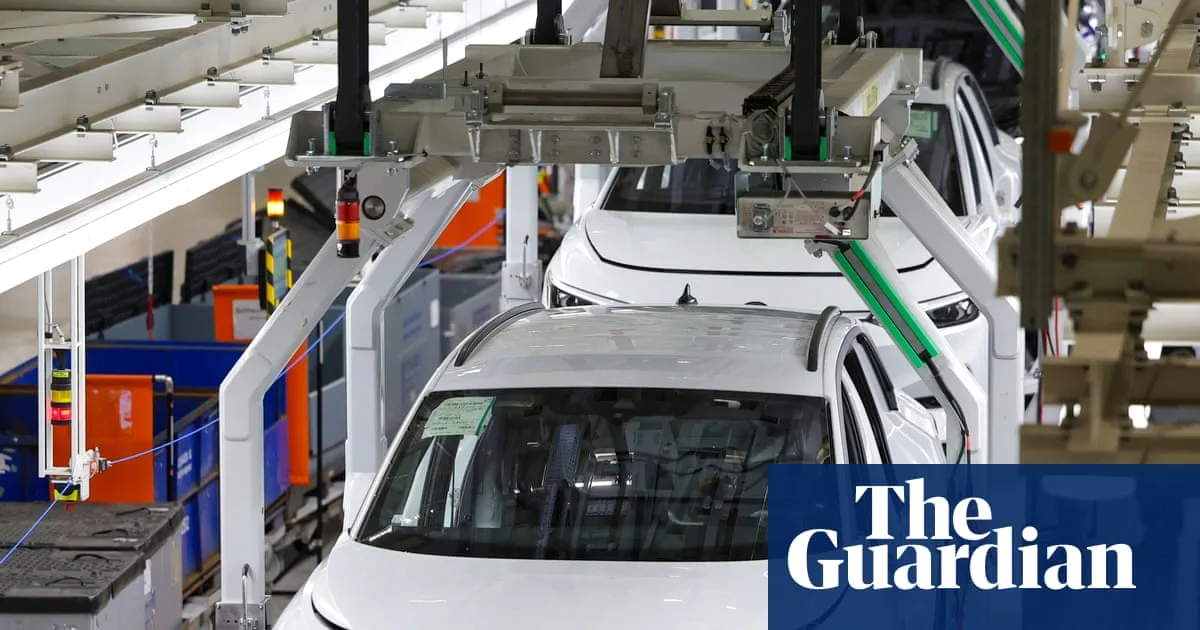
Volkswagen, Europe's largest automaker, has announced plans to cut 50,000 jobs by the end of the decade, citing falling sales in China and North America, as well as punitive US tariffs imposed by Donald Trump. The job losses will affect the entire group in Germany, the company said, as part of a restructuring drive amid a darkening global business climate.
The group had already reached a deal with German trade unions in late 2024 to cut 35,000 jobs by 2030, primarily through natural attrition. The updated plans come as Volkswagen reported a 54% drop in pre-tax profits to €8.9bn (£6.6bn), largely attributed to US tariffs and a costly strategy shift at Porsche, which has postponed its transition to electric vehicles (EVs) due to weak demand.
Volkswagen warned that global turbulence, including US-Israeli military action against Iran, would negatively affect its outlook, potentially impacting demand for its premium Audi and Porsche brands. Chief executive Oliver Blume noted that while the Iran conflict was not hitting supply chains, it could affect sales in the region where margins are high.
The group has been scaling back EV production targets, including at its Italian supercar manufacturer Lamborghini. In China, domestic competition has eroded Volkswagen's market share, prompting Blume to announce the largest product campaign in the company's history there. Chief financial officer Arno Antlitz emphasised the need to reduce costs and increase profitability to fund investments in combustion engines, EVs, and software.
Meanwhile, French carmaker Renault announced that by 2030, all its sales in Europe would be electric or hybrid, with 50% of sales outside Europe also being electric. The company plans to develop a new EV platform with Google based on Android technology, aiming for 90% of vehicle functions to be updatable remotely and ultra-fast charging in as little as 10 minutes.