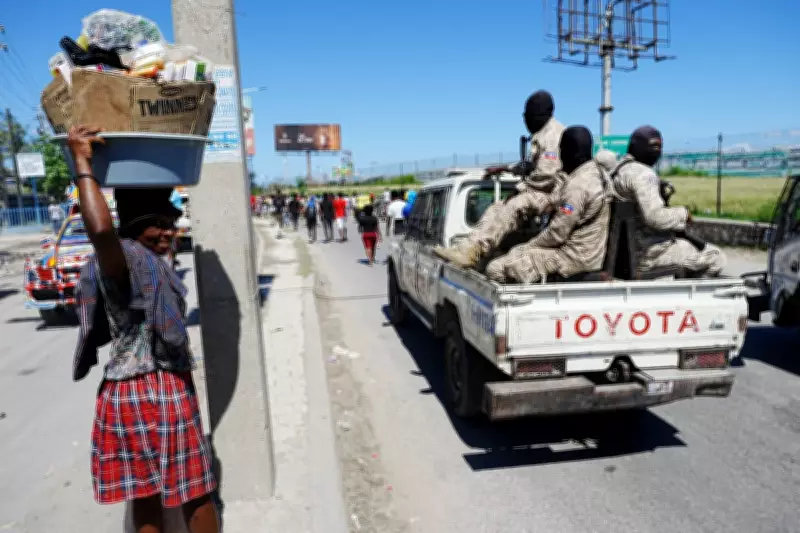
Haiti's new UN-backed international force tasked with combating the country's violent gangs has surpassed its funding targets, receiving pledges exceeding the 5,500 military and police personnel it requires. Chadian troops have already deployed in the capital, Port-au-Prince, according to Carlos Ruiz Massieu, the UN special envoy to the violence-ravaged nation.
Ruiz Massieu informed reporters after briefing the UN Security Council on Thursday that staggered deployments from Chad and other nations are anticipated to continue over the coming months, with all 5,500 members expected to be on the ground between the fall and the end of the year.
New Force Replaces Underfunded Kenya-Led Mission
The United States and Panama proposed the new gang suppression force in early September 2025 to replace a Kenya-led multinational mission that struggled with insufficient funding. That force's strength hovered around 1,000, far short of the desired 2,500. The UN Security Council authorized the 5,500-strong force on September 30, granting it new powers to arrest gang members.

According to a report released Thursday by the United Nations Integrated Office in Haiti (BINUH), more than $200 million has been pledged by 13 UN Security Council member states, with $59 million already disbursed. UN spokesman Stephane Dujarric confirmed that Qatar pledged $30 million to the trust fund for the force, with $10 million to be paid over three years.
Expectations High for Gang Suppression Force
Jacques Christofides, the force's special representative, told the Security Council that the operational framework has been finalized, and the multinational force is collaborating with the Haitian National Police to establish procedures for operations, detentions, and other actions. "Expectations remain high. Many view the GSF as a potential turning point," he said, referring to the gang-suppression force.
A new BINUH report revealed that more than 2,400 people were killed across Haiti between December and February, many of them suspected gang members as police operations intensify. This represents a 23% increase in killings compared with the previous period, with anti-gang operations killing at least 158 civilians and injuring over 100 others. Overall, more than 1,300 suspected gang members were killed and 140 firearms seized.
Ongoing gang violence has displaced a record 1.45 million people, more than half of them children. Last year, over 9,000 people were killed across Haiti, yielding a homicide rate of 76 per 100,000 inhabitants, one of the highest globally. "The people of Haiti have endured far too much for far too long," Christofides stated. "The scale of violence and displacement are simply unacceptable."
Gangs Strengthened Since Presidential Assassination
Gangs have grown in power since the assassination of President Jovenel Moise in July 2021 at his private residence. Police report they control over 70% of the capital and have expanded activities such as looting, kidnapping, sexual assaults, and rape into rural areas. Haiti has not had a president since the assassination.
Christofides, a longtime UN peace-building expert from South Africa, said efforts continue to broaden participation in the force and ensure it has necessary capabilities. He highlighted maritime and border support as particularly important for managing Haiti's ports and commercial entry points. He stressed the need for effective coordination with the United Nations, which will provide logistical and operational support, as well as with the Haitian government and regional partners, including the Dominican Republic.
Elections Planned for Late 2026
Special envoy Ruiz Massieu told reporters that the government currently aims to hold the first round of elections at the end of 2026 and the second round early the following year. However, this depends on improved security and freeing areas under gang control so candidates can campaign and Haitians can vote freely. "We have reasons to be an optimist that the situation can improve in the short and medium term," he said.

In a video posted Thursday, Haiti's National Police announced it was seizing territory once under gang control, including a large school that was severely damaged. An official narrated that a growing number of Haitians were returning to their communities after police cleared them of gangs. "It's been over six months since I last came to this area," said one unidentified man filmed by police. "We're going to start cleaning to see if I can come back home."
Ruiz Massieu noted that the council of ministers has been meeting at Haiti's National Palace in downtown Port-au-Prince, an area largely controlled by gangs. He said the location "is not only symbolic. It is also a powerful signal of the State's gradual return."
Haitian Prime Minister Alix Didier Fils-Aime stated that the transition government "remains fully committed to help Haiti emerge from this crisis" and plans to increase the number of police officers and soldiers. "The state is taking up its rightful place again," he said. "Haiti shall not perish."
US Deputy Ambassador Jennifer Locetta told the council that operations against gangs have shown measurable but fragile progress. "We are not measuring success by what international forces can achieve in Haiti," she said. "We are measuring success by how quickly Haiti will no longer need them."