
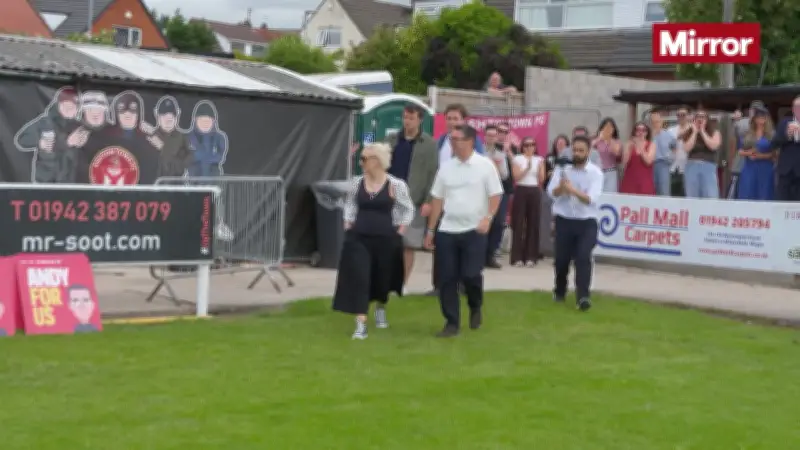
Andy Burnham is on course to become Prime Minister within weeks after Keir Starmer's decision to step down. The Makerfield MP returned to Parliament on Monday after convincingly winning the most consequential by-elections in the modern age. Leadership hopeful Wes Streeting threw his weight behind Mr Burnham after Mr Starmer's resignation, acknowledging that the momentum is behind the Greater Manchester mayor. If no other candidates enter the race, Mr Burnham may enter Downing Street in mid-July without the need for an official Labour leadership contest.
Some Labour MPs believe he needs to set out his plans for Government before he takes the top job. “I do think it would be useful for Burnham to set out his form of Manchesterism to the country, to my constituents, so people have a better idea of what it means,” one senior Labour MP told The Mirror.
Health and Social Care
Mr Burnham’s desire to reform social care dates back to when he was a health minister under Tony Blair and later Health Secretary under Gordon Brown. This area is a key priority for him. In the lead-up to the Makerfield by-election, he proposed bringing forward the publication of the Casey review into social care to 2026; it is currently due to finish in 2028. When he was Health Secretary, he proposed the creation of a National Care Service in 2009 to ensure elderly or disabled people can access care free at the point of use, like the NHS. It was partially adopted in Wales, while the Casey review will look at how the UK government could set up and fund such a service in the future. He believes inheritance tax should be replaced with a “national care levy” to fund the system.
Housing
Mr Burnham has indicated he wants to be radical in ramping up council house building. In his by-election launch speech, he said he wanted to oversee “the biggest programme of council house building since the Second World War”. This could be achieved, he suggested, by diverting funding from the £39bn affordable housing programme entirely to social rent homes. In the past, he has also said that stamp duty could be scrapped by introducing a land value tax (LVT) based on the value of land. In February, he told the Resolution Foundation conference that he would like to see 500,000 council homes built by 2030.
Immigration
Left-wingers who want to see the government's controversial immigration plans torn up by Mr Burnham are likely to be disappointed. During his by-election campaign, his team said that while he wants to reframe the debate around immigration, he will not change course. Measures put forward by Home Secretary Shabana Mahmood—who is tipped to stay in place—are expected to go ahead, including changes to indefinite leave to remain and ending permanent refugee status. Mr Burnham said in a speech on Friday that the immigration system must be “compassionate” but indicated he will not step back despite the backlash. He called for the government to make “greater use” of detention centres, adding that asylum seekers with “no basis for a claim” should be quickly deported. In a speech on Friday, he said: “I heard on so many doorsteps people's concerns about the unfairness of the immigration system, that cut price approach to procurement. That means areas like this can end up like HMO Britain. It's not fair that they think that they can just operate like that and not hear the call of people here, the decent people here who always will do the right thing, the compassionate thing, but not when it's unfair in terms of the way places like this are treated. These are the calls that we've got to hear, and this is the change that we've got to bring.”
Tax
Mr Burnham has said Labour's manifesto pledges not to raise income tax, national insurance, or VAT will still stand if he becomes PM. He said: “I am committed to the manifesto commitments on tax, I think that’s really important from a trust point of view.” But he has said he would consider cutting national insurance contributions for some employers—saying pubs and small family-run businesses should have their rates cut. He favours raising taxes on speculative landlords who leave high street properties continually empty and wants to tax the warehouses of firms like Amazon. He said earlier this month: “Labour have got it wrong on small businesses.” In October last year, he urged the Chancellor to consider a wealth tax. He said: “How can it be justified that council tax has not been revalued since 1991? We think about what’s happened to property prices in this country since, it’s totally wrong. I think on average in the North East people pay about £500 a year more in council tax than they do in the South East, and that is completely unfair. I think it does need to be re-evaluated, and if that is perceived as a wealth tax by some people with very big, very expensive properties, who will have to pay more, I’m not going to shy away from saying that’s exactly what they should be doing. Council tax should be being constantly revalued.” He has insisted that he will stick to Chancellor Rachel Reeves' fiscal rules, which set limits on public spending and government borrowing.
Welfare
Mr Burnham has said he will not be squeamish about cutting the welfare bill—but there are questions about how he plans to do it. In an interview with The Times this month, he said he would avoid “short-term cuts that then create a backlash and create more political turbulence”. Instead, he stated, he wants to focus on supporting people into work. The new Makerfield MP said: “I am not squeamish about saying that the plan would be to reduce the welfare bill. Not at all.” He said it was wrong that for every £25 spent on benefits for young people, just £1 was spent on employment support.
Foreign Policy
One area where Mr Burnham faces a major test will be on foreign policy. He is likely to have sparked Donald Trump's ire when he referred to “divided, dark politics” on the other side of the Atlantic. The thin-skinned US President is unlikely to have been impressed when he said of the Makerfield result: “There is a chance now from this result tonight to build a new politics based on unity and hope. Turning away from the path that takes us to a divided, dark politics of the kind we see in the United States. We must now take this path and put this country back on the right path, and bring people back together and get things working properly again.” During the by-election campaign, he gave few clues about what his position would be on the world stage. He was forced to clarify his views on Brexit after Wes Streeting floated the idea of rejoining the EU. Mr Burnham said: “My view is that Brexit has been damaging, but I also believe the last thing we should do right now is re-run those arguments.” He added: “I am not proposing that the UK considers rejoining the EU. I respect the decision that was made at the referendum and it is going to undermine everything I have said about strengthening democracy if we don't respect that vote.” His comments marked a softening of his position after he said he wanted the UK to rejoin the EU during his lifetime at Labour conference last September. In the coming weeks, he will likely face questions over conflicts in Gaza and Iran. During the 2015 Labour leadership contest, he said: “I can say tonight that the first foreign visit I would do as leader of the Labour Party would be to Israel.”
Nationalising Water Companies
During the by-election campaign, Mr Burnham reiterated his view that public ownership of water companies should be an option. He said that Thames Water should be nationalised, having previously called for greater public control over such firms. In an interview with The Guardian earlier this month, he said: “Public ownership is absolutely an option. I would say for Thames Water, that is what should be done.” The government has previously announced plans to make executives more accountable for their companies' failings but stopped short of nationalising them despite widespread calls.
Manchesterism
Mr Burnham is a champion of an economic and political model known as “Manchesterism”. It is credited for helping to transform Greater Manchester—which has achieved around 3% growth a year—during his time as mayor. He has described it as a response to the 1980s drive under Margaret Thatcher to overcentralise power in the Treasury in Westminster. Burnham believes local areas should have more control over their communities—and should reject “trickle-down economics” from Whitehall. In an article in The Guardian, Mr Burnham said that replicating Manchesterism at a national level “could mean putting electoral reform centre stage” so that there is more agreement on the public investment needed to free the country from the cost of living and housing crises. He has previously called for the introduction of proportional representation for UK general elections.
Transport
Mr Burnham has often given the example of the Bee Network transport system as an example of Manchesterism's success. Under his mayoral leadership, the city brought buses back under local control for the first time in 40 years to deliver a more affordable, reliable, and efficient network for residents. The Bee Network, which includes buses and trams, is the first integrated public transport model outside of London. Mr Burnham has also unveiled plans to integrate trains—with a tap-in, tap-out system, like in the capital—into the network. The system aims to make travelling cheaper and more convenient. Under a Mr Burnham government—and a national form of Manchesterism—more areas could have the opportunity to bring transport (as well as other areas) into local control. He has also said he wants to bring back the northern leg of HS2 between Birmingham and Manchester, which was scrapped by Rishi Sunak due to spiralling costs.
Hillsborough
Andy Burnham—who was born in Liverpool—has been a long-time campaigner on Hillsborough. He drafted the original Hillsborough Law in 2017 as a backbencher and has stood alongside the families in their fight for justice. Keir Starmer vowed to bring in a Hillsborough law during the General Election, but it was pulled from the Commons in January after a major row over how its ‘duty of candour’ requirement would apply to the security services. Mr Burnham weighed into the row at the time and warned that public bodies—including services like MI6, MI5, and GCHQ—should not have “permission to lie or give false information”. Mr Starmer re-introduced the Public Office (Accountability) Bill—known as the Hillsborough law—in this year’s King’s Speech. He was expected to ditch plans to allow security agencies an exemption.




