

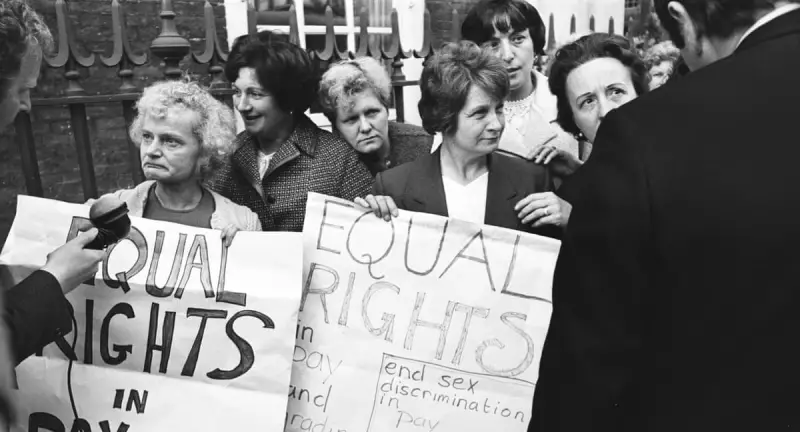
Fifty years after landmark legislation enshrined equal rights for women in UK law, the campaigners who fought for it have often been reduced to caricatures or faded from memory. Yet their story, marked by everyday sexism and strategic perseverance, is one worth reclaiming.
The Daily Grind of Sexism
Celia Brayfield was a young journalist in the Daily Mail's 'Femail' section in the late 1960s when an editor instructed her to infiltrate the women's changing rooms at Wimbledon to report on 'lesbian behaviour'. She refused. This incident, she recalls, typified the era. "We were dealing with everyday sexism on an unbelievable scale," Brayfield said. Women couldn't wear trousers to many press conferences—the Savoy hotel forbade it—yet skirts invited harassment on stairwells.
Brayfield started her career at 19, assisting Shirley Conran, then women's editor of the Observer. The newspaper women's pages of the time, with the notable exception of Mary Stott's at the Guardian, largely ignored the burgeoning Women's Liberation Movement (WLM) sweeping in from America. Editors were "profoundly uninterested," forcing Brayfield to pitch radical interviews, like one with feminist author Kate Millett, to underground magazines such as Frendz instead.

Organising for Change: Women in Media
Along with Conran, Brayfield joined Women in Media, a pressure group founded in 1970 to challenge industry sexism. Its members, many now forgotten, played a crucial role in the campaign to outlaw sex discrimination and enforce equal pay. One infuriating policy they targeted was the broadcasters' refusal to let women read the news. A BBC executive claimed in 1972 that the public would find a female newsreader "unnatural," arguing it was "much easier for a man" to deliver bad news.
This brazen prejudice existed despite a long history of women campaigning for employment rights. After WWII, it was standard for women to be paid roughly four-fifths of a man's wage for the same job. Powerful figures, including Winston Churchill, resisted change. In 1944, Churchill made a vote on equal pay for female teachers a vote of confidence in his wartime government to block it.
The issue was forced into the open by the legendary 1968 strike of 187 sewing machinists at Ford's Dagenham plant. Their action led to the Equal Pay Act of 1970, a compromise that only promised equal pay for 'like work' and had a five-year implementation delay. It was not enough.
The Long Road to Legislation
From 1968, MPs like Labour's Joyce Butler repeatedly tried to introduce a broader anti-discrimination bill. In February 1973, a bill proposed by MP William Hamilton was debated. That same day, 700 women held a 'Women's Parliament' in Westminster's Caxton Hall, processing to Downing Street with torches.
Women in Media formed an action group, Adbag, to lobby relentlessly. They deployed creative tactics, from decorating letters with heart-shaped fabric to, in one debated suggestion, using a woman "in chains and a flesh-coloured bikini" for tabloid coverage. Their pressure was unyielding. In a 1974 report, they warned MPs they would urge women to vote only for those in favour of a bill, "MINDLESS OF PARTY LINES".
The movement gained formal clout when the National Council for Civil Liberties (NCCL), with future minister Patricia Hewitt as its first women's officer, took up the cause. Hewitt noted the convergence of the energy from the women's liberation movement and the trade unionists who began the modern equal pay fight at Dagenham.
To escalate pressure ahead of the October 1974 election, campaigners formed the Women's Rights Campaign and put forward deaconess and GP Una Kroll as a candidate in Sutton and Cheam. Though she won only 298 votes, the stunt generated significant publicity. Shortly after Labour won a majority, it committed to outlawing sex discrimination.
A Compromise, But a Cornerstone
The ensuing debates were fierce. Feminists wanted the law to cover pensions, taxation, and social security, not just employment and education. They also argued for a powerful equality commission with investigative powers, not just a body reliant on individual complaints.

Not all their demands were met. The Sex Discrimination Act and Equal Pay Act finally came into force on 29 December 1975, alongside the new Equal Opportunities Commission (EOC). Women in Media called the final bill "timid tinkering," criticising exemptions for small employers and partnerships. However, the inclusion of protection against indirect discrimination was a key victory.
The work continued immediately, with the NCCL pursuing landmark test cases, like that of Belinda Price against the Foreign Office's age limit. In 1983, the Equal Pay Act was amended to cover 'work of equal value'.
Reflecting on the struggle, Celia Brayfield said, "We really did set out to change our society... but it's a fight you have to keep winning." Patricia Hewitt concurred: "These things are always a compromise... but I think in 1975 we felt we'd done pretty well." Their battle, far from the caricatures, laid the essential groundwork for the equality framework the UK relies on today.





