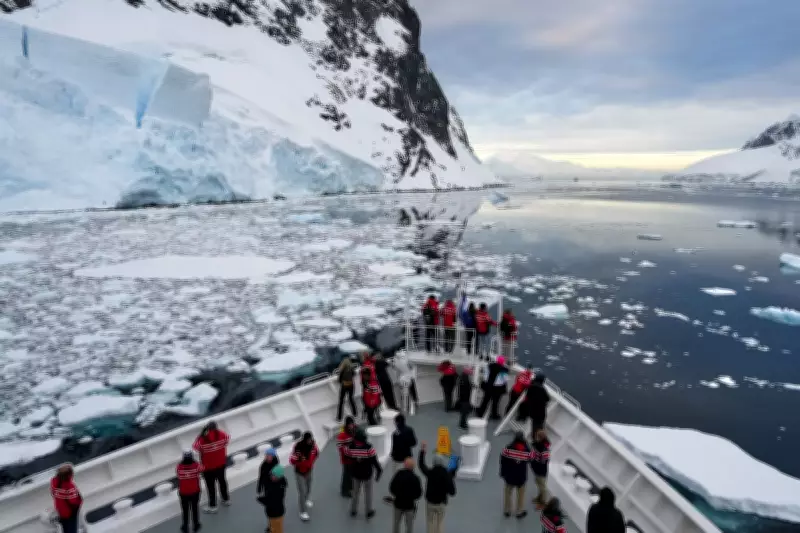
Driven in part by fears that Antarctica's frozen landscapes may be irreversibly melting due to climate change, tourism to the southernmost continent is surging. Experts warn that with more visitors comes an increased risk of contamination, illness, and environmental damage. While visitor numbers remain relatively small due to high costs and travel time, they are growing so rapidly that scientists and environmentalists are raising alarms. A deadly outbreak of the rare hantavirus aboard a Dutch cruise ship on a weekslong polar voyage has brought attention to this escalating trend.
Rapid Growth of Antarctic Tourism
Most expeditions head to the Antarctic Peninsula, one of the fastest-warming regions on Earth. According to NASA, roughly 149 billion metric tons of Antarctic ice melted annually between 2002 and 2020. A common route involves sailing south from Argentina toward Antarctica before heading north along the African coast—the same path taken by the cruise ship MV Hondius.
“The sites you will see in Antarctica are extremely unique and not replicable anywhere else on the planet—the whales, the seals, the penguins, the icebergs—it's all really stunning and makes a huge impression on people,” said Claire Christian, executive director of the Antarctic and Southern Ocean Coalition, an environmental group.

In 2024, more than 80,000 tourists set foot on the ice-cloaked continent, while 36,000 viewed it from ships, according to the International Association of Antarctica Tour Operators. The International Union of Concerned Scientists estimates that tourism to Antarctica has grown tenfold over the past three decades. That figure could rise further as costs decrease with more ice-capable ships and technological advances, said Hanne Nielsen, a senior lecturer of Antarctic law at the University of Tasmania. Her colleagues project annual visits could triple or quadruple to over 400,000 within a decade.
Some tourists are drawn by “last chance tourism,” eager to witness the rapidly changing landscape before it melts further, Nielsen added.
Contamination Risks and Biosecurity Measures
Officials have not found evidence of contamination from the MV Hondius. However, migratory birds have carried avian flu from South America to Antarctica in recent years, according to the U.S. Centers for Disease Control and Prevention. That outbreak prompted tour operators to tighten rules on tourist conduct and hygiene to protect visitors and the ecosystem. To prevent invasive species from spreading, visitors are instructed to stay away from animals and avoid touching the ground with anything but their feet.
“There are rules that people are bound by when they're heading south,” Nielsen said, describing her five voyages as a former guide. Crews and passengers use vacuums, disinfectants, and brushes to scrub shoes and equipment free of bugs, feathers, seeds, and microbe-laden dirt. “Between the tongues and the laces of the boots you can find a lot of things,” she noted.
Cruise ships have experienced outbreaks of diseases like norovirus, which spreads quickly in confined spaces. In 2020, a COVID-19 outbreak on the Diamond Princess turned the ship into an incubator for the then-mysterious virus. Hantavirus, which caused the recent outbreak, typically spreads through inhalation of contaminated rodent droppings.
The Hondius Outbreak and Regulatory Framework
The World Health Organization reported that the MV Hondius departed Ushuaia, Argentina, on April 1 and visited Antarctica and several isolated islands. WHO is investigating possible human-to-human transmission on the ship, said Dr. Maria Van Kerkhove, WHO's director of epidemic and pandemic preparedness. Officials suspect the first infected person contracted the virus before boarding, and they have been told there are no rats on board.
Antarctica is governed by the Antarctic Treaty, signed in 1959, which designates the territory as a scientific preserve for peaceful purposes. Subsequent rules “aim to ensure that all visits, regardless of location, do not adversely impact the Antarctic environment or its scientific and aesthetic values,” according to the treaty's secretariat. Companies and scientific ventures voluntarily comply with biosecurity guidelines and submit environmental impact assessments for their operations.

The treaty was written when tourism numbers were much lower, Christian pointed out. “Activity needs to be regulated appropriately, as you would with any of the world's sensitive and precious ecological sites,” she said from Hiroshima, Japan, where she was preparing for an Antarctic Treaty Consultative Meeting. There, she will join calls to strengthen protections for Antarctica's penguins, whales, seabirds, seals, and krill—tiny creatures at the base of the food chain.
For now, the allure of the frozen frontier continues to draw visitors. “You can put a footprint in Antarctica and it's still there 50 years later,” Christian said.
Associated Press writer Mike Corder contributed from The Hague, Netherlands.