Simon Calder answers your questions on pet passports, war-related flight cancellations, Greece’s implementation of the EU entry system, and train journeys to Turkey.
Dog with EU passport issued in Spain – is it valid?
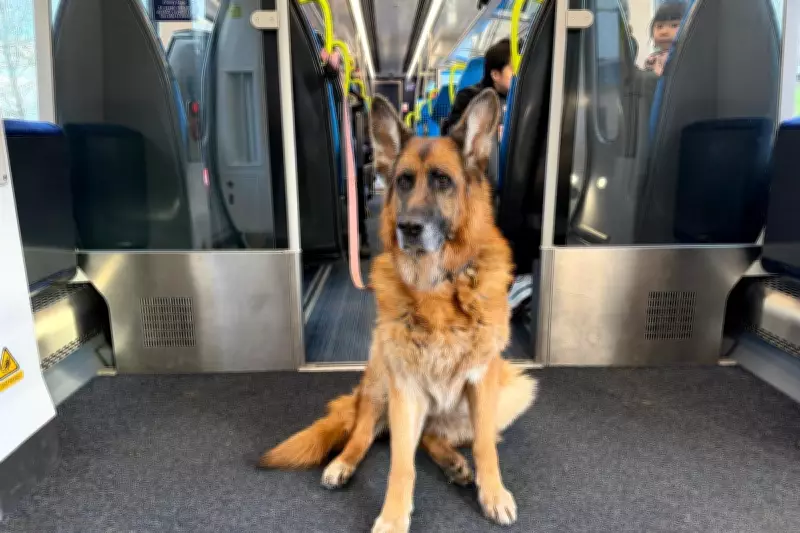
Q Our dog has an EU passport issued in Spain – is it valid? As you are aware, EU pet passports were simple to obtain prior to Brexit. Sadly, due to our government wanting to set our own animal health standards rather than align with Europe, it has become more complicated and expensive to travel abroad with pets. But we were glad to discover that, as long as we had a house in Spain, our Spanish vet was willing to issue an EU pet passport for our dog, Winnie – providing all the inoculations were properly registered as per the Spanish passport requirements. We have used this since 2022 without a problem. I understand the EU has now deemed that the pet’s owner must be resident in the country of pet passport issue. I live in Britain. But as pet passports are issued for the lifetime of the animal, can I use it when heading for Europe next month? Peter A
A Sadly, Winnie’s European heritage no longer applies. The new EU law says: “The pet passport is only intended to be issued to pet dogs, pet cats or pet ferrets kept in the member state where their pet owners reside habitually and have their main residence. Such information is to be furnished by the pet owner to allow the issuing veterinarian to duly and accurately complete the pet passport.” The rule adds: “Pet passports are not intended to be issued to pet dogs, pet cats or pet ferrets which are kept by pet owners who have their main residence outside the Union and reside only temporarily or seasonally in the Union.” That applies to you – and tens of thousands of other travelling pet owners.

You will now have to obtain an Animal Health Certificate from your UK vet, costing upwards of about £100, shortly before each visit to Europe. The only crumb of comfort I can offer is that if the UK continues to realign with Europe on a range of issues, EU pet passports may one day soon be available once again for British residents. The current red tape is a nonsense, but Brussels is merely delivering what we asked for. Finally, there are no changes to the entry requirements when you come back to Great Britain. And anyone with the good fortune to live in Northern Ireland continues to enjoy the right to an EU pet passport.
Will travel insurance cover flight cancellations due to war?
Q Do you know of a travel insurance provider that would cover events like my flight being cancelled due to fuel shortages as a result of the war? I understand that insurance has a war exclusion, meaning it doesn’t cover you for bombs actually falling. But if my flight to Palma is cancelled in August with the airline blaming fuel shortages due to the knock-on effects of the Iran war, would an insurer be within its rights not to cover me for the consequent lost hotel nights? Nick B
A Yours is one of many questions I have received in the past few days as media headlines have warned of flight cancellations on an industrial scale. Surely, the thinking goes, travellers should be able to insure against a potentially expensive risk? Well, I can see a few problems in obtaining such cover – or claiming on existing insurance. I am not aware of policies that specifically cover such consequential losses, but they may exist. The problem is this: because airlines have started to cancel flights in large numbers, insurers may regard the possibility of your departure being grounded as a “known risk”, and therefore refuse cover for such an event.
What about an existing policy? Most exclude paying out for losses incurred as a result of “declared or undeclared war or hostilities”. The current shortage of, not to mention high price of, aviation fuel is a direct consequence of the US-Israeli assault on Iran and the subsequent retaliation. So I imagine any attempt to claim may be rejected.

Happily, though, I believe this discussion is purely academic. Flights to the top Spanish airports in August are plentiful. If airlines choose to cut back (or are ordered to do so), the presumption of the Civil Aviation Authority is that you will be rebooked on another flight to get you to your destination on the same day. On 1 August, for example, 14 flights are scheduled from Manchester to Palma. It would be straightforward to combine some of these (not least because they are clearly not selling brilliantly, with fares as low as £41). There are more from nearby Liverpool airport that airlines could add to the mix. Cancellations would be made in a sensible fashion, and you should not lose any hotel nights.
Greece not using EES – how will exit work?
Q I am going on a cruise starting in Athens and ending in Venice. This will be my first visit to Europe since the implementation of the entry-exit system (EES). As Greece is now not using the system to record entry, how will it work when I get to Venice airport to leave? I will not be registered as having entered Europe in the system, presumably? As this is a popular cruise, I am sure this will affect many other passengers. Christine K
A As it happens, I am taking a cruise on exactly the same route, though for complicated reasons flying into Mykonos and then travelling by ferry to Athens before boarding the ship. But, thankfully, neither of us needs to worry about not being registered under the EES.
The background: Greece has decided to suspend biometric registration for British passport holders going through the digital borders scheme. As the nation builds up to peak summer, special lanes are expected to be introduced at busy Greek airports to segregate and accelerate British arrivals. This may yet turn out to be a short-lived exception to the European rules; Brussels tells me there is no legal basis for Athens making unilateral decisions like this.
Yet if the Greek variation does stay in place, your details will still be recorded. Under the EES, every entry and exit must be registered on the central database. But this does not necessarily have to include biometrics. There is flexibility for frontier staff simply to “skim” the details on the passport and, either in real time or later, transmit them to the database.
When you turn up at Venice airport to fly home, you should find your passport data on the system. However, if the Italian frontier staff are doing their job, you will have your fingerprints and facial biometric taken. Having said all of this, there are – to put it mildly – teething problems with the project, and so you may find formalities rather more random.
Train journey to Istanbul
Q We are planning to visit Istanbul for a city break later in the year when it’s a bit cooler. We would like to travel by train to make it more of an adventure. Please can you advise if this is possible and, if so, can you recommend a route? Michelle J
A I first visited Istanbul in 1989, and have returned about a dozen times since then – always by air. In just over three hours’ flying time from British airports, you can reach one of the world’s most exciting locations. But your plan looks more fun, especially if you build in some other great cities along the way. You can choose your own route via Paris, Strasbourg, Basel, Munich and Vienna – where you could possibly switch to a ferry for the journey via Bratislava to Budapest. The Hungarian capital is about two-thirds of the way in terms of distance, but halfway in terms of time (things slow down further east). Budapest is definitely worth a stay of a night or two for its depth of history, handsome architecture and superb cuisine.
I recommend you make this part of the journey by day trains: the scenery will unfold beautifully. The next stretch of the trip, into and across Romania, is a good choice to make overnight: this is not a section that is scenically overpowering. According to the excellent Mark Smith – the international rail guru known as The Man in Seat 61 – there is an early evening sleeper train that arrives in the Transylvanian city of Brasov just before 9am. Spend at least a morning here, before travelling on through the Carpathian mountains to Bucharest. I suggest another overnight in the city. One more possible stop: the ancient Bulgarian capital, Veliko Tarnovo. Mr Smith’s website, Seat61.com, gives full details of the onward journey to Istanbul. Disappointingly, the end of the line is at a suburban station, Halkali, rather than the more celebrated Sirkeci station, terminus for the Orient Express. Buy an Istanbul Card and travel on a Marmaray suburban train to Sirkeci – close to the Blue Mosque and Agia Sophia. Check out the small and impressive Orient Express museum on the eastern platform. After all that, I recommend the quick, cheap and easy journey home by air.
Email your question to s@hols.tv or tweet @SimonCalder