Iranian Drone Strike Forces Closure of Major UAE Oil Refinery
An Iranian drone attack on Abu Dhabi has compelled the shutdown of one of the world's largest oil refineries, sparking immediate concerns that the resulting spike in oil prices could precipitate a global economic crisis. This aggressive move by Tehran forms part of a broader campaign targeting the United Arab Emirates, Israel, and other US allies across the Middle East since the outbreak of recent hostilities.
Escalating Conflict and Economic Fallout
Iran has furiously launched missiles and drones at regional targets, focusing on oil depots and critical energy infrastructure. These attacks have directly contributed to petrol prices rising at their most rapid rate since 2022. The cost of a barrel of oil soared to nearly $120 on Monday, a dramatic increase from approximately $72 prior to the US and Israeli strikes that resulted in the death of Ayatollah Ali Khamenei. This sharp escalation has reignited fears of another severe cost-of-living crisis for consumers worldwide.
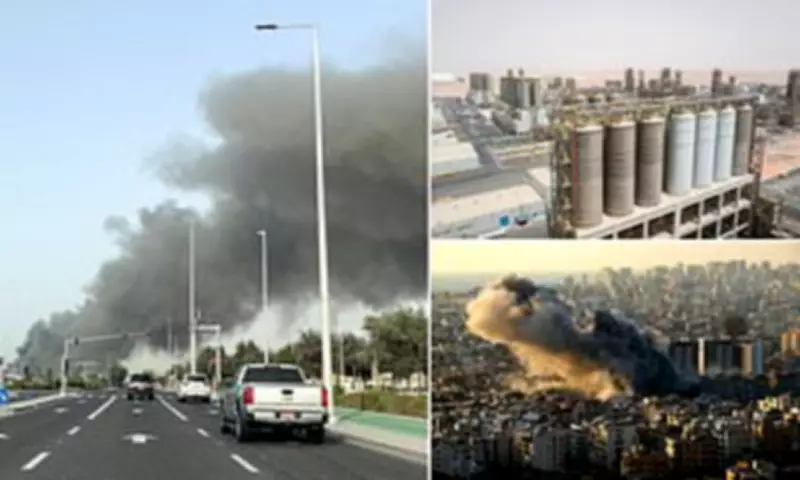
Tehran's strategy appears designed to incapacitate major Gulf refineries while simultaneously tightening its chokehold on the strategically vital Strait of Hormuz. The objective is to inflict maximum economic pain on the global economy by disrupting energy supplies. In a direct strike, Iranian drones hit the Ruwais oil refinery, causing a significant fire and forcing its precautionary closure on Tuesday.

The Ruwais Refinery: A Critical Hub
The Ruwais facility, operated by the state-owned Abu Dhabi National Oil Company (Adnoc), is not only the largest refinery in the Middle East but also ranks as the world's fourth-largest single-site refinery. With a daily processing capacity of 922,000 barrels, it serves as a central hub for the country's extensive chemical, fertilizer, and industrial gas plants. A source confirmed, "The Ruwais refinery has halted operations out of precaution." Earlier statements from the Abu Dhabi Media Office acknowledged a drone attack had ignited a fire within the Ruwais Industrial City.
An eyewitness account from a driver at the complex described the chaotic scene: "Just as we were about to leave, we saw two more bursts of fire rising from the complex, with loud sounds like explosions." This shutdown threatens to cause further chaos in global oil markets, which are already reeling from the ongoing closure of the Strait of Hormuz—a critical maritime passage responsible for transporting roughly 20 percent of the world's oil.
Global Ripple Effects and Consumer Impact
The surge in petrol prices has prompted urgent advice in the UK, with motoring organisations like the AA and RAC urging drivers to reduce non-essential journeys and adopt fuel-efficient driving techniques to conserve petrol. Warnings suggest petrol could reach £2 per litre for the first time. Concurrently, natural gas prices have skyrocketed to above 120p per thermal unit, up from a pre-conflict range of 70 to 90p.
In response to the growing economic anxiety, political figures are attempting to calm public fears. Keir Starmer is working to alleviate concerns of a repeat of the 2022-style cost-of-living squeeze, hinting at potential government intervention despite the fragile state of public finances.
Regional Warnings and Broader Conflict
Saudi Arabia has issued a stark warning, describing a potential "catastrophe" if the Strait of Hormuz remains closed. Aramco CEO and president Amin H. Nasser emphasized that the conflict will have "catastrophic consequences" for the global economy, advocating strongly for the strait's reopening. The Middle East war has severely destabilised oil supplies, with Iran targeting energy installations across the Gulf, including Aramco's sprawling Ras Tanura facility, which has partially halted operations.
The oil-rich Gulf region has borne the brunt of Iran's retaliatory attacks following the US-Israeli strikes that ignited the broader Middle East conflict. Tehran has targeted not only US assets but also civilian infrastructure, including energy facilities and airports. Oil prices have experienced extreme volatility due to these supply disruptions, rocketing by 30 percent on Monday before falling again after comments from US President Donald Trump suggesting the war might end soon.

Expert Analysis and Military Posturing
Robert Mogielnicki, a non-resident scholar at the Arab Gulf States Institute, summarised the dire situation: "The Gulf energy sector is getting whacked from multiple angles. Energy facilities are being targeted, export capability through the strait is hampered, and storage capacity is filling up." Earlier on Monday, Iran issued a severe warning, threatening to prevent "one litre of oil" from being shipped from the Middle East if US and Israeli attacks continue.
This warning did little to deter US military action. US Defence Secretary Pete Hegseth claimed Tuesday would witness the "most intense day" of shelling against Iran to date, stating the US was "crushing the enemy" with more refined intelligence and greater force. Hegseth also noted that Iran had fired its fewest missiles in the past 24 hours since the war's inception.
Massive airstrikes pounded Tehran overnight, with the sky above the Iranian capital glowing from explosions. President Trump promised the conflict would end "very soon" and claimed the US had "already won," while also vowing to "go further" to ensure total defeat of the enemy. His remarks highlighted a contradictory stance, describing the operation as a "short-term excursion" yet expressing a willingness to prolong hostilities until decisive victory is achieved.