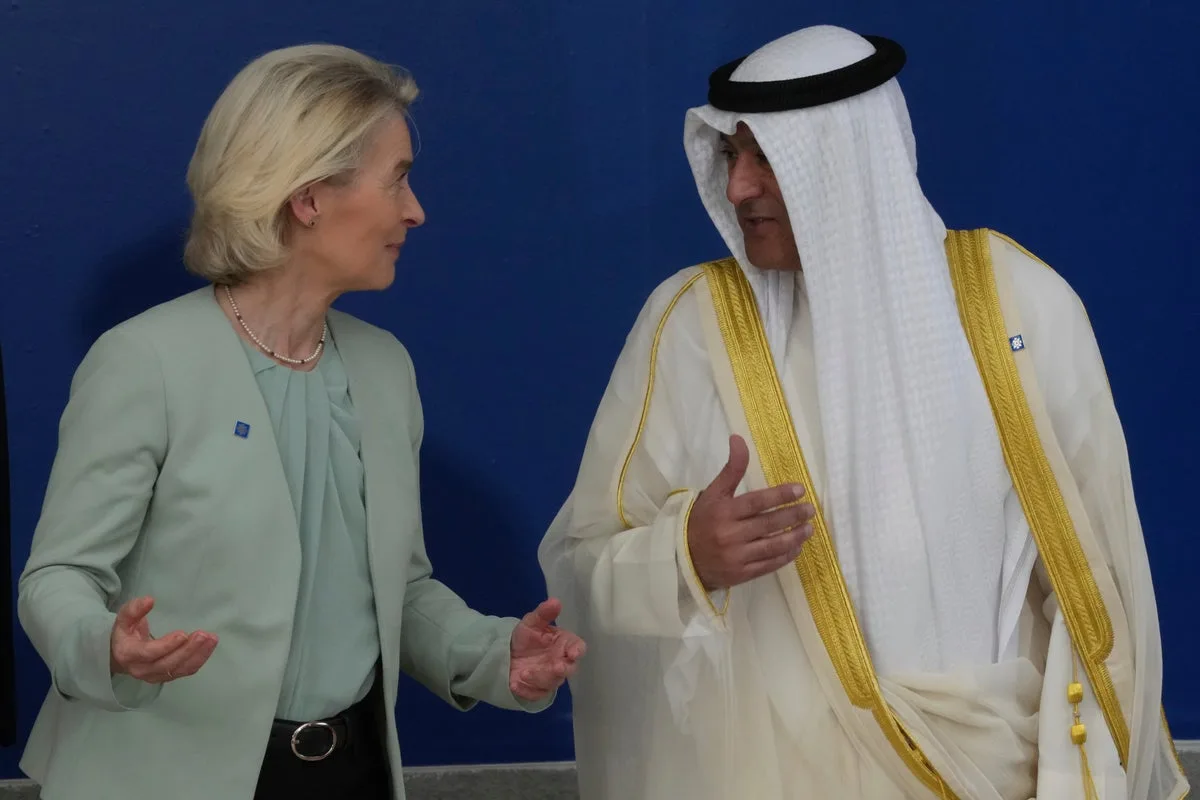
The European Union is considering funding alternative energy routes in the Middle East to circumvent conflict zones such as the Strait of Hormuz, following a fuel crunch and soaring oil and gas prices triggered by the Iran war. European Commission President Ursula von der Leyen stated on Friday that the EU is ready to collaborate with Persian Gulf countries on new projects to convey energy to global markets without being vulnerable to war or geopolitical strife.
During a news conference in Cyprus after an informal EU leaders' meeting, von der Leyen emphasised the intrinsic link between security and energy, noting that a threat to a merchant vessel in the Strait of Hormuz threatens factories in Belgium. She called for diversifying export infrastructure away from the bottleneck of the Hormuz Strait and offered to help repair Gulf energy infrastructure damaged in the war.
Von der Leyen referred to the India-Middle-East-Europe Economic Corridor as a potential model but provided no precise details on specific projects or timelines. A summit between the EU and the Gulf Cooperation Council, scheduled for later this year, is expected to explore these opportunities. The rotating EU presidency, held by Cyprus, has sought to strengthen ties with Middle Eastern countries.
The informal summit was attended by Syrian President Ahmad al-Sharaa, Egyptian President Abdel-Fattah El Sissi, Lebanese President Joseph Aoun, Jordan's Crown Prince Hussein, and GCC Secretary-General Jasem Mohamed AlBudaiwi. Al-Sharaa noted that Europe needs Syria as much as Syria needs Europe, while Aoun called for EU support in rebuilding his country.
European Council President Antonio Costa praised Aoun for banning Hezbollah's military activities, pledging EU assistance in disarming the militant group. Costa stated that the EU is not part of the conflict but will be part of the solution. Human rights groups criticised EU leaders for not increasing pressure on Israel over its military campaigns.
EU leaders, including German Chancellor Friedrich Merz, said they would not lift sanctions on Iran until issues such as its missile programme and support for proxies are resolved. Cyprus itself faced a drone attack from Lebanon in March, prompting several EU member states to dispatch warships with anti-drone capabilities. Cypriot President Nikos Christodoulides said EU leaders agreed to create a formal mutual assistance mechanism, as current ad hoc arrangements are unreliable.