Whether it's a celebration or a bottomless brunch, nothing hits the spot quite like a glass of fizz. But it turns out you've probably been drinking prosecco wrong this entire time.
The Science of Sparkling Wine Glasses
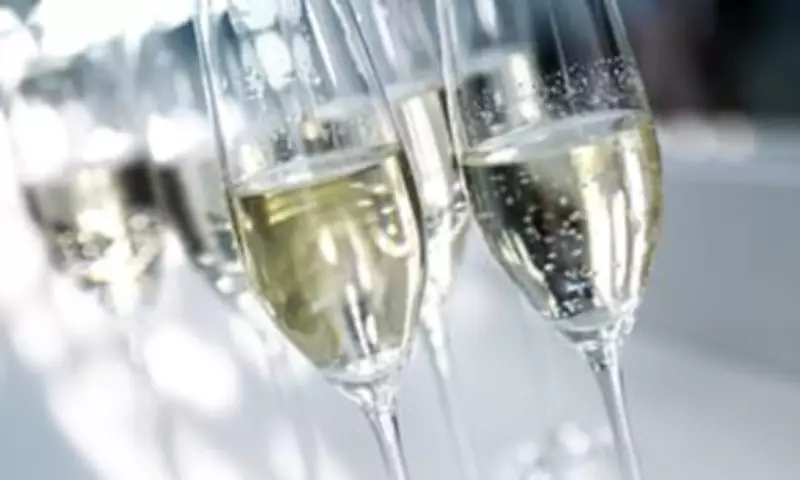
While many people opt for a traditional flute, scientists now say that this is not the best vessel to drink fizz from. Instead, you should opt for a tilted glass, which will keep your drink bubbly for longer.
In a new book, called 'Sparkling beverages: Champagne and beyond', physicist Gérard Liger–Belair investigates whether there is an ideal glass to best appreciate the taste of sparkling wines. He found that while a regular flute can deliver a stronger aroma and more intense nose, a traditional coupe can make the drink feel smoother.

However, he revealed that he has recently come across a 'curious glass prototype whose chalice is inclined at around 60 degrees relative to its leg'. And this has 'multiple advantages when tasting sparkling wine,' he wrote.
The Tilted Glass Advantage
The glass features a regular stem but is topped with an elongated, tear–drop shaped chalice that is turned on its side. Professor Liger–Belair said the glass is being considered by a famous Michelin–starred restaurant in France, where he recently got to experience it for himself.
The physicist explained its unique design helps boost the scent of the wine and – most importantly – prevents bubbles being 'lost'. He said that tilting a glass increases the surface area of the wine available for breathing in its aromas.
'When tasting a wine, whether still or sparkling, we instinctively tilt our glass to better feel the scents escaping from it,' he wrote. 'When you taste a wine in a glass whose chalice is already tilted, the aromatic perception is therefore naturally increased by geometric effect.'
The aroma of wine is crucial because it provides the majority of the sensory experience, accounting for most of what is perceived as 'flavour'. When it comes to sparkling varieties, the aroma reveals the wine's character – ranging from fresh and fruity floral notes to more complex aromas like hazelnut.
Bubbles and CO2 Preservation
Another key feature of sparkling wine is the bubbles, which can also be boosted by this shape of glass. Professor Liger–Belair explained that when sparkling wine or champagne is poured vertically, the turbulence caused by its sudden fall into the glass considerably accelerates the loss of dissolved carbon dioxide (CO2). This reduced the 'reservoir' of CO2 needed to produce bubbles, he said.
'When served in this tilted glass, the wine flows much more gently to invade the chalice, which therefore preserves aromas, but also a significant quantity of dissolved CO2 for more effervescence during tasting,' he wrote. 'Once the wine is served in this tilted glass, the wine naturally has a reservoir of additional dissolved CO2, which will allow the formation of a greater number of bubbles throughout the tasting. A theoretical calculation shows that tens of thousands of additional bubbles are likely to form in this tilted glass.'
A tilted chalice also helps by reducing the height of the wine within the glass. This, in turn, has a direct consequence on the size of the bubbles, he said, and provides 'the distinct advantage of refining the bubbles'.
Climate Change and Prosecco
Scientists have previously warned that prosecco could soon be wiped out by global warming and climate change. Mountainside vineyards – where the grapes that go into the bubbly beverage are produced – are most at risk from soil degradation and drought, say scientists. The phenomenon also applies to other famous vintages including Burgundy, Grand Cru and Cabernet Sauvignon, the world's most popular red.
Study lead author Dr Paolo Tarolli, of the University of Padova in Italy, said: 'The risk is not only losing an agricultural product or seeing a landscape change, negatively impacting the local economy. The risk is losing entire communities' history and their cultural roots.'
How to Taste Wine Properly
When it comes to drinking wine, there a few things that can make all the difference. Australian wine-connoisseur Caitlyn Rees offers how to taste wines like an expert.

- Step 1: See – Before you even down that first sip, you first need to take a look at the wine in your glass. 'See refers to the appearance of the wine. This is where you can check the clarity, intensity and colour. If the wine is hazy it could be faulty but more likely unfiltered.'
- Step 2: Swirl – You've probably seen wine drinkers swirl the wine in their glass before taking a sip. The reason is to allow the wine to 'open up' and reveal the maximum amount of aroma, flavour and intensity. 'Swirling releases the aroma particles that make the next step, smell, more helpful.'
- Step 3: Smell – Smelling wine serves two purposes. It helps you detect scents and flavours as well as providing a way to check for faults.
- Step 4: Sip and savour – Once you've taken in the full aroma of the wine, now it's time to sip.
- Step 5: Spit or swallow – Unless the wine you are tasting has gone bad, the final step in the process of wine tasting is to swallow. The trick though isn't to gulp it down. It's more to let it drift down over the back of your tongue to allow your taste buds to pick up the intensity of the flavour.