From 100,000 sunflowers in Gower and cosmic art in Galloway to a bat safari and messing about in boats, there is enough here to keep you and the kids busy until September. Here are 20 brilliant UK family days out for summer.
Walk Through Sunflowers in Gower
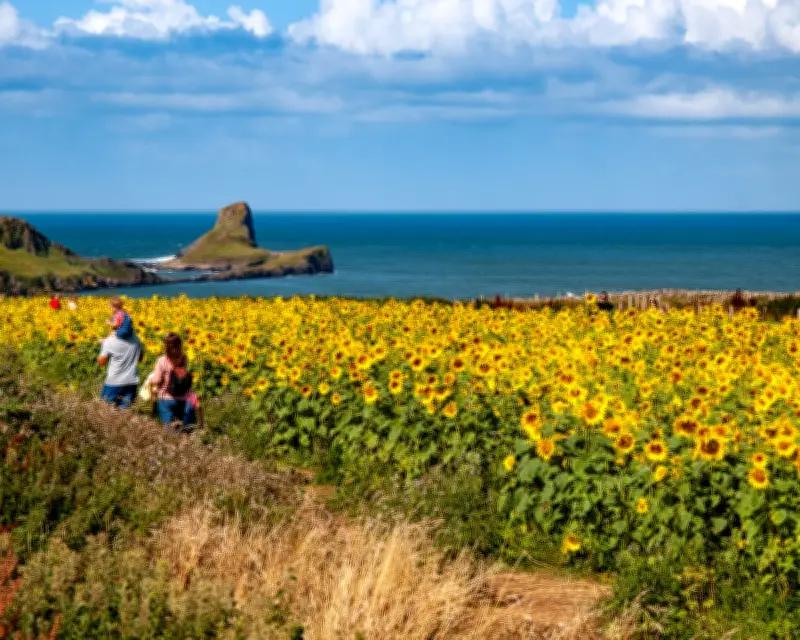
At the westernmost tip of the Gower peninsula, Rhossili Bay is a gloriously wide sweep of sand, backed by dunes and licked with waves perfect for bodyboarding and surfing. Wild ponies graze on the southern headland, while walkers time their trip across to the serpent-like Worm's Head promontory to avoid being cut off by the tide. In summer, there is an added draw: 100,000 sunflowers. A 20-minute walk from the Worm's Head National Trust car park, the flowers hit their peak from late July into August. Across the site, there are pick-your-own fields, a trail to follow between wooden animal structures and giant swings (for photo ops as much as fun). Entry to the sunflowers costs £4 on weekdays and £4.50 on weekends.
Fabulous Forest Play in Dorset
Deep in the woods at Moors Valley country park are giant ant nests and snake pits, huge hawks and spiders, all stars of Forestry England's play trail. It wiggles for a mile through the trees with tunnels to crawl through, slides to whiz down and crocodile-shaped balancing beams. There is also the inclusive beehive with double-width slide and quiet areas for those requiring less stimulation. New for this year is Woodland Rhapsody, a musical play structure with gravel-filled rain makers and drums to bang, and the Timber area, which tells the story of a forester's job, with pulleys to sort seeds, timber tangles to climb and a big wooden harvester with steering wheel and levers to operate. Entry is free, but car parking charges apply.
A Wine (and Wildlife) Hike in the Surrey Hills
Wine hikes, with scenic trails linking vineyards, are often associated with mainland Europe, but here is a great English alternative using the North Downs Way. Start at Albury Vineyard (take the 32 bus from Guildford train station), where the self-guided wildlife walk through the vines passes bat and barn owl boxes, bug hotels, beehives, wildflower meadows and a pond. It is then a seven-mile stomp to Denbies Wine Estate to board the vineyard "train", with carriages hooked up to the back of a Land Rover. Other shorter walking loops start and end at Denbies Estate, passing artist James Tunnard's wavy wooden seat, Radius, and up Denbies Hillside, which is alive with butterflies and wild orchids – the perfect picnic spot. The Albury Vineyard wildlife walk is free (suggested donation £10 a group to Surrey Wildlife Trust). The Denbies vineyard train tour costs £12.50 for adults and £6.95 for children.
Spot Dolphins in the Moray Firth
About 200 bottlenose dolphins live in the waters north of Inverness, the most northerly colony in the world. They are a hardy bunch, hunting and swimming around the Moray Firth and beyond all year, but sightings of them throwing fish and leaping from the water are more frequent in the summer months. The Scottish Dolphin Centre at Spey Bay is not only a good place to get the binoculars out (there are plenty to borrow – keep an eye out for ospreys, seals and otters, too), but also a hub of marine learning. Housed in a former 18th-century fishing station, there are tours of the old ice house, an interactive dolphin exhibition with live wildlife cameras, plus river rambles and nature-themed holiday clubs during the Scottish school summer holidays. Entry is free; holiday clubs cost £1.50-£3 per child.
Celebrate David Hockney in West Yorkshire
The late David Hockney's oil painting Salts Mill depicted the building's Victorian facade glowing orange and the Yorkshire hillsides glinting emerald green. It was a present for Jonathan Silver, Hockney's friend, who transformed this former textile mill into a cultural hub, and it hangs in the entrance to the building. Upstairs, there are more of Hockney's works in the 20 Flowers for 2025 and Some Bigger Pictures exhibition, which runs until January 2027. It is a free, inspiring space – perhaps pick up a sketch book and paints in the shop afterwards. Plus, there are burgers and pizzas at Salts Diner for lunch, the Peace Museum (also inside the mill) to potter around, and a lovely walk along the canal to Bingley. Entry is free.
Visit the Quentin Blake Centre in London
Revered illustrator Quentin Blake has been championing a museum of his craft for 20 years, and in June, aged 93, he opened the Quentin Blake Centre for Illustration, a permanent home for the art form in an 18th-century waterworks in Clerkenwell. Blake is most famous for his scribbly style, as seen in his illustrations for Roald Dahl's stories, but all kinds of work are celebrated here, from comics to graphic murals. Plenty is free to wander: a library in the former Engine House, a cafe in the Boiler House, as well as the gardens. Paid exhibitions delve into Blake's extensive archive and spotlight contemporary illustrators. Budding artists can try out fabric painting and printmaking at the Creative Studio during the summer holidays (Wednesdays, 10.30am-12.30pm). Exhibition tickets cost £15 for adults, £6 for children, under-5s free, and family tickets from £23 (1 adult + 3 children).
Count Butterflies on the Hampshire Downs
The wildlife charity Butterfly Conservation predicts it is going to be a bumper summer, thanks in part to a massive migration of painted lady butterflies from Africa. Its Big Butterfly Count runs until 9 August – the world's largest butterfly survey – and last year 125,000 citizen scientists each spent 15 minutes outside noting numbers of butterflies and moths. The organisation's Magdalen Hill Down nature reserve on a chalk hillside just outside Winchester would be a good place to count – 46 hectares of chalk grassland, wildflower meadows and woodland, which are home to butterflies such as the adonis blue, chalk hill blue and brown argus. Entry is free.
Monastic Life on a Pembrokeshire Island
The first monks arrived on Caldey Island off Pembrokeshire's south coast in the sixth century. Today, the Cistercian order are as well known for their chocolate and lavender perfume-making as for their vow of nightly silence (with no unnecessary speech during the day). It is 20 minutes by boat from Tenby to this peaceful escape, where paths wind through woodland and along cliffs to the working lighthouse, soft sands of Priory Beach and a chocolate and fudge kitchen. This summer, there is a new natural play area and the Monastic Story Hall, which charts the island's history and explores monastic life, as well as highlighting the unique wildlife here, which includes red squirrels, hedgehogs, seals and Manx shearwaters. Tickets cost £24.95 for adults, £12.95 for children (under-4s free), and £64.95 for a family (2 adults + 2 children).
Watch History Come to Life in County Durham
Each summer, on Saturday evenings in Bishop Auckland, Boudicca battles against the Romans. Vikings invade, knights joust and a full-size steam locomotive chugs across a 7.5-acre stage as part of Kynren – An Epic Tale of England. With a 1,000-strong cast, the outdoor show whips through 2,000 years of history, and now has an equally dramatic daytime counterpart, Kynren – The Storied Lands. The five daily shows offer a journey through time and legend, with immersive re-enactments and live-action storytelling, featuring swooping birds of prey, charging horses, ancient monsters from the deep, a Viking village and a maze-like Victorian imaginarium. Tickets from £30 for adults, £20 for children, running from 18 July to 12 September.
A Bat Safari by Punt in Cambridge
Bats might have their big moment at Halloween, but the best time to see them fluttering around is the height of summer, just after sunset. One of the most atmospheric ways is on a Bat Safari Punting tour along the River Cam. The trips take place every Friday and Saturday evening in summer – departure times vary depending on dusk. Run by the local wildlife trust (with 50% of ticket sales going towards its work), guides use bat detectors to listen for the clicks and squeaks from pipistrelle and Daubenton's bats along the riverbanks of Grantchester Meadows. In late July and early August, there is a chance to see the mothers and pups in tandem flight in the night sky. Family row for two costs £63, for three £73.
Take a Dip Along the Thames
There has been talk of floating lidos and river swimming in London for years, and this summer a spot at Ham, in the west, became the capital's first designated bathing water area on the Thames. Elsewhere in London, Sea Lanes Canary Wharf opened a 50-metre six-lane pool in June, bobbing in Eden Dock and designed for swimming lengths, though over-8s who are strong swimmers are welcome. Plus, there is a summer programme of free open-air cinema, mini golf and other fun around Canary Wharf for afterwards. For younger children, the free Royal Docks Summer Splash at Royal Victoria Dock has a paddling pool, deckchairs and sandpits. Sea Lanes: pay-per-swim £10. Summer Splash is free, running from 24 July to 16 August.
Waterworld in Staffordshire
North-east of Birmingham, Cliff Lakes is part of a series of human-made lakes along the River Tame, formed from former gravel pits and sand quarries. Today, the tranquil waters are home to a host of activities: open water swimming lanes (popular with training triathletes), boating and wakeboarding, a paddleboarding school and the UK's largest aqua park with floating assault courses. The newest challenge this summer is the X Tower, a 12-metre-tall inflatable with six slides – four with kickers to send thrill-seekers high into the air before splashdown (age 12 and over). There is a dedicated kids park for younger water babies, while Aqua Chimp is a high ropes course suspended above the water. Tickets cost £25 per person (over-6s) including parking, wetsuit, aqua socks and buoyancy aid.
Henry Moore in London and Hertfordshire
Henry Moore and his wife, Irina, moved to rural Hertfordshire from London in 1940 after their home was damaged in the Blitz. For the next 46 years, the sculptor worked at Hoglands, creating some of his best-known works. The farmhouse and outbuilding studios have been preserved as the Henry Moore Studio & Gardens, his huge works sitting, as he envisioned them, among the lawns, orchards and woodlands. This year, the Sheep Field Barn reopened as a gallery with hands-on spaces for messy monoprinting sessions and collaborative sculpture workshops. Kew Gardens in London is having its own Moore moment, displaying 30 of his sculptures for Henry Moore: Monumental Nature (until 31 January 2027), with a family trail including prompts for sketching and games. Henry Moore Studio & Gardens: £23 adults, £11 children, under-5s free, family tickets from £38. Kew Gardens: £24 adults, £2 children, under-4s free.
See Osprey Fledglings in Mid Wales
Ospreys disappeared from the UK in 1916, the victims of persecution and egg-collecting, but populations have been slowly recovering since the 1950s. In Wales, there are now five breeding pairs that return each year to lay their eggs after wintering in west Africa. Telyn and Idris, one of these pairs, are now raising three chicks, which hatched at the end of May, at the Dyfi Osprey Project outside Machynlleth. The centre's YouTube channel has more than 20,000 subscribers following their progress. At the Cors Dyfi nature reserve, visitors get a front-row seat – the observatory tower less than 200 metres from the nest, and this summer those chicks will begin to fly, then learn to hunt for themselves. Adults £8, children £4.
Biking in Robin Hood Country
Forestry England's Sherwood Pines is an activity-filled corner of Sherwood Forest, north Nottinghamshire, more popular these days with mountain bikers than merry men. The 1,336-hectare (3,300-acre) woods has a network of trails for all abilities: advanced dirt jumps, single track downhills filled with berms and rollers, and the four-mile Maid Marion family loop for gentle off-road cycling (bike hire available). The new Pedal and Play trail allows the next generation of freeriders to learn on three loops of increasing skill, including one wide enough for adaptive bike users. King John's Castle with its wobbly bridge, climbing tree and dungeon, is opposite for a post-pedal play. Entry is free, but parking charges apply.
A Tidal Swimming Pool Tour on the Fife Coast
In the early 20th century, tidal pools were all the rage as bathers discovered the health benefits of salt water. Up and down the coast, rugged lidos were created, which fill with seawater at high tide, offering a sheltered swim away from waves and currents. The pools at St Monans, Pittenweem and Cellardyke sit on the Fife coast and have been revamped in recent years by community-driven projects. Start at boulder-edged St Monans; then at Pittenweem add a round of mini golf which funds the pool's upkeep; and after finishing at Cellardyke, have wood-fired pizza and coffee. This stretch of East Neuk is strung with pretty fishing villages (each with top-notch fish and chips) linked by the beautiful Fife Coastal Path. Entry is free.
Cosmic Land Art in Dumfries and Galloway
A 400m-long path lined with giant standing stones cuts north to south across the gently rolling hillsides of southern Scotland. This is not the mysterious work of Neolithic man, but of American visionary land artist Charles Jencks. The pathway splits his Crawick Multiverse down the middle: on one side are the spiralling mounds of the Milky Way and Andromeda; on the other, a semicircle of trees, boulders and rusted scrap collide in jagged formations, representing the birth of a billion new stars as galaxies slam into each other. The 22-hectare site was an abandoned opencast mine, and Jencks turned tonnes of excavated earth and rock into an otherworldly sculptural installation. Adults £8.50, children £5.
Surf on a Blue Flag Beach in North Shields
Each year, the Blue Flag awards (or equivalent Scotland Beach awards) recognise the cleanest, safest, most environmentally well-managed stretches of coast in the UK. In 2026, 144 made the cut, from the gorgeous curve of Gyllyngvase Beach near Falmouth to the remote Sands of Breckon in Shetland. Among them is the dune-backed, mile-long Tynemouth Longsands, the north-east's year-round surf hub, 50 minutes from Newcastle on the metro. Both Longsands Surf School and Tynemouth Surf Co offer board hire and lessons for all ages, and in summer the swell is also dotted with kayakers and paddleboarders. Head to Longsands Fish Kitchen for fish and chips after. Tynemouth Surf Co: kids' lessons from £15 for 1.5 hours. Longsands Surf School: kids' lessons from £22.50 for two hours.
Springwatch in County Fermanagh
BBC's Springwatch had a new home this year with Chris Packham and Michaela Strachan broadcasting live for the first time in Northern Ireland at the National Trust's Crom Estate. Set along the shores of Upper Lough Erne, this is one of Ireland's most important nature conservation areas, with a tapestry of habitats: ancient oak-tangled woodlands, reed-fringed wetlands and flower-filled meadows. The programme followed the estate's red squirrels, pine martens, otters and birds of prey across its 810 hectares, and throughout the summer, young wildlife watchers can borrow a tracker pack to find some of the animals themselves. For older children, there are guided canoeing sessions on the lough (over-12s), or hire a rowing boat for all the family to mess about on the water. Adults £9.50, children £4.75 (under-5s free).
Thrills and Red Squirrels in the Cairngorms
The Cairngorms national park is great for outdoor adventures of all kinds. Head to the Landmark Forest Adventure Park near Carrbridge for action-packed attractions from a high-ropes course to a bouncy aerial net challenge, treetop trails, a water raft ride and a 10-metre climbing wall. Away from the high-tempo thrills, spot red squirrels among the Scots pines and climb the 105 steps of the forest tower to survey the Highland scenery through the telescope at the top. Adults from £31, children from £29 (under-3s free).